Table of Contents
Author’s note: This guide draws on hands-on experience evaluating PAM deployments across regulated industries, direct analysis of vendor documentation and Gartner research, and synthesis of incident reports from publicly disclosed breaches. The goal is not to sell any platform — it is to give security practitioners the technical depth and honest trade-off analysis they need to make the right call for their specific environment.
What Is a PAM System?
A PAM system — short for Privileged Access Management system — is the security infrastructure an organization deploys to control, monitor, audit, and enforce policies around privileged accounts: the administrative credentials, service accounts, API keys, and root-level identities that hold the highest level of access within any IT environment.
The term “privileged” is precise. A standard user account can read files and send emails. A privileged account can reconfigure a firewall, delete a production database, deploy software across thousands of endpoints, or extract an entire customer record set. The scope of damage a compromised privileged account enables is categorically different from an ordinary credential breach — which is why attackers pursue them with such deliberate focus.
What separates a mature PAM system from older approaches — static password managers, shared admin accounts, manual jump servers — is the combination of identity-centric architecture with continuous enforcement. A modern Privileged Access Management platform does not just store passwords. It governs the entire lifecycle of privileged access: who requests it, how it is approved, when it is active, what happens during the session, and what the audit trail shows afterward.
PAM System vs. Traditional Access Controls
The architectural gap between a legacy jump server and a production-grade PAM system is substantial enough that they should not be considered the same category of tool.
| Capability | Traditional Jump Server | Modern PAM System |
|---|---|---|
| Access governance | Static, manually managed | Dynamic, policy-driven, automated |
| Credential management | Manual password rotation | Automated vaulting, rotation, and checkout |
| Session monitoring | None | Real-time recording with AI analysis |
| Threat detection | None | Behavioral anomaly detection |
| Just-In-Time (JIT) access | Standing privileges — always on | Temporary, task-scoped, auto-expiring |
| Zero Trust alignment | Implicit trust after network entry | Continuous identity verification per session |
| Audit and compliance logs | Limited or manually produced | Automated, tamper-proof, exportable |
| Cloud and hybrid support | Typically limited to on-premises | Multi-cloud, SaaS, and on-premises unified |
| Non-human identity coverage | None | API keys, service accounts, automation pipelines |
The operational implication is significant: a jump server puts a door in front of your infrastructure. A PAM system puts a complete checkpoint — with identity verification, session recording, behavioral monitoring, and automatic revocation — in front of every privileged action.
Why Privileged Accounts Are the Primary Target
The logic from an attacker’s perspective is simple. Compromising a standard user account gives limited access. Compromising a domain admin, a database root credential, or a cloud IAM role with unrestricted permissions gives everything. This asymmetry is precisely why privileged credential theft has become the dominant initial access technique in both nation-state and criminal threat actor playbooks.
Two cases from 2024 illustrate the stakes more clearly than any abstract threat model.
The Salt Typhoon campaign — attributed to a Chinese state-linked threat group — compromised at least nine major U.S. telecommunications providers by exploiting weaknesses in privileged access controls. Attackers moved laterally across carrier infrastructure for months before detection, accessing lawful intercept systems designed for government use. The dwell time, measured in months rather than days, was only possible because privileged session activity was not monitored consistently.
The Change Healthcare breach exposed the protected health information of approximately 190 million patients — the largest healthcare data breach in U.S. history. The intrusion vector was a compromised Citrix remote access portal that lacked multi-factor authentication. A single set of credentials, applied to a system with privileged access to internal networks, unlocked a catastrophe that cost the parent company UnitedHealth Group an estimated $872 million in remediation costs in 2024 alone.
The Data Behind the Threat
These cases are not outliers. They are representative of a documented and consistent pattern:
- 80% of data breaches involve compromised privileged credentials, according to Forrester Research’s analysis of breach incident reports.
- 34% of all breaches over the last decade involved stolen or misused credentials, per Verizon’s 2025 Data Breach Investigations Report (DBIR).
- 68% of breaches in the most recent DBIR cycle involved a human element — social engineering, credential theft, or direct privilege misuse.
- $4.4 million is the average cost of an insider-related breach, according to IBM’s 2025 Cost of a Data Breach Report — the highest average across all breach categories.
- 27% of organizations reported a compromised privileged identity incident in the past year, according to the IDSA 2025 Trends in Identity Security report — and this figure appears alongside stolen credentials (35%) and brute force attacks (27%) as the top recurring attack categories. 30% of organizations experienced an identity-related incident generated using artificial intelligence in 2025, a new attack vector that did not appear in prior IDSA survey cycles (IDSA, 2025). 91% of organizations still face barriers to identity security, with environmental complexity (44%) and identity framework complexity (40%) cited as the top two obstacles — both increasing year over year (IDSA, 2025).
- 57% of companies report more than 20 insider-related security incidents per year (Ponemon Institute, 2024).
The PAM market response to this threat environment has been proportionate. Valued at $3.49 billion in 2024, the global PAM market is projected to reach $42.96 billion by 2037, growing at a compound annual rate exceeding 21% — making it one of the fastest-growing segments within the broader $182 billion cybersecurity industry (Grand View Research, 2024; MarketsandMarkets, 2025).
Core Principles of a PAM System
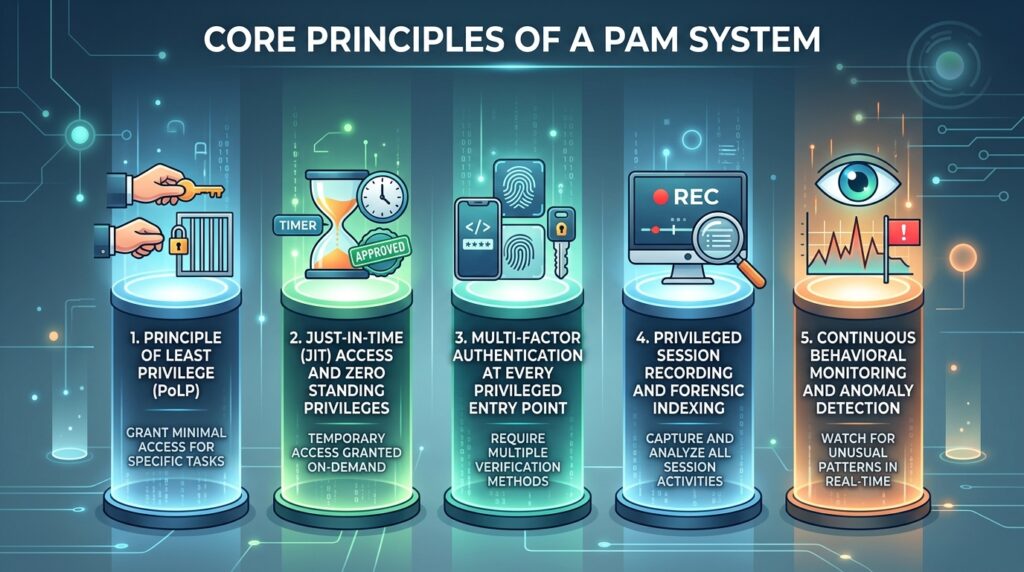
Every mature Privileged Access Management implementation rests on the same foundational principles, regardless of vendor or deployment model. Understanding these principles is more important than understanding any specific product — because they determine whether a PAM deployment actually reduces risk or simply adds administrative overhead.
1. Principle of Least Privilege (PoLP)
Every identity — human, service, or application — receives only the minimum access required to perform its specific function. This sounds obvious, but in practice it requires constant enforcement. Privileged accounts accumulate permissions over time through organic IT operations: a developer gets temporary database access during an incident and it never gets revoked; a service account created for a legacy integration retains write access to production systems years after the integration was replaced.
A PAM system enforces least privilege not as a one-time configuration but as a continuous operational control. Access that is not explicitly authorized and actively needed does not exist.
2. Just-In-Time (JIT) Access and Zero Standing Privileges
The most architecturally significant principle in modern PAM is the elimination of standing privileges. A standing privilege is an account that has elevated access at all times — whether or not anyone is currently using it. Every standing privilege is a persistent attack surface.
JIT access replaces standing privileges with time-bounded, task-scoped access grants. An administrator requests elevated access, justifies the request, receives approval through a workflow, performs the task, and the access expires — automatically, without manual revocation. Credentials rotate post-session, invalidating anything that may have been captured during the window.
The IDSA 2025 research makes the operational case for JIT with precise data: when asked which controls could have prevented identity-related incidents they experienced, 43% of respondents identified automatic access revocation upon detection of a high-risk event as the single most impactful measure — ranking above all other controls. The second and fourth most cited preventive measures were continuous discovery of privileged access rights (37%) and more timely review of privileged access (33%) — both direct functions of a mature JIT access implementation (IDSA, 2025).
Organizations that implemented JIT access achieved a 44% reduction in policy violations on average, according to CyberArk’s 2024 Identity Security Threat Landscape Report. The reduction comes not from policy writing but from architectural enforcement: when access does not exist by default, it cannot be misused by default.
3. Multi-Factor Authentication at Every Privileged Entry Point
MFA is not optional in a PAM deployment. It is the control that closes the gap between stolen credentials and unauthorized access. According to 2024 identity security benchmarking data, 43% of security leaders identify universal MFA enforcement as the single highest-impact measure available for breach prevention.
A PAM system enforces MFA at the access proxy layer — before any session is established, before any credential is presented to a target system. This architecture is critical: it means that even if an attacker has a valid username and password for a privileged account, they still cannot initiate a session without satisfying the second factor at the PAM proxy.
4. Privileged Session Recording and Forensic Indexing
Every action performed during a privileged session — every command issued, every file accessed, every configuration changed — is recorded and indexed. This serves dual purposes that security practitioners frequently underweight.
The deterrence effect is real: when users know that their session activity is recorded and reviewable, they behave with more care. The forensic value is equally important: when an incident occurs, session recordings provide complete, tamper-proof evidence of exactly what happened, eliminating the uncertainty that makes post-breach investigation costly and inconclusive.
Modern PAM systems do not just record sessions — they analyze them. AI-powered platforms flag dangerous commands the moment they occur: mass file deletions, unauthorized outbound data transfers, privilege escalation attempts, or access to systems outside a user’s defined scope.
5. Continuous Behavioral Monitoring and Anomaly Detection
A PAM system should know what normal looks like for every privileged user and alert immediately when activity deviates. A database administrator who suddenly begins querying tables outside their normal scope at 2:00 AM from an unrecognized device is not generating a security incident — until a PAM system flags that pattern and triggers a response.
The IDSA 2025 Trends in Identity Security report introduces an important nuance here: 61% of security professionals identify outlier behavior detection as the top AI/ML use case for identity security — down from 71% in 2024. This decline reflects calibration, not rejection. As AI adoption has accelerated in general business contexts, identity practitioners are applying more scrutiny to where AI delivers genuine value versus where it adds operational complexity. The four use cases where AI is consistently seen as beneficial are: identifying outlier behaviors (61%), evaluating alert severity in the SOC (56%), automating access reviews (55%), and streamlining onboarding and offboarding workflows (52%) (IDSA, 2025). For PAM deployments, behavioral analytics tuned to the specific environment remains the highest-impact AI application — the market has moved from broad enthusiasm to targeted implementation.
PAM System Architecture: Component-Level Breakdown
A production-grade PAM system is not a single product — it is an integrated set of components that enforce security at every layer of the privileged access chain. Understanding the role of each component is essential for both architects designing a PAM deployment and practitioners evaluating vendor coverage.
Administration Console
The centralized management interface where security teams configure policies, manage user provisioning, review compliance dashboards, and respond to alerts. In enterprise deployments, this interface needs to support delegation — different administrators managing different scopes — without anyone having unchecked access to the entire platform configuration.
Credential Vault
The encrypted, hardware-secured store for all privileged credentials: passwords, SSH keys, API tokens, TLS certificates, and service account credentials. The vault eliminates the single most common PAM anti-pattern — hardcoded credentials in scripts, configuration files, and application code — by providing a programmatic checkout mechanism that applications use to retrieve credentials at runtime rather than storing them statically.
A properly configured vault rotates credentials automatically on a defined schedule and always after session checkout. This means a credential captured during a session is invalid before the attacker can reuse it.
Access Proxy
The session broker that stands between users and target systems. Users connect to the proxy — never directly to the target — and the proxy injects credentials on their behalf, maintaining a complete audit trail without the user ever seeing the password. This architecture is fundamental: it means credential exposure is eliminated at the user layer, and access can be revoked at the proxy without touching the target system.
Session Manager
The component responsible for recording, indexing, and analyzing privileged sessions across every protocol the environment uses: SSH, RDP, database connections, HTTPS administrative interfaces, and application-level sessions. Session managers in mature platforms support live session termination — an analyst reviewing a session in real time can kill it if suspicious activity is detected.
Behavioral Analytics Engine
The AI layer that establishes behavioral baselines and identifies deviations. This component ingests session data, login patterns, access timing, geographic location signals, and command-level activity to build user-specific risk profiles. When deviation occurs, the engine triggers configurable responses — alerts, step-up authentication challenges, or automated session termination.
Secrets Management Layer
Distinct from the human-oriented credential vault, the secrets management layer serves applications, DevOps pipelines, CI/CD systems, and container workloads. It provides dynamic secret generation, automatic rotation, and audit trails for machine-to-machine credential use — addressing the non-human identity attack surface that traditional PAM platforms originally ignored.
MFA Enforcement and SSO Integration
Authentication enforcement integrated at every privileged access entry point. Enterprise PAM systems connect to existing MFA providers (Duo, Okta, Microsoft Authenticator) and enforce challenge requirements at the proxy layer. SSO integration ensures that privileged access flows through the same centralized identity provider as standard access — unifying identity governance across the entire user population.
API and SIEM/SOAR Integration Layer
The connectors that tie the PAM system into the broader security operations ecosystem. Privileged access events need to flow into SIEM platforms (Splunk, Microsoft Sentinel, IBM QRadar) in real time for correlation with other security telemetry. SOAR integration enables automated incident response playbooks triggered by PAM alerts — isolating sessions, revoking access, and notifying response teams without manual intervention.
The Privileged Access Lifecycle
The lifecycle model is where architectural principles translate into operational process. Each phase introduces controls that cumulatively eliminate the gaps attackers exploit in environments without a PAM system.
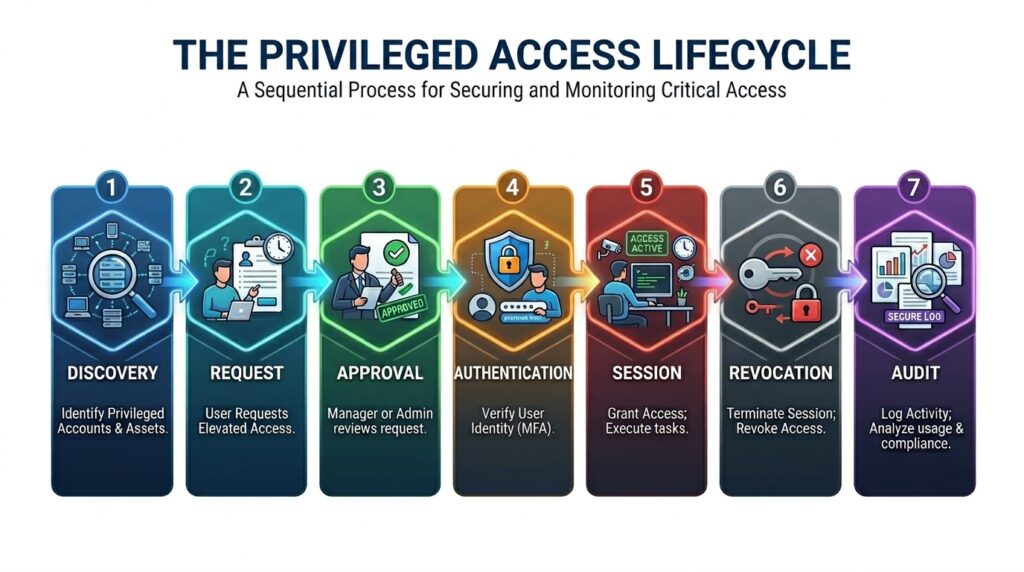
Phase 1: Discovery and Inventory
You cannot protect what you cannot see. Automated scanning identifies all privileged accounts across the environment — active directory accounts, local administrator accounts, service accounts, API keys in cloud environments, and embedded credentials in legacy applications.
In practice, discovery consistently surfaces accounts that security teams did not know existed. Orphaned accounts — credentials belonging to former employees or decommissioned systems — were found in 69% of surveyed organizations (Forrester, 2024). These accounts represent persistent attack surfaces: valid credentials with no owner watching for misuse.
Discovery is not a one-time exercise. It must run continuously, because new accounts are created through both intentional provisioning and organic IT operations. A DevOps engineer spinning up a new service account for a pipeline integration will not file a help desk ticket — the PAM system needs to find it automatically.
Phase 2: Request and Approval Workflow
Users submit time-bounded, task-justified access requests through the PAM system. The request specifies: which system, what level of access, why it is needed, and for how long. High-risk access categories — domain admin, production database write access, firewall management — require dual-control approval: two authorized reviewers must independently approve before a session is granted.
This workflow creates an accountability layer that does not exist in environments with shared admin credentials or standing privileges. It also creates an audit-friendly record: every access grant is traceable to a named individual, a specific business justification, and an approval decision.
Phase 3: Authentication at the Proxy Layer
Before any session is established, the PAM proxy enforces MFA and validates the identity claim. This is the control that breaks the most common attack path: even with a valid credential set, an attacker who cannot satisfy the MFA requirement at the proxy cannot proceed. The target system never sees an unauthenticated request.
Phase 4: Active Session Monitoring
The session manager records the complete session: keystrokes, screen activity where applicable, commands issued, files accessed, and network connections initiated. AI-driven analysis runs against the session content in real time. Dangerous command patterns — rm -rf / on a Linux system, DROP TABLE on a production database, bulk data exports from sensitive repositories — trigger immediate alerts and can trigger automated session termination.
Phase 5: Automatic Access Revocation
When the session ends — by the user’s choice, by time-out, or by automated termination — access is revoked immediately and credentials are rotated. This step eliminates the persistent value of captured credentials: a password extracted from network traffic during a PAM-managed session is invalid within seconds of session close.
Phase 6: Audit and Compliance Reporting
Tamper-proof logs — with session recordings, access request records, approval decisions, and credential rotation events — are retained and formatted for compliance reporting. Automated report generation against GDPR, SOC 2, ISO 27001, HIPAA, PCI DSS, and NIS2 frameworks reduces the manual effort of audit preparation from weeks to hours.
PAM System Maturity Model
One of the most practical frameworks for assessing an organization’s PAM posture is a staged maturity model. This model helps security leaders understand where they are today, what they need to close the most critical gaps, and where to target investment next.
The model below is based on the NIST Cybersecurity Framework maturity tiers and informed by Gartner’s PAM deployment research across enterprise deployments.
Level 0 — Unmanaged (Ad Hoc)
Characteristics: Shared admin credentials in spreadsheets or sticky notes. No centralized password management. No session recording. Privileged access provisioned manually without formal review. Terminated employees may retain active credentials for weeks or months.
Risk exposure: Maximum. Any credential compromise provides unrestricted, unmonitored access. Insider threats are undetectable until damage occurs.
What to do first: Immediately conduct a privileged account discovery scan. Identify and disable orphaned accounts. Implement an emergency password manager as an interim measure while evaluating PAM platforms.
Level 1 — Basic Control (Reactive)
Characteristics: Centralized credential vault in place. Manual access reviews conducted periodically. MFA enforced inconsistently or only for external-facing access. Session recording absent or limited to specific high-value systems. No behavioral analytics.
Risk exposure: High. Credentials are centralized, reducing the worst-case spreadsheet scenario, but access governance remains reactive and inconsistent.
What to do next: Implement MFA universally at the PAM proxy layer. Enable session recording on all production systems. Begin quarterly access reviews and automate orphan account detection.
Level 2 — Defined (Proactive)
Characteristics: MFA enforced across all privileged access paths. Session recording active on all critical systems. Formal access request and approval workflows in place. Credential rotation automated on a defined schedule. Basic compliance reports generated from PAM logs.
Risk exposure: Moderate. The most common attack paths are closed. Gaps remain in JIT access, behavioral analytics, and cloud identity coverage.
What to do next: Implement JIT access to begin eliminating standing privileges. Extend PAM coverage to cloud environments and SaaS administrative consoles.
Level 3 — Optimized (Adaptive)
Characteristics: JIT access deployed, eliminating most standing privileges. Behavioral analytics active and tuned to the organization’s environment. Cloud identity entitlement management (CIEM) integrated. PAM events feeding SIEM in real time. Compliance reporting automated and mapped to specific framework requirements.
Risk exposure: Low. The attack surface for privileged credential misuse is substantially reduced. Anomalies generate automatic responses.
What to do next: Extend coverage to non-human identities and machine credentials. Implement automated SOAR playbooks triggered by PAM alerts. Begin integrating PAM with DevSecOps pipelines for secrets management.
Level 4 — Advanced (Predictive and Automated)
Characteristics: Comprehensive coverage of human and machine identities. AI-driven risk scoring at the session level. Automated response to anomalous behavior without human intervention. PAM maturity documented and auditable, informing cyber insurance underwriting. Zero standing privileges across cloud, on-premises, and OT environments.
Risk exposure: Minimal. Remaining risk is in unknown unknowns — new attack techniques that behavioral baselines have not yet encountered.
What to do next: Continuous red team exercises targeting PAM controls. Contribution to threat intelligence sharing programs. Quarterly maturity reviews against evolving frameworks.
PAM for Small and Medium Businesses (SMBs)
The conventional narrative positions Privileged Access Management as an enterprise-exclusive discipline — a multi-year, seven-figure investment appropriate only for large financial institutions or critical infrastructure operators. That framing has become dangerously outdated.
Small and medium businesses are targeted with the same credential theft techniques as enterprises. Ransomware-as-a-service operators do not filter targets by headcount. Attackers looking for misconfigured remote desktop endpoints or exposed service account credentials are running automated scans — not manually selecting Fortune 500 organizations.
The 2023 Verizon DBIR found that 46% of all cyber breaches impacted businesses with fewer than 1,000 employees. SMBs typically have fewer IT resources to manage the aftermath of a breach, making the financial impact proportionally more severe.
Why SMBs Have Historically Avoided PAM
The barriers have been real:
- Cost: Enterprise PAM platforms from CyberArk or BeyondTrust can run $50,000 to $500,000+ annually, making them inaccessible for organizations without dedicated security budgets.
- Complexity: Large platform deployments require dedicated security architects, extended implementation timelines, and ongoing specialist maintenance.
- Perceived scope mismatch: IT teams managing 20 servers and 150 users reasonably questioned whether the same tool used to manage 10,000 endpoints was appropriate for their environment.
These barriers are no longer as prohibitive as they once were.
SMB-Appropriate PAM Approaches
SaaS-First PAM Platforms
Cloud-delivered PAM platforms — particularly Delinea and KeeperPAM — have dramatically lowered the deployment barrier. SaaS delivery eliminates infrastructure requirements, reduces implementation time to days or weeks rather than months, and shifts the operational burden from the customer’s IT team to the vendor’s platform team. Modular pricing means SMBs can start with credential vaulting and session recording, then add JIT access and behavioral analytics as the organization matures.
Open-Source PAM: JumpServer
For SMBs with technical competence but constrained budgets, JumpServer’s Community Edition provides a meaningful subset of PAM capabilities at zero licensing cost. It covers credential vaulting, SSH key management, session recording, SSO integration, and role-based access control — enough to address the most critical exposure points without enterprise pricing.
The trade-offs are documented: JumpServer lacks behavioral analytics, advanced CIEM, and automated compliance reporting. For a 50-person organization managing 10 servers, those gaps are acceptable. For a 200-person company under HIPAA or PCI DSS audit requirements, they are not.
Microsoft Entra ID PAM Features
For small and medium businesses already operating within the Microsoft 365 ecosystem, Microsoft Entra ID (formerly Azure AD) includes PAM-adjacent capabilities — Privileged Identity Management (PIM), conditional access policies, and JIT access for Azure resources — that provide a foundational PAM posture at no additional licensing cost beyond the existing Microsoft subscription tier.
The limitations are important to understand: Microsoft’s PAM features are deeply integrated with the Azure/Microsoft 365 environment but provide limited visibility and control over non-Microsoft infrastructure. For organizations running mixed environments with Linux servers, third-party SaaS applications, or on-premises databases, Microsoft PIM is a starting point, not a complete solution.
Practical SMB Implementation Roadmap
The right starting point for a small or medium business implementing a PAM system is not the most feature-rich platform — it is the fastest path to closing the three highest-risk exposure points:
- Week 1–2: Run a privileged account discovery scan. Disable all orphaned and unused privileged accounts. Document every active privileged identity.
- Week 3–4: Deploy a credential vault. Eliminate all shared admin passwords and hardcoded credentials. Enable automated password rotation.
- Month 2: Enable MFA on all privileged access paths. Configure session recording on production systems.
- Month 3–4: Implement an access request and approval workflow. Review and right-size privilege assignments.
- Month 5–6: Evaluate JIT access features and begin migrating away from standing privileges on highest-risk accounts.
This sequence does not require a six-figure platform. A well-implemented SMB PAM deployment using JumpServer or a SaaS-tier platform can achieve Level 2 maturity on the model above within six months, at a fraction of the cost of an enterprise deployment.
Non-Human Identities and Machine Credential Management
The security industry spent the better part of the 2010s focused on human privileged accounts. The 2020s have revealed the more difficult problem: machine identities now outnumber human ones in most enterprise environments, and they represent one of the most under-governed attack surfaces in cybersecurity.
A 2023 analysis by Microsoft’s Security Research team identified over 209 million cloud identities across monitored environments. More than 50% of those identities held unrestricted access to all resources in their cloud estate — the equivalent of a domain admin account for every service account, automation pipeline, and API key in the environment.
What Are Non-Human Identities?
Non-human identities include:
- Service accounts: Domain accounts used by applications, scheduled tasks, and Windows services to authenticate to resources.
- API keys and tokens: Credentials used by applications to authenticate to third-party services, cloud APIs, and internal microservices.
- Certificates and SSH keys: Cryptographic credentials used for server-to-server authentication and encrypted communications.
- CI/CD pipeline credentials: Secrets embedded in build pipelines, deployment scripts, and infrastructure-as-code repositories.
- Container workload identities: Credentials used by containerized applications in Kubernetes and similar environments.
The Machine Identity Problem in Practice
The most common non-human identity vulnerability is the hardcoded credential: a database password embedded in application source code, an AWS access key checked into a GitHub repository, or an SSH private key stored in a configuration file on a developer’s workstation. Code scanning tools find these regularly — the challenge is that fixing them requires changing code, updating deployments, and managing the rotation process without breaking application functionality.
The scale of exposure from a single discovered hardcoded credential can be extreme. In the 2023 CircleCI breach, attackers compromised a CI/CD system and extracted secrets from build pipelines — affecting every customer whose credentials were stored in the platform, regardless of their own security posture.
PAM System Coverage for Machine Identities
Modern PAM platforms address machine identities through a dedicated secrets management layer, distinct from the human-oriented credential vault:
- Dynamic secrets: Instead of static credentials stored in applications, the application requests a fresh credential from the vault at runtime, uses it for the session, and the credential expires automatically.
- Secrets scanning: Integration with code repositories to detect hardcoded credentials before they are committed.
- Certificate lifecycle management: Automated tracking, renewal, and rotation of TLS certificates and SSH keys across the environment.
- Kubernetes and container integration: Native secrets injection for containerized workloads, eliminating the need to embed credentials in container images or environment variables.
HashiCorp Vault, CyberArk Conjur, and AWS Secrets Manager are the dominant platforms in this space. Enterprise PAM vendors increasingly incorporate these capabilities natively — recognizing that an organization that tightly controls human privileged access but leaves machine credentials unmanaged has addressed half the problem at best.
PAM System Integration with SIEM, SOAR, and IAM
A PAM system deployed as an isolated tool provides access control and session recording. A PAM system integrated into the broader security operations ecosystem provides the telemetry, context, and automated response capability that actually reduces mean time to detect (MTTD) and mean time to respond (MTTR) to privileged access threats.
PAM and SIEM Integration
Security Information and Event Management platforms aggregate logs from across the environment to identify threat patterns that no single source can surface alone. PAM telemetry is among the highest-signal data sources in any SIEM deployment — privileged access events correlate with nearly every significant attack pattern in the MITRE ATT&CK framework.
Critical PAM events to forward to SIEM:
- Failed authentication attempts against privileged accounts
- Access requests outside normal business hours or from unexpected geographic locations
- Commands matching dangerous patterns (privilege escalation, bulk data access, process injection)
- Session recording gaps or tampering attempts
- Credential vault access failures and lockouts
- Newly discovered privileged accounts not registered in the PAM system
Integration platforms: Splunk ES, Microsoft Sentinel, IBM QRadar, and Elastic SIEM all have native connectors for major PAM vendors. For platforms without native connectors, syslog forwarding with a defined event schema provides functional integration.
PAM and SOAR Integration
Security Orchestration, Automation, and Response platforms close the gap between alert generation and response action. When a PAM system flags suspicious privileged activity, a SOAR playbook can execute a response sequence automatically — without waiting for analyst review:
Example automated response playbook:
- PAM behavioral analytics flags a privileged session for anomalous bulk file access.
- SOAR playbook triggered: capture session snapshot, query Active Directory for account history.
- If account has no prior incident history: send alert to analyst, apply step-up authentication challenge to active session.
- If account has prior incidents or risk score exceeds threshold: terminate session immediately, lock account, open P1 incident ticket in ServiceNow, notify security team via PagerDuty.
This sequence — from alert to session termination — can execute in under 60 seconds with SOAR automation. Without integration, the same response requires a human analyst to receive the alert, investigate, and manually take action — a process that typically takes 30 to 60 minutes in best-case scenarios.
PAM and IAM/IGA Integration
Identity Governance and Administration platforms manage the broader lifecycle of all identities across the organization — joiners, movers, and leavers. Integration between IGA and PAM closes one of the most persistent privileged access gaps: accounts that are deprovisioned in the IAM system but remain active in the PAM vault.
Key integration points:
- Joiner workflow: When a new privileged user is provisioned in the IGA system, the PAM system automatically creates the associated vault account and enforces the correct policy set.
- Mover workflow: When a privileged user changes roles, the IGA-PAM integration triggers an automatic access review and right-sizes permissions to the new role.
- Leaver workflow: When a user is terminated in the IGA system, the PAM vault account is automatically disabled, all active sessions are terminated, and credentials under that account are rotated.
Without IGA-PAM integration, leaver workflows depend on IT staff manually executing deprovisioning steps in both systems — a process that fails regularly under operational pressure.
PAM and Regulatory Compliance
For regulated industries, a PAM system is not a discretionary security enhancement — it is the technical control that most directly satisfies access management, audit trail, and least-privilege requirements across every major compliance framework. Auditors familiar with HIPAA, PCI DSS, and SOC 2 will look for evidence of PAM controls before looking at almost anything else in the identity and access management domain.
| Regulation | Scope | Key Requirement | Applicable PAM Control |
|---|---|---|---|
| GDPR | EU data processing | Access control to personal data; right to audit | Credential vaulting, session logging, access reviews |
| SOC 2 Type II | SaaS and cloud service providers | Logical access controls; continuous monitoring | JIT access, behavioral monitoring, audit trails |
| ISO 27001 | All industries (global) | A.9 Access control; A.12 Operations security | RBAC enforcement, MFA, access review procedures |
| HIPAA | U.S. healthcare | Unique user IDs; automatic logoff; audit controls | Session management, audit logs, MFA |
| PCI DSS v4.0 | Payment card processing | Req. 7 and 8 — Restrict access; Authenticate users | Least privilege, MFA, credential vault |
| SOX | U.S. public companies | Internal controls over financial systems | Segregation of duties, dual-control approvals |
| NIS2 | EU critical infrastructure | Identity and access management for critical assets | PAM for OT and ICS environments |
| CMMC 2.0 | U.S. defense contractors | AC.2.006 — Least privilege; AC.2.007 — Non-privileged access | PAM with JIT and audit logging |
ISO 27001 Annex A.9 requires organizations to restrict and monitor access to information assets — but the standard tells you what to achieve, not how to achieve it. Privileged Access Management is the implementation layer that auditors expect to see behind every A.9 control. Learn exactly how a PAM system maps to ISO 27001 access control requirements and what auditors look for during certification →
A Note on Compliance vs. Security
A compliance-driven PAM deployment and a security-driven PAM deployment look different in practice — and security practitioners should understand the gap.
Compliance requirements typically specify what controls must exist: audit logs must be retained for a defined period, MFA must be enforced for administrative access, privileged accounts must be reviewed quarterly. They rarely specify how effective those controls must be.
An organization can pass a PCI DSS audit with session recording enabled but alerts disabled, or with behavioral analytics deployed but baselines never tuned. The audit passes. The security risk remains. The most valuable PAM deployments are those where controls are implemented to reduce actual risk — not to produce documentation for auditors.
Common PAM Implementation Failures
56% of IT leaders who attempted PAM deployments failed to reach their stated objectives, primarily due to scope underestimation and complexity mismanagement, according to the Ponemon Institute’s 2024 Privileged Access Management Study. The IDSA 2025 report reinforces why: 91% of organizations still face barriers to identity security, with environmental complexity (44%, up from 38% in 2024) and identity framework complexity with multiple vendors and different architectures (40%, up significantly from 30% in 2024) ranking as the top two obstacles (IDSA, 2025). These are not technology problems — they are deployment discipline and scope management problems. The same failure patterns appear repeatedly across organizations of every size.
Understanding these failure modes before beginning a deployment is the most cost-effective risk management step available.
Failure 1: Skipping the Discovery Phase
The most common — and most costly — PAM deployment mistake is beginning the deployment before conducting a complete privileged account inventory. Organizations that deploy a credential vault without discovering what goes in it will vault their known accounts, declare success, and leave orphaned accounts, service accounts, and hardcoded credentials completely unmanaged.
What actually happens: Six months after deployment, an attacker compromises a service account that was created before the PAM deployment and never migrated into the vault. The account has been running a legacy integration with standing admin rights since 2019. There is no session recording on it. There are no alerts on it. The breach goes undetected for weeks.
The fix: Before deploying any PAM tooling, run a complete privileged account discovery scan. This includes Active Directory analysis, local admin account enumeration across all endpoints, cloud IAM audit, and — if technically possible — application code scanning for hardcoded credentials. Treat the discovery output as the authoritative scope of the deployment, not a suggestion.
Failure 2: Starting with the Most Complex Use Cases
Security teams with strong technical instincts sometimes begin PAM deployments with the hardest problems: legacy application integration with hardcoded credentials, OT/ICS environments with air-gapped systems, or cloud identity governance across 15 different accounts. These are important problems. They are not the right starting point.
What actually happens: The implementation stalls in a complex integration project, consuming six to twelve months of effort. Stakeholder confidence drops. The deployment scope is reduced. The organization ends up with a PAM system covering 30% of its environment and a project that has lost executive sponsorship.
The fix: Start with the highest-volume, highest-risk, lowest-complexity use case: interactive privileged sessions to production servers. Get the core platform running, build organizational familiarity with the workflow, and use demonstrated success to build the support for tackling harder problems.
Failure 3: Treating PAM as a Set-and-Forget Tool
PAM systems require ongoing maintenance that is consistently underestimated in initial project planning. Policies drift out of alignment with business needs. New accounts are created outside the vault. Behavioral analytics baselines require tuning. Compliance report formats change with framework updates.
What actually happens: An organization deploys a PAM system with significant effort and expense, then reduces the dedicated team managing it when competing priorities emerge. Eighteen months later, the vault contains 40% of privileged accounts, alerts are unreviewed because the queue is too noisy, and the session recording storage is full and not alerting on failure.
The fix: Budget for ongoing PAM operations explicitly — not just initial deployment. Define a named owner for PAM policy, a review cadence for alert tuning, and a quarterly access certification process. Treat PAM as a production security service, not a project with a completion date.
Failure 4: Deploying PAM Without MFA Enforcement
Session recording without MFA creates a security theater scenario: you have excellent records of what the attacker did after they got in, but nothing that would have stopped them.
The fix: MFA enforcement at the proxy layer is non-negotiable. If existing MFA infrastructure cannot integrate with the PAM platform, resolve that before deploying session recording or credential vaulting.
Failure 5: Ignoring the User Experience Impact
PAM systems that add significant friction to the daily work of system administrators will be worked around. Users with sufficient technical capability will find ways to bypass PAM controls — especially if the approval workflow takes hours for access they genuinely need in minutes during an incident.
What actually happens: An operations team, frustrated by a PAM workflow that requires manager approval before they can access a production server during an outage, begins maintaining a shared admin account outside the PAM system “for emergencies.” That account is now an unmonitored standing privilege.
The fix: Implement emergency access (break-glass) procedures that provide expedited access with enhanced monitoring rather than bypassing controls entirely. Tune approval workflows to match the urgency profile of different access types — routine access can follow standard workflows, incident response access needs an expedited path that still preserves the audit trail.
PAM System ROI Framework
Justifying PAM investment at the board or executive level requires translating security risk into financial terms. The following framework is based on IBM’s Factor Analysis of Information Risk (FAIR) methodology, adapted for privileged access management programs.
Direct Cost Avoidance
Breach cost reduction: IBM’s 2024 Cost of a Data Breach Report quantifies the average breach cost at $4.88 million globally, with breaches involving privileged account misuse averaging $4.99 million. Organizations with strong privileged access controls reduce breach probability by an estimated 33%, per CyberArk’s 2024 research. For an organization with annual revenue of $100 million, even a modest reduction in breach probability generates measurable expected-value savings.
Ransomware exposure reduction: 74% of successful ransomware deployments require privileged account access to execute the final encryption stage. PAM systems that eliminate standing privileges and enforce JIT access directly reduce the probability of reaching that stage — not by blocking the initial intrusion, but by limiting the lateral movement and privilege escalation that precedes deployment.
Cyber insurance premium reduction: Insurers actively evaluate PAM maturity as a risk factor. Organizations with documented JIT access, MFA enforcement, session monitoring, and privileged account discovery in place qualify for meaningfully lower premiums — in some cases 10 to 20% reductions on cyber liability coverage. For a $500,000 annual premium, a 15% reduction represents a $75,000 annual saving.
Operational Efficiency Gains
Manual privileged access management — password resets, access provisioning, deprovisioning, quarterly access reviews — consumes significant IT team time that automated PAM controls eliminate or substantially reduce:
- Password rotation automation: Eliminating manual password rotation for 500 privileged accounts at 30 minutes per rotation cycle saves approximately 250 hours per rotation cycle.
- Access certification automation: Automated quarterly access reviews reduce review time from weeks of manual effort to hours of automated report generation with analyst sign-off.
- Incident investigation acceleration: When an incident does occur, session recordings reduce forensic investigation time from days to hours, directly reducing breach costs and MTTR.
Compliance Cost Reduction
Manual audit preparation for SOC 2, HIPAA, or PCI DSS in environments without a PAM system typically requires extensive manual log collection, evidence documentation, and policy gap remediation. Organizations with automated PAM compliance reporting reduce audit preparation time by 40 to 60% in documented deployments — a saving measured in person-weeks per audit cycle.
Top PAM Solutions: Vendor Comparison (2025–2026)
Evaluation Methodology
The comparison below was built from vendor documentation analysis, Gartner Magic Quadrant for PAM (2024), real user reviews on G2 Crowd, Gartner Peer Insights, and public deployment case studies. Each platform was evaluated across eight criteria: deployment flexibility, credential management maturity, session recording capability, JIT access implementation, behavioral analytics, cloud and non-human identity coverage, compliance support, and total cost of ownership.
One pattern is consistent across the 2025–2026 market: the vendors that have meaningfully separated from the field are those that extended beyond credential vaulting as the primary value proposition. Just-In-Time access, behavioral analytics, Zero Trust alignment, and non-human identity coverage are now baseline requirements in enterprise evaluations — not differentiators.
Important note on ratings: G2 ratings reflect user sentiment at scale. They should be read alongside the qualitative comments — a 4.4 from 1,200 reviews tells a different story than a 5.0 from 12 reviews.
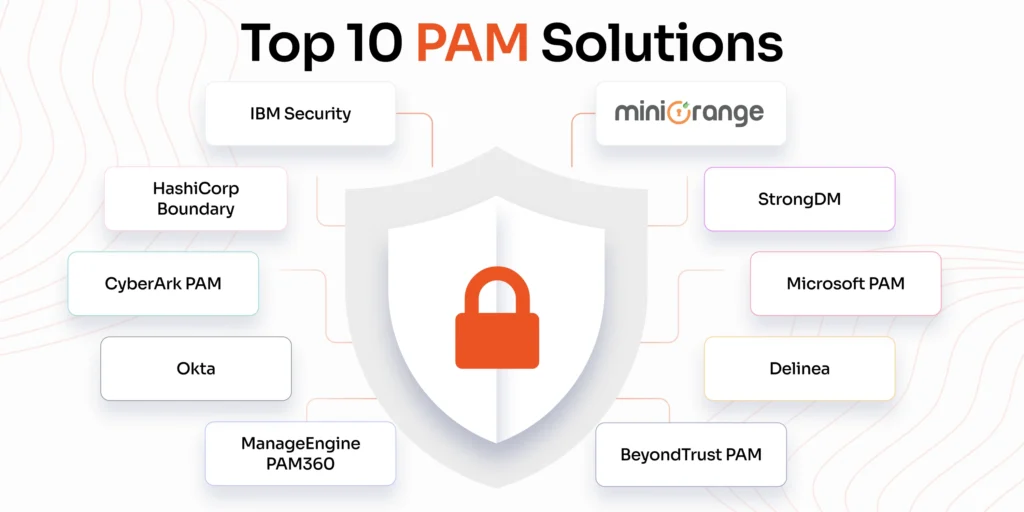
| # | Solution | Best For | Deployment | Key Strengths | Main Limitations | G2 Rating |
|---|---|---|---|---|---|---|
| 1 | CyberArk PAM | Large enterprise — finance, healthcare, critical infrastructure | On-prem, SaaS, hybrid | Advanced threat detection, behavioral analytics, broadest integration ecosystem, industry standard for compliance | High cost, complex initial setup, steep learning curve, significant internal expertise required | 4.4 |
| 2 | BeyondTrust PAM | Large enterprise, OT-heavy environments | On-prem, SaaS, hybrid | Full suite coverage, strongest endpoint privilege management, granular access control, strong OT/ICS support | Complex setup, ongoing licensing refinement, some integration gaps with modern cloud-native tools | 4.5 |
| 3 | Delinea | Mid-market to enterprise, cloud-first teams | SaaS-first, on-prem available | Fastest time-to-value, intuitive interface, strong compliance reporting, competitive cyber insurance positioning | Platform stability concerns in some deployments, advanced features require expertise, less suitable for complex OT environments | 4.4 |
| 4 | StrongDM | DevOps teams, modern cloud infrastructure | Cloud, on-prem (agentless) | Fastest agentless deployment, excellent JIT, strong developer experience, real-time session logging, highly rated support | Complex initial configuration for legacy systems, some feature gaps in compliance automation | 4.6 |
| 5 | Okta PAM | Cloud-native organizations within the Okta ecosystem | Cloud-native (SaaS) | Deep Okta identity integration, dynamic policy-driven access, time-bound sessions, strong user experience | No support for web application, database, or Kubernetes targets; server-centric design; high cost relative to scope | 4.5 |
| 6 | Microsoft Entra ID PIM | Microsoft 365 and Azure-centric organizations | Cloud (Azure), hybrid | Native Microsoft integration, no additional licensing for M365 customers, JIT for Azure resources, strong conditional access | Limited visibility across non-Microsoft infrastructure, limited behavioral analytics maturity, not suitable as a standalone PAM system | 4.5 |
| 7 | ManageEngine PAM360 | Organizations using ManageEngine or Zoho ecosystem | On-prem, cloud | Broad feature set, role-based JIT, SIEM and ITSM integrations, competitive pricing | Limited scalability at high server volumes, documentation gaps, inconsistent support quality | 4.5 |
| 8 | One Identity Safeguard | Organizations needing integrated vaulting, sessions, and analytics | On-prem, virtual, SaaS | Integrated platform covering passwords, sessions, and analytics in one product, strong compliance support | Admin UI complexity, advanced scenarios require significant planning, limited community resources | 4.1 |
| 9 | IBM Security Verify Privilege | Large enterprise, complex hybrid environments | Cloud, on-prem | Strong session monitoring, enterprise scalability, Zero Trust support, robust credential vaulting | Difficult setup and administration, complex licensing structure, limited customization options | 4.5 |
| 10 | JumpServer (Open Source) | SMBs, budget-constrained organizations, open-source adopters | Self-hosted | Zero licensing cost, SSH and RDP session recording, RBAC, SSO integration, active community | No behavioral analytics, no CIEM, limited compliance automation, requires internal operational expertise | N/A (OSS) |
Feature-Level Comparison: CyberArk vs. BeyondTrust vs. Delinea
| Feature | CyberArk | BeyondTrust | Delinea |
|---|---|---|---|
| Credential vaulting | Advanced — industry benchmark | Strong | Strong |
| Session recording | Full AI analysis | Standard with analytics | Agentless + video AI |
| Just-In-Time access | Yes — mature implementation | Yes | Yes |
| Endpoint privilege management (PEDM) | Yes | Strongest — Windows and Linux | Windows and macOS |
| Cloud Identity Entitlement Mgmt (CIEM) | Yes | Yes | Not available |
| Secrets management (DevOps) | Yes — CyberArk Conjur | Yes — workload identity | Separate module |
| Deployment complexity | High | Medium to High | Low to Medium |
| Time to value | Weeks to months | Weeks | Days to weeks |
| Ideal organization size | Enterprise (1,000+ users) | Enterprise, OT-heavy | Mid-market to Enterprise |
| Gartner Magic Quadrant position (2024) | Leader — Vision | Leader — Execution | Leader |
Open-Source PAM: JumpServer
For organizations evaluating cost-effective Privileged Access Management, JumpServer stands out as the most mature open-source option in the market. Built in Python with a distributed, agentless architecture, it supports SSH key management, SSO integration, cloud audit logging, and role-based access control — delivering core PAM capabilities without licensing fees.
JumpServer is not a toy. The Community Edition is deployed in production environments managing hundreds of servers across multiple industries. The key to evaluating it honestly is understanding where the capability gaps are meaningful versus where they are acceptable given your specific threat model.
| Capability | JumpServer | Gap vs. Enterprise PAM |
|---|---|---|
| Credential vaulting | Yes | Comparable for core use cases |
| Session recording (SSH, RDP) | Yes | No AI analysis — manual review required |
| MFA / SSO | Yes | Comparable |
| Just-In-Time access | Limited — manual workflows | Significant gap |
| Behavioral analytics | Not available | Significant gap |
| CIEM / Cloud governance | Not available | Significant gap |
| Compliance reporting automation | Basic logs only | Gap for regulated industries |
| Secrets management | Not available | Significant gap for DevOps environments |
| Licensing cost | Free (Community Edition) | Enterprise platforms: $50K–$500K+ annually |
When JumpServer is the right choice: SMBs without regulatory compliance requirements, organizations that need a fast path to eliminating shared admin credentials, and technical teams with Linux expertise who can manage the operational overhead of a self-hosted deployment.
When JumpServer is not enough: Organizations under HIPAA, PCI DSS, or SOC 2 audit requirements; environments where behavioral analytics is a compliance requirement; teams without internal expertise to manage platform operations; and any organization where JIT access and automated compliance reporting are priorities.
PAM Trends Shaping Security Strategy in 2026
Zero Trust Integration
PAM has become the primary enforcement layer for Zero Trust architectures. The Zero Trust principle — no user or system should be trusted by default, regardless of network location — requires continuous identity verification at every access decision. PAM systems operationalize this by validating every privileged access request with full context: who is requesting, from what device, from what location, against what system, under what policy.
The IDSA 2025 research confirms Zero Trust has crossed into mainstream adoption: 95% of surveyed organizations have adopted the Zero Trust framework to some degree. Of those, 23% apply Zero Trust principles rigorously across all identities, while 48% apply them selectively across critical or high-risk identity groups — exactly the privileged account population that PAM systems govern. Among organizations that have invested in Zero Trust, 71% report achieving good or significant business value, with the primary benefits being better visibility and control over identities (23.7%), reduced workload for security teams (25%), and fewer security incidents (22.9%) (IDSA, 2025).
Gartner’s Identity and Access Management Primer for 2025 identifies an identity-first security approach with continuous adaptive trust as essential for modern organizational security architectures. In practical terms, this means PAM is no longer positioned as a standalone security tool — it is the identity enforcement layer within a broader Zero Trust framework.
AI-Powered Privileged Access Governance
Machine learning models embedded in PAM platforms now analyze behavioral patterns at a granularity that human analysts cannot match at scale. Session content analysis, command risk scoring, peer group comparison, and temporal anomaly detection all operate continuously against the full volume of privileged session data — generating signal that would be invisible in a purely log-based review process.
With 71% of security leaders citing outlier behavior detection as the primary expected use case for AI in identity security (IDSA, 2024), AI-driven PAM is transitioning from a premium differentiator to a standard expectation in enterprise procurement cycles.
Non-Human Identity Management at Scale
As cloud architectures proliferate and CI/CD pipelines become standard, the machine identity problem is growing faster than the human identity problem. Every containerized microservice, every automation pipeline, every cloud function has an associated identity and credential. Managing those credentials with the same rigor applied to human privileged accounts is the defining PAM challenge of 2025–2026.
The vendors making meaningful progress here — CyberArk with Conjur, HashiCorp Vault, and cloud-native solutions from AWS and Azure — are those that have invested in dynamic secrets generation and programmatic secrets consumption rather than treating machine credentials as just more items in a human-oriented vault.
PAM as a Cyber Insurance Requirement
This trend deserves clear emphasis: cyber insurance underwriters have moved from suggesting PAM controls to requiring evidence of them as a condition of coverage. Organizations without documented PAM programs — particularly those that cannot demonstrate JIT access, MFA enforcement on privileged accounts, and privileged session monitoring — are increasingly receiving coverage denials or premium structures that make coverage economically impractical.
PAM has moved from a security investment decision to a financial risk management decision. The CFO and board-level visibility of cyber insurance has brought PAM onto agendas where it previously had no audience.
PAM for Operational Technology (OT) and Industrial Control Systems (ICS)
As IT and OT networks converge and industrial systems become increasingly internet-connected, privileged access management for operational technology has emerged as a critical — and technically challenging — discipline. OT environments run on protocols and systems that traditional enterprise PAM platforms were not designed to handle: Modbus, PROFINET, legacy SCADA interfaces, and air-gapped network segments.
NIS2, the EU’s updated Network and Information Security directive, explicitly extends identity and access management requirements to operators of critical infrastructure — including energy, water, transportation, and manufacturing sectors. BeyondTrust and CyberArk have made the deepest investments in OT-specific PAM capabilities, but this remains an area of significant market development.
PAM Implementation Framework by Organization Profile
Important preliminary: 56% of IT leaders who attempted PAM deployments failed to reach their stated objectives (Ponemon Institute, 2024). The most common cause is not product quality — it is entering the deployment without a complete picture of what needs to be protected. Always begin with a privileged account discovery phase before committing to any platform decision.
| Organization Type | Primary Requirement | Recommended Approach | Suggested Platform |
|---|---|---|---|
| Global enterprise (5,000+ users) | Complete security coverage, compliance automation, non-human identity | Full PAM suite with CIEM, AI analytics, and secrets management | CyberArk |
| Mid-market (500–5,000 users) | Fast deployment, manageable complexity, cloud coverage | SaaS-first PAM with modular expansion path | Delinea |
| Manufacturing, OT-heavy environments | Endpoint privilege management, IT/OT bridge, cross-platform support | PAM with strong PEDM and OT protocol support | BeyondTrust |
| Cloud-native / DevOps-focused | Developer experience, JIT, secrets management, agentless | Cloud-native PAM with strong API and pipeline integration | StrongDM / CyberArk Conjur |
| Microsoft-centric organizations | Leverage existing Microsoft licensing, Azure governance | Microsoft Entra PIM + supplemental PAM for non-Microsoft scope | Microsoft Entra PIM + Delinea |
| SMB or startup (under 200 users) | Cost efficiency, core PAM capabilities, low operational overhead | Open-source or cloud-native lightweight PAM | JumpServer / KeeperPAM |
| Regulated industries (finance, healthcare) | HIPAA, PCI DSS, SOX compliance automation, audit-ready reporting | Enterprise PAM with built-in compliance mapping and automation | CyberArk / BeyondTrust |
Enterprise PAM Solution Comparison: Top Vendors in 2025
For the fourth consecutive year, Gartner’s Magic Quadrant for PAM recognized CyberArk, Delinea, and BeyondTrust as the three Leaders — citing their adaptability to client needs and consistent execution on product vision. Each platform takes a meaningfully different approach to privileged access, making the right choice highly dependent on organizational size, complexity, and deployment preferences.
| Platform | Best Fit | Deployment | Cloud-Native | AI/ML Analytics | Pricing | Gartner Position |
|---|---|---|---|---|---|---|
| CyberArk | Large enterprise, finance, healthcare | On-prem, SaaS, hybrid | Yes | Advanced | Quote-based | Leader #1 (Vision) |
| Delinea | Mid-market, cloud-first teams | SaaS-first, on-prem available | Yes (native) | AI-driven video analytics | Modular, quote-based | Leader #2 |
| BeyondTrust | Enterprise, complex IT/OT environments | On-prem, SaaS, hybrid | Partial | Session analytics | Quote-based | Leader #3 |
| One Identity Safeguard | High-assurance, appliance deployments | Appliance-based | Limited | Behavioral analytics | Quote-based | Challenger |
| JumpServer | SMB, open-source, budget-conscious | Self-hosted | Distributed architecture | Limited | Free / Open Source | Niche |
Feature-Level Comparison: CyberArk vs. Delinea vs. BeyondTrust
| Feature | CyberArk | Delinea | BeyondTrust |
|---|---|---|---|
| Credential vaulting | Advanced | Strong | Strong |
| Session recording | Full AI analysis | Agentless + video AI | Standard |
| Just-In-Time (JIT) access | Yes | Yes | Yes |
| Endpoint privilege management (PEDM) | Yes | Windows and macOS | Strongest — Windows and Linux |
| Cloud Identity Entitlement Mgmt (CIEM) | Yes | Not available | Yes |
| Secrets management (DevOps) | Yes | Separate module | Yes — workload identity |
| Deployment complexity | High | Low to Medium | Medium to High |
| Time to value | Weeks to months | Days to weeks | Weeks |
| Ideal organization size | Enterprise (1,000+ users) | Mid-market to Enterprise | Enterprise, OT-heavy |
Selection guidance: CyberArk is the optimal choice for organizations with complex security requirements and large security teams. Delinea delivers faster time-to-value and is preferred where deployment agility matters. BeyondTrust excels in environments with significant endpoint and operational technology security requirements. For cost-constrained or SMB environments, JumpServer’s open-source model provides a viable entry point with core PAM capabilities.
Open-Source PAM: JumpServer
For organizations evaluating cost-effective privileged access management, JumpServer stands out as the most mature open-source option. Built in Python with a distributed, agentless architecture, it supports SSH key management, SSO integration, cloud audit logging, and role-based access control — delivering a meaningful subset of enterprise PAM capabilities without licensing fees.
| Capability | JumpServer | vs. Enterprise PAM |
|---|---|---|
| Credential vaulting | Yes | Comparable |
| Session recording | Yes | No AI analysis — partial gap |
| MFA / SSO | Yes | Comparable |
| Just-In-Time access | Limited | Significant gap |
| Behavioral analytics | Not available | Significant gap |
| CIEM / Cloud governance | Not available | Significant gap |
| Compliance reporting automation | Basic logs only | Gap for regulated industries |
| Licensing cost | Free (Community Edition) | Enterprise: $50K–$500K+ annually |
PAM Trends Shaping Cybersecurity Strategy in 2025
Zero Trust Integration
PAM has become the primary enforcement layer for Zero Trust architectures. By validating every access request — regardless of whether it originates inside or outside the network perimeter — PAM solutions operationalize the Zero Trust principle that no user or system should be trusted by default. Gartner’s Identity and Access Management Primer for 2025 identifies an identity-first approach — with continuous adaptive trust — as essential for modern organizational security.
AI-Powered Privileged Access Governance
Machine learning models now enable PAM platforms to analyze user behavior patterns in real time, identify outlier actions, and trigger automated responses — from issuing alerts to revoking sessions — without human intervention. With 96% of security leaders expecting AI to enhance identity security and 71% citing outlier behavior detection as the primary use case, AI-driven PAM is transitioning from a differentiator to a standard feature.
Non-Human Identity and Machine Credential Security
Of the 209 million cloud identities identified in 2023, over 50% were classified as “super identities” — service accounts, automation pipelines, and API keys with unrestricted access to all resources across cloud estates. Modern PAM platforms are expanding coverage to these machine identities, applying the same vaulting, rotation, and monitoring capabilities previously reserved for human accounts.
PAM as a Cyber Insurance Requirement
Cyber insurance carriers now evaluate PAM maturity as part of the underwriting process. Organizations with documented PAM programs — particularly those with JIT access, MFA enforcement, and privileged session monitoring — qualify for more favorable premium structures. PAM has moved from a pure security initiative to a board-level financial risk management tool.
PAM Implementation: Selection Framework by Organization Profile
Important: 56% of IT leaders who attempted PAM deployments failed to reach their objectives, primarily due to complexity and scope underestimation. Always start with a privileged account discovery phase to establish a complete inventory — organizations that cannot identify where their privileged accounts exist cannot protect them.
| Organization Type | Primary Requirement | Recommended Approach | Suggested Platform |
|---|---|---|---|
| Global enterprise (5,000+ users) | Complete security coverage, compliance automation | Full PAM suite with CIEM and AI analytics | CyberArk |
| Mid-market (500–5,000 users) | Fast deployment, manageable complexity | SaaS-first PAM with modular expansion | Delinea |
| Manufacturing and OT-heavy | Endpoint privilege management, IT/OT bridge | PAM with PEDM and cross-platform support | BeyondTrust |
| SMB or Startup (under 200 users) | Cost efficiency with core PAM capabilities | Open-source or cloud-native lightweight PAM | JumpServer / KeeperPAM |
| Regulated industries (finance, healthcare) | HIPAA, PCI DSS, SOX compliance automation | Enterprise PAM with built-in compliance reporting | CyberArk / BeyondTrust |