Table of Contents
The gap between thriving companies and those struggling to survive isn’t always defined by capital, but by operational resilience. Modern history has shown that digital maturity is the strongest buffer against market volatility. For organizations—regardless of their size—digitalization is no longer a luxury or a line item in a budget; it is the fundamental architecture required to maintain a competitive edge in a high-demand environment. Upgrading systems is not an expense, but a strategic move to eliminate the technical friction that stunts growth.
This guide will help you navigate the challenges of technological change and build a clear plan to accelerate your digital transformation — one that genuinely improves the experience you deliver to your customers.
Key Takeaways
- Modernizing your operations is no longer optional — it is a fundamental requirement to stay competitive.
- A strategic shift toward digital transformation can radically change the way your business creates value for customers.
- New technologies help simplify day-to-day tasks and improve long-term efficiency.
- This process opens significant growth opportunities for businesses with limited resources.
- Successfully managing this change leads to better performance and more satisfied customers.
- Having a clear plan is essential for navigating challenges and getting the most out of digital tools.
- The primary goal of transformation is to build a more resilient and adaptable organization.
Introduction to Digital Transformation

What exactly is digital transformation? (And what it isn’t)
Let’s be honest: who hasn’t heard the term “Digital Transformation” by now? It’s thrown around so often in business conversations that it has almost lost its meaning. The terminology is everywhere — on conference stages, in boardrooms, in magazine headlines. But has anyone stopped to ask what digital transformation actually means?
Here’s a good place to start: digital transformation is not about buying new software. It is not about creating an Instagram account for your business, nor about hiring someone who knows their way around a computer. The definition is simpler than it sounds:
A definition: Digital transformation is the process of redesigning how your company creates value—for your customers and for yourself—using technology as a catalyst for change. It’s not a destination, it’s a way of operating.
Think of it this way: if it used to take three people to manage phone orders, enter data into a spreadsheet, and send confirmation emails, digital transformation is the process of automating those three tasks — doing them faster, with fewer errors — so those three people can focus on work that genuinely grows your business.
Why is it urgent right now?
Recent history has taught us a definitive lesson: digitalization is no longer an innovation project; it is a survival strategy. Industry benchmarks, including those from firms like McKinsey, have highlighted a direct correlation between digital maturity and revenue growth, showing performance gaps of up to 20% in organizations that accelerated their transition.
This is not an optional advantage. In a globalized market, competition is no longer local; the real threat comes from any player that has successfully eliminated friction in their user experience and optimized operational availability through technology. It’s not just about being present; it’s about being efficient and scalable in an environment that never stops.
The three biggest mistakes when starting out
- Believing that everything boils down to technology: Technology is merely the means, not the end. Without a clear strategy and a prepared team, even the best tool in the world implemented in your business simply won’t yield results.
- Trying to transform everything at once: Companies that attempt to digitize all their processes simultaneously end up making mistakes. Implementation should be progressive and prioritized. Small, well-executed pilot projects generate a greater impact.
Tip: Identify and prioritize your processes. Determine which ones you can use to create a minimum viable product (MVP) and implement it. - Not measuring anything: If you don’t establish indicators before starting, you’ll never know if what you did worked. And without data, there’s no way to measure, no way to improve.
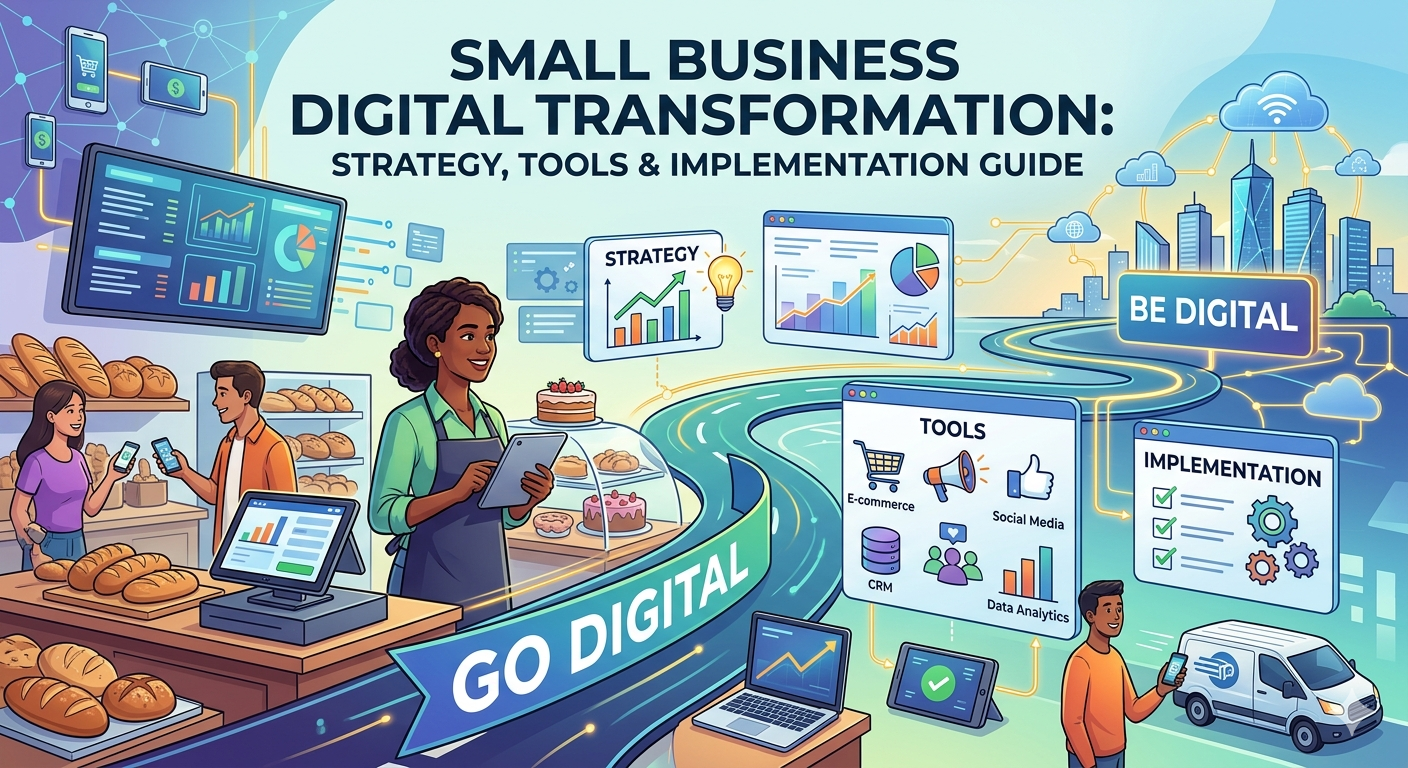
Go Digital vs. Bi-Digital: the difference that nobody explains to you
This is one of the most important concepts in this article and, interestingly, one of the least explained in small business guides. Understanding the difference between these two philosophies can completely change the way you plan your strategy.
What is Go Digital?
The digitization strategy involves adopting a completely digital model. This means the company will stop using traditional physical channels and processes and migrate to entirely digital solutions.
Imagine a bookstore. This bookstore closes its physical store and warehouse and starts selling books exclusively online. This saves money on significant expenses such as the premises and storage. Now it can offer home delivery and manage shipments through an intermediary.
Main features of the Go Digital model:
- The digital channel replaces the physical or in-person channel.
- Operations are designed from scratch to function in digital environments.
- The cost structure changes radically: less physical infrastructure, more investment in technology.
- The scalability speed is high; you can grow without multiplying costs proportionally.
- The customer profile is changing: it requires greater digital autonomy and less direct human interaction.
When does the Go Digital approach work best?
- Businesses whose products or services are 100% deliverable digitally (software, online courses, remote consulting, content).
- Companies seeking to scale rapidly without geographical restrictions.
- Startups that design their business model from scratch.
- Markets where the customer already has a high level of digital maturity and education.
What is Bi-Digital?
The bi-digital model, also sometimes called physical-digital, is based on one idea: the world is not entirely digital, nor will it be anytime soon. There are areas where people need both in-person and digital experiences. The important thing is not to choose between the two, but to find a way to combine them so they complement and enhance each other.
Let’s consider a bookstore as an example. In the bi-digital model, the bookstore still exists. It’s connected to the online platform. Customers can browse the books available in the store from their phones, reserve them, and pick them up in fifteen minutes. They can also buy them online and receive them the same day. The physical store doesn’t disappear. The bi-digital model transforms the physical store into a special element that sets it apart from the rest. This model aims for the physical store and the online platform to work together, strengthening each other. The bi-digital model allows businesses to make the most of both the in-person and digital experiences.
Main features of the Bi-Digital model:
- Physical and digital channels coexist and complement each other.
- The customer experience is seamless and integrated between both worlds.
- Technology improves, extends, and enriches face-to-face interaction.
- Data from the digital channel informs decisions in the physical channel and vice versa.
- The customer chooses how they want to interact with the brand at any given time.
When does the Bi-Digital approach work best?
- Retail trade where the product requires physical experience before purchase.
- Health, education and welfare services where human interaction has intrinsic value.
- Restaurants, hotels and hospitality services.
- Companies with a diverse customer base in terms of digital maturity.
- Local businesses whose competitive advantage depends on the personal relationship with the customer.
Comparative table: Go Digital vs. Bi-Digital
| Dimension | Go Digital | Bi-Digital (Phygital) |
|---|---|---|
| Physical presence | It is eliminated or reduced to a minimum. | It is maintained and enhanced with technology |
| Sales channel | 100% digital | Omnichannel (integrated physical + digital) |
| Initial investment | High level of technological infrastructure | Moderate, distributed between physical and digital |
| Scaling potential | Very high, without geographical limits | High within defined markets |
| Ideal customer type | High digital autonomy, digital native | Diverse, including low and high digital maturity |
| Implementation speed | Fast if the team has digital skills | Moderate, requires systems integration |
| Main risk | Losing customers who prefer physical interaction | Operational complexity of managing two channels |
| Key differentiator | Efficiency and coverage | Enhanced customer experience |
| Typical examples | SaaS, pure e-commerce, educational platforms | Retail with apps, banks with digitized branches, hybrid clinics |
| Better for SMEs when… | The product does not require physical contact. | Personal relationships are a competitive advantage |
Practical Conclusion: For most established small businesses, the Bi-Digital model offers the most realistic and low-risk path. It allows them to leverage the trust and reputation already built in the local market while expanding reach and improving operational efficiency through digital tools. This approach not only enhances current margins but also significantly reduces the costs and technical risks associated with an eventual migration to a Go-Digital model.
With these models in perspective, the next critical step is defining your Digital North Star. This is more than an aspirational goal; it is the strategic axis that will drive your roadmap, ensuring that every technological investment is strictly aligned with the institutional vision of true Digital Transformation.
Digital North Star: Our compass in the age of disruption
Defining the Digital North Star is not simply about choosing which technologies to adopt, but about establishing a medium- and long-term vision where technology acts as the fundamental enabler of strategic objectives. In our view, the Digital North Star is the point of convergence between operational excellence, security by design, and a seamless user experience.
For this vision to be viable, we must articulate it through three fundamental pillars:
1. Resilience and Technical Trust
In an environment where data availability and integrity are non-negotiable, the Digital North prioritizes robust architectures. This involves transitioning from a reactive infrastructure to a proactive and secure ecosystem, capable of handling high processing loads while protecting the most valuable assets of both the organization and its users.
2. Value-Oriented Agility
True digital transformation is not measured by the volume of code written, but by the speed at which we convert a detected need into a functional solution. Our North seeks the implementation of methodologies that allow for rapid iterations and continuous delivery, ensuring that innovation remains a constant rather than an isolated event.
3. Human-Centric Design
Technology remains sterile if it does not solve real-world problems. The Digital North compels us to look beyond the screen to understand the internal workflows of teams and the specific needs of the end client. This ensures that every digital tool is intuitive, efficient, and, above all, a tangible generator of value.
“The Digital North is not a final destination, but a commitment to maintaining competitive relevance through constant technological evolution and cultural adaptation.”
Now that you’ve defined your digital North Star, it’s important that it’s supported by initiatives, which are strategic objectives that will be implemented to change how your company generates value for your customers.
Defining digital transformation initiatives requires a balance between strategic vision and technical execution capabilities. To ensure that each project delivers real value, I suggest following this structured process.
“If you want to learn how to define your Digital North Star and ensure your strategy remains resilient against constant change, you can dive deeper into the full methodology here: How to Define Your Digital North in Your Digital Transformation Journey. This foundation will help you navigate the next steps we are about to cover.”

The digital transformation roadmap: step by step
A digital transformation without a roadmap is like building a house without blueprints. You might make progress, but you’ll eventually tear down the walls you’ve already built. This roadmap is specifically designed for small businesses with limited resources and small teams.
Steps to Define Initiatives
- Maturity Assessment: Evaluate the current state of your processes, organizational culture, and technological infrastructure.
- Pain Point Identification: Interview area leaders to identify bottlenecks that affect customer experience or your company’s operational efficiency.
- Impact/Effort-Based Prioritization: Use a matrix to rank ideas. Prioritize “Quick Wins” (high impact, low effort).
- KPI Definition: Establish how we measure success (e.g., 20% reduction in response times, 15% increase in digital transactions).
- Feasibility Validation: Consult with the infrastructure and security team to ensure the initiative is sustainable.
Initiative Evaluation Checklist
For each initiative, be sure to check these points before approving it:
- ☐ Strategic Alignment: Does it align with the organization’s objectives for this year?
- ☐ User Focus: Does it solve a real customer or employee problem?
- ☐ Data Availability: Do we have the necessary data to power this solution?
- ☐ Scalability: Can this solution grow without requiring a complete redesign?
- ☐ Security and Compliance: Does it comply with data protection regulations and cybersecurity standards?
Initiative Definition Matrix
Below, we present a proposed structure for documenting your initiatives:
| Initiative | Business Case | Scope | Timeline (Horizon) | Potential Obstacles |
| Process Automation (RPA) | High operational efficiency and reduction of manual errors. | Critical financial and administrative processes. | Short Term (3-6 months) | Resistance to change from staff; technical debt in legacy systems. |
| Architecture Modernization (Microservices) | Agility for deploying new features and high availability. | Core services and external APIs. | Medium Term (6-18 months) | Team learning curve; complexity in data migration. |
| Data Analytics & BI | Evidence-based decision making and demand forecasting. | Dashboards for management and commercial departments. | Short/Medium Term (4-9 months) | Fragmented data (silos); lack of data governance culture. |
| Digital Experience Optimization (UX/UI) | Improved user retention and conversion rates. | Web, mobile channels, and self-service platforms. | Short Term (3-5 months) | Technical limitations of current platforms. |
The initiatives you define must be aligned with your institutional strategic objectives; they are not mutually exclusive, both should be complementary.
Key technologies and when to adopt them
The enterprise software market is vast and can be overwhelming. Here we present the most important categories, with specific tools and a guide on when it makes sense to adopt them depending on your company’s stage of development.
| Category | What is it for? | Recommended tools | Ideal phase | Reference price |
|---|---|---|---|---|
| CRM | Customer and sales management | HubSpot (free), Zoho CRM, Pipedrive | Phase 2 | Free – $25 USD/user/month |
| Electronic invoicing | Automated issuance and collection | QuickBooks, Alegra, Contabilium | Phase 2 | $15 – $50 USD/month |
| Email Marketing | segmented mass communication | Mailchimp, Brevo, ActiveCampaign | Phase 2 | Free – $30 USD/month |
| Internal communication | Team coordination | Slack, Microsoft Teams, Google Chat | Phase 1 | Free – $15 USD/user/month |
| Project management | Tracking tasks and deadlines | Trello, Asana, Notion, Monday.com | Phase 1 | Free – $20 USD/user/month |
| E-commerce | Online product sales | Shopify, WooCommerce, Tienda Nube | Phase 2 | $29 – $79 USD/month |
| Automation | Connect systems without code | Zapier, Make (Integromat) | Phase 3 | Free – $49 USD/month |
| Web analytics | Understanding online behavior | Google Analytics 4, Hotjar, Microsoft Clarity | Phase 3 | Free |
| generative AI | Content, support, data analysis | Claude, ChatGPT, Gemini, Copilot | Phase 3 – 4 | Free – $20 USD/month |
| Business Intelligence | Advanced reports and dashboards | Power BI, Google Looker Studio, Tableau | Phase 4 | Free – $15 USD/user/month |
Important tip: Before purchasing any new tool, ask yourself if it integrates with the ones you already have. A disconnected ecosystem of tools that don’t communicate with each other is just as problematic as having no tools at all.
The human factor: preparing your team for change
This is the most overlooked part of the article, and it’s the one that most sabotages transformations. You can have the best software in the world, but if your team uses it reluctantly or doesn’t understand it, you’ve made a bad investment.
Resistance to change isn’t irrationality or laziness. It’s a completely normal human response to uncertainty. When someone has been doing something a certain way for five years and you suddenly come along with a new tool that “will do everything differently or faster,” their first reaction will be to protect what they already know.
The five most common barriers and how to overcome them
| Barrier | What does your team say? | What lies behind | How to respond |
|---|---|---|---|
| Fear of obsolescence | “Is this going to replace my job?” | Genuine job insecurity | Take your space, explain to him how the tool will allow him to dedicate his time to higher value tasks. |
| Lack of digital trust | “I don’t know anything about technology.” | Previous experiences of failure with complex tools | Implement short, practical training sessions. Appoint a “digital champion” on the team. |
| Accommodation | “What we have works well this way” | The cost of change appears to outweigh the benefit. | Show with concrete data the real cost of not changing: lost time, errors, lost customers. |
| Tool saturation | “We already use too many things” | Real fatigue from poorly implemented tools in the past | Consolidate first. Before adding anything new, remove what is not used. |
| Lack of visible leadership | “The boss doesn’t use it either.” | Adoption is not top-down | Leadership must be the first to use the new tools, publicly and consistently. |
The ADKAR model applied to SMEs
The ADKAR framework is one of the most effective and pragmatic change management models available. Its acronym stands for: Awareness, Desire, Knowledge, Ability, and Reinforcement. Here it is adapted to the reality of a small business:
- Awareness: Your team needs to understand why change is necessary. Not “what we’re going to do,” but “why we can’t continue as we are.” Share the diagnostic data with everyone.
- Desire: Generates genuine motivation to participate in change. Involve your team in choosing tools. People are more likely to adopt what they feel they helped choose.
- Knowledge: Provides practical and accessible training. No 200-page manuals: short videos, quick reference guides, and practice sessions with real-world examples from your business.
- Ability: Give yourself time and space to practice without pressure. The first mistakes with a new tool are part of the learning process, not a failure.
- Reinforcement: Celebrate progress, no matter how small. Publicly recognize those who successfully adopt new tools. Culture is built on what is celebrated.
Costs, ROI and how to measure success
The question every business owner needs to answer before investing in technology is simple: when will I recoup my investment? The good news is that, when executed well, digital transformation has one of the most predictable returns on investment in the business world.
How to calculate the ROI of your digitization
The basic formula is:
ROI = (Net profit obtained – Investment cost) / Investment cost × 100
But to implement it, you need to measure before and after. Here are the most relevant indicators for SMEs:
| Category | Key Performance Indicator (KPI) | How to measure it | Target goal for 12 months |
|---|---|---|---|
| Operational efficiency | Weekly hours spent on manual tasks | Record of time before and after | Reduction of 40 to 60% |
| Sales | Lead conversion rate | CRM: leads generated vs. closed customers | Increase from 20 to 35% |
| Customers | Customer satisfaction (NPS) | Automated post-purchase surveys | NPS greater than 40 |
| Marketing | Customer Acquisition Cost (CAC) | Marketing investment divided among new customers | Reduction of 25 to 40% |
| Finance | Average collection time | Days between invoice issuance and payment | Reduction of 30 to 50% |
| Retention | Recurring customer rate | CRM: Percentage of customers with a second purchase | Increase from 15 to 25% |
| Productivity | Revenue per employee | Total revenue divided by number of employees | Increase from 20 to 30% |
Practical tip: Define your three most important KPIs before you begin and don’t forget to measure them every month. You don’t need to measure everything; you need to measure what truly matters for your type of business.

Complete checklist: Is your company ready to transform?
Use this checklist to assess your current situation and plan your next steps. Be honest in every answer: the goal isn’t to look good, but to know exactly where you stand today.
Block 1: Basic Digital Foundations
- ☐ You have your own website with a custom domain (not a Facebook page as a substitute)
- ☐ Your business appears on Google My Business with up-to-date information and managed reviews
- ☐ Your entire team uses corporate emails, not personal Gmail or Hotmail accounts
- ☐ Your critical documents are stored in the cloud, not just on local drives
- ☐ You have automatic backups of your most important information
- ☐ You use two-factor authentication on your primary accounts
- ☐ You have a defined internal communication tool that is adopted by the entire team
Block 2: Digitized Business Processes
- ☐ You have a centralized system to manage your customer information (CRM)
- ☐ Your billing and collections are automated, without depending on Excel or Word
- ☐ You can view your inventory status in real time from any device
- ☐ Your sales process is documented and digitized, without depending on the salesperson’s memory
- ☐ You can handle customer inquiries outside of office hours, at least with automated responses
- ☐ Your accounting is integrated with your invoicing, eliminating the need to enter data twice.
Block 3: Digital Presence and Marketing
- ☐ You have an active content strategy on at least two digital channels
- ☐ You use paid online advertising and can measure its return on investment in a concrete way
- ☐ You have a database of clients and prospects that you can communicate with directly
- ☐ You measure your website traffic and know where each visit comes from.
- ☐ You have a defined process for managing online reviews and reputation
- ☐ You offer at least one completely digital purchase or contact channel
Block 4: Automation and Integration
- ☐ Your main software systems are integrated and automatically share data
- ☐ You have automated communication flows with customers: welcome, follow-up, and reminders
- ☐ Repetitive tasks that your team used to perform are now executed without manual intervention
- ☐ You use artificial intelligence in at least one task of your daily operation
Block 5: Culture and People
- ☐ Your team knows and understands the company’s digital strategy
- ☐ There is at least one person in your organization responsible for leading the digital transformation
- ☐ You regularly invest in digital training for your team
- ☐ As a leader, you actively use the digital tools that you ask your team to adopt.
- ☐ There is a culture of experimentation: mistakes with new tools are seen as learning, not as failures
How to interpret your result?
| Marked items | Level of digital maturity | What to do now |
|---|---|---|
| 0 to 8 | Initial — Analog Operation | Start with Phase 1 of the route. Prioritize the foundations before anything else. |
| 9 to 15 | In development — Partial digitization | Identify the blocks with the most unmarked items and complete Phase 2. |
| 16 to 22 | Intermediate — Digitized processes | Proceed to Phase 3: automation and systems integration. |
| 23 to 27 | Advanced — Digitally mature company | Focus on Phase 4: BI, AI and market expansion. |
Conclusion
Transforming an organization is no easy feat, nor is it a process that happens overnight; it demands looking far beneath the surface. The success of these innovation models hinges on building a solid, long-term scalable foundation from the outset—from security across infrastructure layers to the efficiency of internal workflows.
The core lies in a cultural shift: redefining operations and empowering teams not just with tools, but with a technical architecture that minimizes operational friction and ensures data integrity in every transaction. True modernization must be measured by stability and resilience. Define your Digital North Star, conduct a deep dive into your current state, and based on those findings, adopt either the ‘Bi-Digital’ or ‘Go-Digital’ approach. Identify and prioritize change initiatives that align strictly with your institutional strategic plan.
The landscape is clear and the foundation is set. The time for hesitation is behind you; you now possess the strategic clarity to turn complexity into a competitive advantage. You are now ready to embark on your digital transformation roadmap. Don’t wait for the market to force your hand—take control of your technological architecture and lead the way toward the future today.