Table of Contents
Introduction: The Architecture Decision That Will Define Your Application’s Future
You’ve built a data model, written your schema, and pushed to production. Three months later, your query planner is choking on a five-table JOIN, your DBA is recommending index rewrites for the third time, and your latency numbers are creeping upward as your dataset grows. Sound familiar?
This is the moment most engineering teams realize they made their database choice based on familiarity rather than fit. The relational model has been the industry default for decades — and for good reason. But the explosion of interconnected data, real-time recommendation engines, fraud detection pipelines, and knowledge graphs has exposed the performance ceiling of SQL when applied to the wrong problem domain.
This article is not a sales pitch for either paradigm. It is a rigorous, field-tested breakdown of when graph databases outperform relational systems, when the opposite is true, and how to make an architecture decision you won’t regret at scale. Whether you’re evaluating your first production graph deployment or auditing an existing PostgreSQL or MySQL stack, this guide delivers the technical depth to move forward with confidence.
At a Glance: Graph vs Relational Database
Before diving into the technical details, the following tables provide a high-level orientation — both a feature comparison and a real-world use-case mapping.
Core Comparison Table
| Dimension | Relational Database | Graph Database |
|---|---|---|
| Data Model | Tables, rows, columns with a predefined schema | Nodes, edges, and properties with a flexible schema |
| Relationships | Expressed via foreign keys and JOIN operations | First-class citizens; stored as explicit edges |
| Query Language | SQL (ANSI standard) | Cypher (Neo4j), Gremlin (Apache TinkerPop), SPARQL |
| Schema Flexibility | Rigid; schema changes require migrations | Schema-optional or schema-flexible |
| Relationship Traversal | Performance degrades with JOIN depth | Constant-time traversal regardless of graph depth |
| Best Data Shape | Tabular, structured, normalized | Highly connected, network-like, polymorphic |
| ACID Compliance | Native and mature across all major engines | Supported in major graph DBs (Neo4j, Amazon Neptune) |
| Horizontal Scaling | Challenging with sharding complexity | Varies; some engines handle distributed graphs natively |
| Ecosystem Maturity | Decades of tooling, ORMs, managed services | Growing rapidly; enterprise-grade options available |
| Learning Curve | Low for SQL-literate developers | Moderate; graph thinking requires a mental model shift |
| Typical Use Cases | ERP, CRM, e-commerce, financial records | Fraud detection, recommendations, knowledge graphs, IAM |
| Popular Systems | PostgreSQL, MySQL, MariaDB, SQL Server, Oracle | Neo4j, Amazon Neptune, ArangoDB, TigerGraph |
System-Level Decision Matrix: Graph, Relational, or Both?
| Business System / Use Case | Recommended Approach | Rationale |
|---|---|---|
| E-commerce order management | Relational | Structured transactions, inventory, clear tabular relationships |
| Social network (friend-of-friend queries) | Graph | Multi-hop traversals are O(1) in graph; exponential in SQL |
| Real-time fraud detection | Graph | Ring detection, shared entities, fast pattern matching |
| HR & payroll processing | Relational | Normalized records, compliance reporting, audit trails |
| Product recommendation engine | Graph | “Customers like you also bought” requires graph traversal |
| Content management system (CMS) | Relational | Structured content, taxonomies, well-defined schema |
| Identity & access management (IAM) | Graph | Hierarchical roles, permission propagation, entitlement graphs |
| Financial ledger / accounting | Relational | Double-entry bookkeeping, ACID-critical, tabular reporting |
| Supply chain network mapping | Both | Logistics data is relational; routing and dependency mapping is graph |
| Healthcare patient journey mapping | Both | Patient records in RDBMS; care pathway analysis in graph |
| Cybersecurity threat intelligence | Graph | Lateral movement detection, entity correlation graphs |
| Inventory management | Relational | Stock levels, SKUs, warehouse tables |
| Knowledge graph / ontology | Graph | Semantic relationships are native to graph structure |
| Master data management (MDM) | Both | Golden records in relational; entity resolution in graph |
| Real-time network topology (telco/ISP) | Graph | Network is literally a graph; path queries are native |
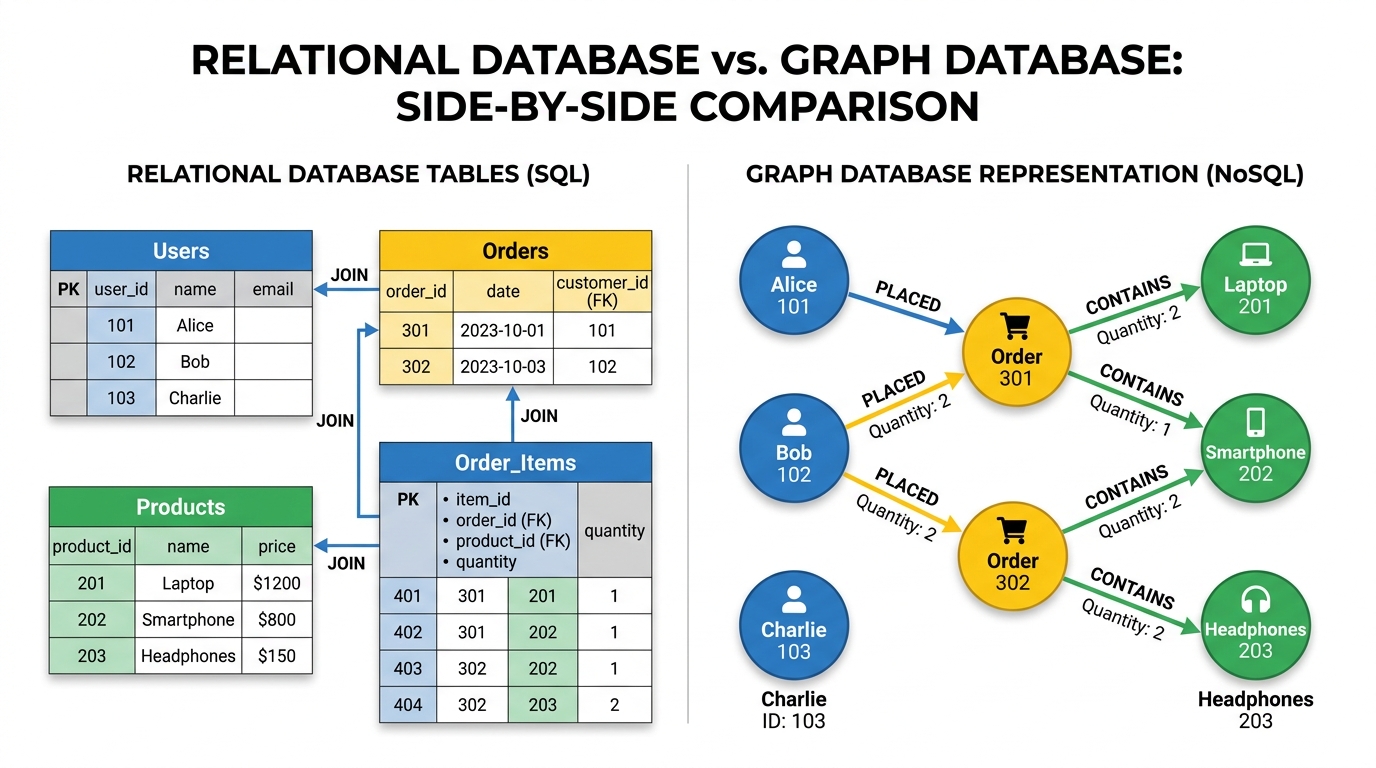
Understanding the Relational Model at Production Scale
The Foundation That Powers Most of the Internet
The relational database management system (RDBMS) remains the most deployed database architecture in enterprise software worldwide. Its foundations — set theory, relational algebra, and Edgar Codd’s normalization principles — give it structural integrity that document and key-value stores simply do not match for transactional workloads.
In production environments, the choice most commonly narrows to two open-source titans: PostgreSQL and MySQL. Both are battle-tested, but they are not interchangeable. Understanding the mysql vs postgresql distinction is not academic — it directly affects your indexing strategy, JSON support, replication topology, and query optimizer behavior.
MySQL vs PostgreSQL: The Differences That Actually Matter
The mysql and postgresql difference goes deeper than licensing or market share. Here is what actually matters at the architecture level:
Concurrency Model: PostgreSQL uses MVCC (Multi-Version Concurrency Control) with a true serializable isolation level, making it the stronger choice for write-heavy, concurrent workloads. MySQL’s InnoDB also implements MVCC but historically has had more edge cases with phantom reads under certain isolation levels.
JSON and Semi-Structured Data: PostgreSQL’s JSONB type is a compressed binary representation that supports full indexing, path queries, and operator classes — making it a legitimate contender against MongoDB for semi-structured workloads. MySQL’s JSON support, while improved significantly in recent versions, still lags behind in index expressiveness and operator richness.
Standards Compliance: PostgreSQL has a long-standing reputation for strict SQL standard compliance. MySQL historically shipped with non-standard behaviors (silent truncation, lenient GROUP BY without ONLY_FULL_GROUP_BY) that could produce inconsistent results — many of which have been corrected in MySQL 8.x but remain in legacy codebases.
Extensibility: PostgreSQL’s extension ecosystem (PostGIS, pgvector, TimescaleDB, Citus) transforms it into a multi-paradigm engine. If you need geospatial queries, vector similarity search, or time-series within your relational model, PostgreSQL is architecturally superior.
When mysql or postgresql is the right framing:
- Choose PostgreSQL when you need JSONB, advanced analytics, PostGIS, or when you’re building on a cloud-native stack where managed postgres services like Amazon RDS for PostgreSQL, Google Cloud SQL, or Neon are available.
- Choose MySQL when you’re inheriting a LAMP stack, when your ORM generates MySQL-specific DDL, or when your team’s operational expertise is MySQL-centric.
MariaDB: The Fork That Diverged More Than Expected
Performance de MariaDB is often cited as a reason teams fork away from Oracle-controlled MySQL. MariaDB has introduced its own storage engines (Aria, ColumnStore), its own optimizer improvements, and diverged significantly from MySQL’s JSON handling. In OLAP workloads, MariaDB ColumnStore demonstrates measurable throughput advantages. For OLTP, the difference is marginal on equivalent hardware. The critical caveat: MariaDB and MySQL are no longer drop-in replacements for each other in all scenarios — particularly around replication formats and system table structures. Treat them as cousins, not twins.
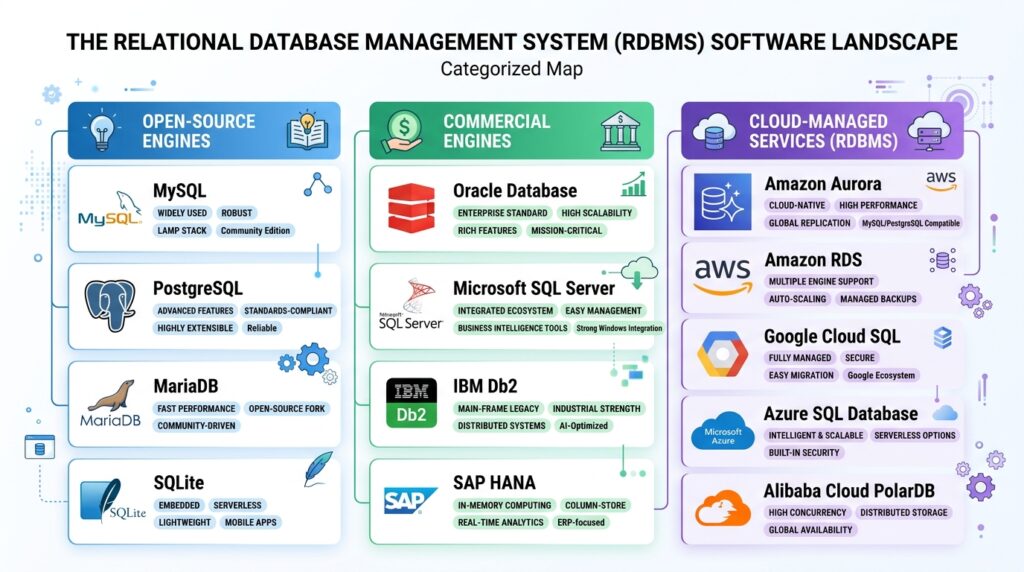
Relational Database Management System Software: The Ecosystem Overview
Understanding the landscape of relational database management system software is essential before committing to an architecture. The market segments broadly into three tiers:
Tier 1: Open-Source Engines
| Engine | Primary Strengths | Typical Workload |
|---|---|---|
| PostgreSQL | Standards compliance, extensibility, JSONB, MVCC | OLTP, analytics, geospatial, vector search |
| MySQL 8.x | Speed on read-heavy workloads, wide ORM support | Web applications, CMS, e-commerce |
| MariaDB | Galera Cluster, ColumnStore, community innovation | OLTP with high-availability requirements |
| SQLite | Embedded, zero-configuration, file-based | Mobile apps, testing, embedded systems |
Tier 2: Commercial/Enterprise Engines
| Engine | Primary Strengths | Typical Workload |
|---|---|---|
| Oracle Database | Mature optimizer, RAC clustering, PL/SQL | Enterprise ERP, financial systems |
| Microsoft SQL Server | .NET integration, SSRS, SSIS, Azure synergy | Enterprise Windows environments |
| IBM Db2 | Mainframe integration, columnar storage | Banking, insurance, legacy enterprise |
Tier 3: Cloud-Native Managed Services
| Service | Underlying Engine | Key Differentiator |
|---|---|---|
| Amazon Aurora | MySQL/PostgreSQL compatible | 5x MySQL throughput, auto-scaling storage |
| Neon | PostgreSQL | Serverless branching, developer-friendly |
| PlanetScale | MySQL (Vitess) | Horizontal sharding, schema branching |
| Supabase | PostgreSQL | Full-stack backend platform |
| CockroachDB | PostgreSQL-compatible | Distributed ACID, geo-partitioning |
Managed postgres services have dramatically lowered the operational burden of running PostgreSQL at scale. Services like Amazon RDS for PostgreSQL, Google AlloyDB, and Neon eliminate the need for manual vacuuming management, replication setup, and failover configuration — without sacrificing the extensibility that makes PostgreSQL compelling.
Comparative Analysis: MongoDB, PostgreSQL, and Relational Integrity
One of the most consequential decisions in modern data architecture is choosing between a document database like MongoDB and a relational engine. This decision intersects multiple dimensions: data modeling philosophy, consistency guarantees, and the nature of relationships in your domain.
MongoDB Relational Database: The Misconception and the Reality
MongoDB is a document-oriented database, not a relational one. Yet organizations frequently attempt to use it as a mongodb relational database by embedding join-like logic in application code or using $lookup aggregation stages. This pattern — known as application-side joins — trades database-level guarantees for schema flexibility, and the consequences manifest at scale.
MongoDB vs PostgreSQL: Relational Workload Comparison
| Criterion | MongoDB | PostgreSQL |
|---|---|---|
| Data model | Documents (BSON/JSON) | Tables, rows, typed columns |
| Schema enforcement | Optional (schema validation via JSON Schema) | Enforced at DDL level |
| Joins | $lookup (aggregation pipeline) | Native JOIN with query planner optimization |
| Referential integrity | Not enforced natively | Foreign keys with CASCADE/RESTRICT |
| Transactions | Multi-document ACID (since 4.0) | Full ACID with mature isolation levels |
| Relational data modeling | Embedded documents or manual references | Normalized tables with FK constraints |
| Index types | B-tree, text, geospatial, hashed | B-tree, GIN, GiST, BRIN, partial, expression |
| Horizontal scaling | Native sharding | Requires Citus or external tooling |
| Aggregation | Aggregation pipeline | SQL + window functions + CTEs |
| Full-text search | Atlas Search (Atlas only) or basic text indexes | tsvector/tsquery natively |
MongoDB Relational Data: When the Fit Breaks Down
The mongodb relational data problem surfaces when your domain has entities that are genuinely relational — meaning their integrity depends on cross-entity consistency. Consider an e-commerce platform:
- An
Orderreferences aCustomerand multipleProducts. - If a
Productis deleted, orphanedOrderrecords become semantically invalid. - MongoDB will not enforce this — you must handle it in application code or with a change stream listener.
PostgreSQL’s foreign key constraints enforce relational integrity declaratively. A DELETE on a referenced row either fails with a constraint violation or cascades — depending on your DDL — without any application-layer logic.
Relational Integrity: Why It Matters at Scale
Relational integrity encompasses two core principles: entity integrity (every row is uniquely identifiable via a primary key) and referential integrity (foreign keys point to valid records). In high-volume, concurrent write environments, the absence of database-enforced relational integrity creates data consistency bugs that are notoriously difficult to diagnose.
A practical lesson: teams that abandon relational integrity in favor of document flexibility often rebuild it in their application layer — but with worse performance, more complexity, and less reliability than what a constraint-enforcing RDBMS would have provided natively.
PostgreSQL Relational Database: The Gold Standard for Structured Data
As a postgresql relational database, PostgreSQL occupies a unique position: it is simultaneously the most standards-compliant open-source SQL engine, the most extensible, and — when managed through services like Amazon Aurora or Neon — one of the most operationally tractable.
Its strength in relational workloads is not simply about SQL. It is about the combination of:
- A sophisticated query planner with statistics-based cost estimation
- True serializable snapshot isolation (SSI)
- Row-level locking with minimal contention
- Constraint deferral within transactions
- Support for
CHECK,UNIQUE,NOT NULL,FOREIGN KEY, andEXCLUSIONconstraints
For teams building financial systems, healthcare platforms, or any domain where data correctness is non-negotiable, PostgreSQL’s constraint model is a feature, not a limitation.
Object Relational Mapping: The Bridge and Its Hidden Costs
Object relational mapping (ORM) frameworks — SQLAlchemy (Python), Hibernate (Java), ActiveRecord (Ruby), Prisma (Node.js), GORM (Go) — abstract SQL into object graphs that developers interact with through their application language. This abstraction accelerates development and reduces boilerplate, but introduces a class of problems that experienced engineers must understand:
ORM Comparison for Relational Databases
| ORM Framework | Language | Database Support | Known Limitations |
|---|---|---|---|
| SQLAlchemy | Python | PostgreSQL, MySQL, SQLite, Oracle | N+1 queries if relationships aren’t eagerly loaded |
| Hibernate / JPA | Java | All major RDBMS | Lazy loading proxies create complex session management |
| ActiveRecord | Ruby | PostgreSQL, MySQL, SQLite | Abstraction hides query complexity; easy to generate cartesian products |
| Prisma | TypeScript/JS | PostgreSQL, MySQL, SQLite, CockroachDB | Limited raw query support; schema migration tooling is opinionated |
| GORM | Go | PostgreSQL, MySQL, SQLite, SQL Server | Callback system can obscure data flow |
| Sequelize | JavaScript | PostgreSQL, MySQL, MariaDB, SQLite | Complex associations generate verbose and sometimes inefficient SQL |
The N+1 problem is the most common ORM performance trap: fetching a list of records and then issuing an individual query per record to load a relationship, resulting in N+1 database round trips instead of one. Most ORMs solve this with eager loading directives (include, preload, joins) — but developers must understand the underlying SQL to apply them correctly.
A real production pattern worth knowing: never trust your ORM in performance-critical paths without reviewing the generated SQL. Use your engine’s EXPLAIN ANALYZE output to validate that indexes are being used and that sequential scans are not occurring on large tables.
Graph Databases: The Architecture for Relationship-First Data
Why Relationships Become a Performance Problem in SQL
In a relational database, relationships are stored as foreign key values and materialized at query time through JOIN operations. Each JOIN requires the query engine to resolve two sets of rows, match on a predicate, and return a combined result set. For shallow relationships (one or two hops), this is fast. For deep traversals (five-plus hops), the computational cost grows with each level.
Consider a fraud detection use case: you want to identify all accounts that share a device fingerprint, IP address, or phone number with a flagged account, up to five degrees of separation. In SQL, this requires a recursive CTE or a series of self-joins — and the execution plan degrades rapidly as the graph depth increases. In a graph database, this is a single Cypher query with a variable-length path pattern ([:SHARES_DEVICE*1..5]) that traverses edges in constant time per hop.
Core Graph Concepts Every Engineer Must Understand
- Node: An entity (User, Account, Device, Transaction)
- Edge (Relationship): A directed, typed connection between two nodes (
:TRANSFERRED_TO,:LOGGED_IN_FROM,:OWNS) - Property: Key-value data stored on a node or edge
- Label: A categorical classifier for nodes (
:Person,:Account) - Path: A sequence of nodes and edges representing a traversal
- Index-free adjacency: Edges store direct pointers to adjacent nodes, eliminating the need for index lookups during traversal — this is the architectural source of graph’s traversal performance advantage
When Graph Databases Deliver Demonstrable Performance Gains
Graph databases outperform relational systems specifically when:
- Traversal depth is variable or deep — friend-of-friend queries, org hierarchy traversal, dependency chains
- Relationship types are heterogeneous — a single node connected to many different entity types with different relationship semantics
- The query pattern is “find paths” — shortest path, all paths, cycles detection
- Data is sparse — most entities don’t share relationships; a JOIN table for this would be mostly NULL or empty rows
- Relationship properties matter — edges carrying weight, timestamps, or other attributes that influence traversal logic
Performance Monitoring: Keeping Both Paradigms Healthy
MySQL and PostgreSQL Performance Monitoring Tools
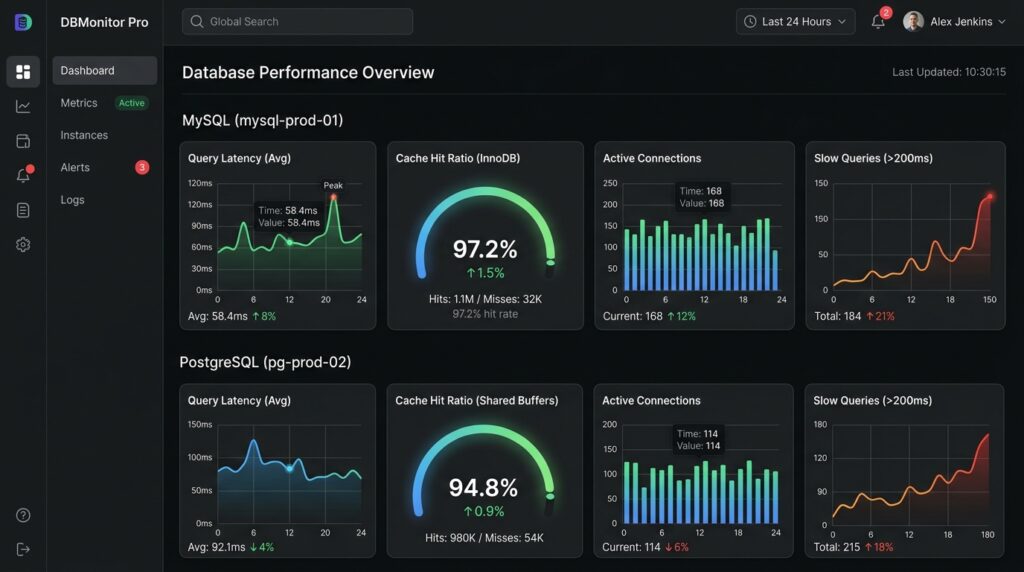
Choosing your database is only the first decision. Operating it at production scale requires continuous observability. The mysql and postgresql performance monitoring tools ecosystem has matured significantly, with both open-source and commercial options:
Performance Monitoring Tooling Overview
| Tool | Supported Engines | Key Capabilities |
|---|---|---|
| pgBadger | PostgreSQL | Log analysis, slow query parsing, report generation |
| pg_stat_statements | PostgreSQL | Extension for tracking per-query execution statistics |
| PMM (Percona Monitoring and Management) | MySQL, PostgreSQL, MongoDB | Full-stack database observability, query analytics |
| VividCortex / SolarWinds DPM | MySQL, PostgreSQL, SQL Server | Real-time query profiling, anomaly detection |
| Datadog Database Monitoring | MySQL, PostgreSQL, SQL Server, Oracle | APM integration, query-level metrics, explain plan capture |
| New Relic | MySQL, PostgreSQL and others | Full observability stack with database query tracing |
| Prometheus + postgres_exporter | PostgreSQL | Metrics scraping for Grafana dashboards |
| MySQL Performance Schema | MySQL | Built-in instrumentation for statements, waits, stages |
| EXPLAIN ANALYZE | PostgreSQL / MySQL | Query plan inspection; essential for index optimization |
| slow_query_log | MySQL / MariaDB | Captures queries exceeding a configurable threshold |
Key metrics to monitor regardless of engine:
- Query execution time (p50, p95, p99 latencies)
- Lock wait time and deadlock frequency
- Cache hit ratio (buffer pool for MySQL; shared_buffers for PostgreSQL)
- Replication lag
- Connection pool saturation
- Index usage vs sequential scan ratio
- Vacuum and autovacuum activity (PostgreSQL-specific)
For graph databases, monitoring focuses on different signals: traversal depth distribution, memory usage during large graph expansions, and cache efficiency of the node/edge store.
Expert Insights: What Years in the Field Actually Teach You
This section contains the kind of institutional knowledge that only surfaces after running databases in production — through incidents, post-mortems, and the slow accumulation of operational experience.
1. The “Let’s Just Use Postgres for Everything” Trap
PostgreSQL’s versatility — JSONB, ltree for hierarchies, pg_graphql, even pgvector for embeddings — tempts teams into using it as a universal data store. This works until it doesn’t. When your graph traversal query hits 200ms at 10K nodes and the same query at 1M nodes takes 45 seconds, you’ve hit the architectural wall. The time to evaluate graph is before the data grows, not after.
2. Graph Modeling Is a Discipline, Not a Conversion
Teams migrating from relational to graph often make the mistake of mapping their tables to nodes one-for-one. This produces a graph that queries like a relational database. Effective graph modeling requires thinking in patterns: what traversals does your application perform? Model your graph to make those traversals efficient, not to mirror your existing ERD.
3. Foreign Keys Are Not Optional in OLTP Systems
In high-throughput environments, teams sometimes disable foreign key constraint checking for insert performance. This is a risk that compounds over time. Orphaned records, broken references, and silent data corruption are the long-term cost. If insert throughput is genuinely constrained by FK validation, the right solution is batching, deferred constraints, or a write-optimized ingestion layer — not disabling integrity enforcement.
4. Managed Services Change the Operational Calculus
Five years ago, running PostgreSQL at scale meant deep DBA expertise in WAL management, replication slots, and VACUUM tuning. Today, managed postgres services handle most of this. The calculus has shifted: the question is no longer “do we have the DBA bandwidth to run Postgres?” but “does our workload fit the managed service’s constraints?” Understand the connection limits, extension availability, and replication topology of your managed service before committing.
5. Polyglot Persistence Is Not Complexity for Its Own Sake
The most scalable data architectures are often polyglot: a PostgreSQL core for transactional data, a graph database for relationship traversal, a vector store for semantic search, and Redis for caching. This is not over-engineering — it is matching each data shape to the engine designed for it. The integration layer (typically event streaming via Kafka or change data capture) is the engineering investment, and it pays dividends at scale.
6. Test Your Graph Queries at 10x Expected Data Volume
Graph traversals can be deceptively fast on small datasets. A query that returns in 3ms on a 50K-node graph may take 800ms on a 5M-node graph if the traversal is unbounded. Always test with a LIMIT clause on path lengths and use query profiling tools (PROFILE in Cypher) before releasing to production.
Making the Decision: A Structured Framework
Use the following decision criteria as a checklist:
Choose a Relational Database when:
- Your data is primarily tabular with well-defined, stable relationships
- You require strict ACID compliance with complex multi-entity transactions
- Your team has SQL expertise and your ORM ecosystem is mature
- You are building ERP, CRM, financial, or compliance-driven systems
- Reporting and analytics are primary workloads
Choose a Graph Database when:
- Relationships between entities are first-class features of your domain
- Your queries involve multi-hop traversals or path-finding
- You are building fraud detection, recommendation engines, IAM systems, or knowledge graphs
- The relationship structure is dynamic or polymorphic
- Traversal performance at depth is a non-negotiable requirement
Choose Both when:
- Your system has a relational core (transactions, records) plus a connected overlay (recommendations, access control, network analysis)
- You are building a platform where different subsystems have fundamentally different data shapes
Frequently Asked Questions
Q1: Can PostgreSQL replace a graph database for moderately complex relationship queries?
For graphs with limited depth (two to three hops) and moderate data volumes, PostgreSQL with recursive CTEs or the ltree extension can be a practical substitute. The pg_graphql extension also enables GraphQL-style queries over relational data. However, as traversal depth and dataset size increase, PostgreSQL’s execution model becomes inefficient for path-finding queries. If your domain’s core value is in relationship traversal, a dedicated graph engine is architecturally justified.
Q2: What is the difference between MySQL and PostgreSQL for a new project in 2025?
The mysql vs postgresql decision for greenfield projects in 2025 almost universally favors PostgreSQL. PostgreSQL’s JSONB support, superior standards compliance, richer index types, and the depth of the managed postgres ecosystem (Aurora, Neon, Supabase, AlloyDB) give it a clear edge for most web and enterprise applications. MySQL remains a strong choice when migrating existing infrastructure or when your team has deep MySQL operational expertise.
Q3: Is MongoDB suitable for applications that need relational integrity?
MongoDB can handle mongodb relational data through embedded documents and $lookup aggregations, but it does not enforce relational integrity at the database level. For applications where data correctness and cross-entity consistency are critical — financial systems, healthcare records, compliance reporting — a relational engine with enforced foreign key constraints is the architecturally sound choice. MongoDB excels in catalog management, content platforms, and event data where schema flexibility outweighs strict consistency requirements.
Q4: What are the performance benchmarks for graph vs relational databases on deep traversal queries?
Published benchmarks from Neo4j, TigerGraph, and academic sources consistently show that for queries requiring five or more hops across millions of nodes, graph databases outperform SQL-based systems by orders of magnitude. The underlying reason is index-free adjacency: graph engines follow direct memory pointers between connected nodes, while SQL engines must resolve each hop through an index lookup. The performance gap widens as both depth and graph density increase. For shallow queries on tabular data, relational databases remain faster.
Q5: What should I monitor to ensure MySQL and PostgreSQL perform well in production?
The most actionable mysql and postgresql performance monitoring signals are: slow query logs (captures queries exceeding your SLA threshold), pg_stat_statements or MySQL’s Performance Schema for per-query statistics, lock contention metrics, replication lag, and cache hit ratios. Tools like Percona Monitoring and Management (PMM), Datadog Database Monitoring, and Prometheus with postgres_exporter provide the observability layer. Establishing query performance baselines before scaling is essential — without a baseline, anomalies are invisible until they become incidents.
Conclusion: Architecture Is a Long-Term Commitment
The graph vs relational database question does not have a universal answer — it has a contextual one. The engineers who make this decision well are those who start from data shape and query patterns, not from familiarity or hype.
Relational databases — particularly PostgreSQL and MySQL — remain the correct default for the majority of enterprise workloads. Their maturity, tooling depth, managed service availability, and the reliability of enforced relational integrity make them the appropriate foundation for transactional systems. The postgresql relational database and its ecosystem represent decades of engineering investment that should not be abandoned without clear evidence of fit problems.
Graph databases are not a replacement for this foundation. They are a specialized tool that delivers transformative performance gains in a specific class of problems: deep relationship traversal, pattern matching across connected data, and real-time analysis of network-shaped domains. When your application’s value is in the connections — not just the records — graph architecture is not a luxury; it is a necessity.
The most sophisticated production architectures combine both: a relational core for structured, transactional data and a graph layer for relationship intelligence. The integration investment required to run a polyglot stack is substantial, but for platforms where both data shapes are fundamental, it is the only architecture that performs correctly at scale.
Make the decision based on your data’s shape, your query patterns at target scale, and your team’s operational capacity to run and monitor the system. Everything else is secondary.
For production database architecture consulting and peer review of database design decisions, refer to resources published by the PostgreSQL Global Development Group, the Neo4j engineering blog, Percona’s database performance blog, and the VLDB (Very Large Data Bases) conference proceedings for peer-reviewed research on database performance.