Table of Contents
Reading level: Intermediate / Advanced ITSM practitioners, service owners, transformation leads, and technology executives in the United States, Canada, and the United Kingdom.
Introduction: Why This Update Matters Right Now
If you are reading this, chances are you already know ITIL 4 well — the Service Value System, the four dimensions, the 34 practices. You have probably built incident workflows, change advisory boards, and continual improvement registers around that model. And you have likely felt, over the past two or three years, that the framework was straining under the weight of three forces it was never designed to absorb at scale: agentic AI, product-centric operating models, and end-to-end digital experience accountability.
That tension is precisely what ITIL Version 5 — published by PeopleCert in early 2026 — was created to resolve. This is not a cosmetic refresh. It is a deliberate architectural shift: from “IT service management” to digital product and service management, from a linear value chain to an iterative lifecycle, from AI-as-a-tool to AI-as-a-governed-capability.
This article gives you what most launch summaries do not: the working knowledge an experienced practitioner needs to assess whether to migrate, when to migrate, and what will actually change in your operating model when you do. We cover the five stages of ITIL as they have evolved across versions, the new eight-activity lifecycle, a side-by-side comparison of ITIL 4 and ITIL 5, a practical migration path, and the trade-offs no vendor will tell you about.

What Is ITIL Version 5?
ITIL Version 5 is the current iteration of the Information Technology Infrastructure Library, the most widely adopted framework for managing technology services and digital products. It is published, maintained, and certified by PeopleCert, which has been the sole steward of the ITIL intellectual property since acquiring AXELOS in 2021.
Whereas ITIL 4 was framed around service management, ITIL Version 5 is officially defined as a framework for the management of digital products and services. That single change in scope cascades through every subsequent design decision in the framework: lifecycle activities, practices, certification paths, and the way value is measured.
Three principles underpin the entire architecture:
- AI-native by design. AI governance is embedded in the core of the framework, not bolted on as an extension.
- Product-centric operating model. Practices are aligned to how modern technology organizations actually deliver — through persistent product teams rather than project-and-handoff cycles.
- Experience- and outcome-focused. Human experience (customer, user, and employee) is treated as a measurable contributor to value alongside availability, capacity, and cost.
ITIL 5 Release Date and Rollout Timeline
The ITIL 5 release date is not a single date — it is a phased calendar that practitioners need to know if they are planning training budgets or transformation roadmaps:
- 12 February 2026 — ITIL Foundation (Version 5) launched.
- 26 February 2026 — ITIL Foundation Bridge (Version 5) made available for ITIL 4 holders.
- March 2026 — ITIL Product, ITIL Service, and ITIL Experience modules released.
- 9 April 2026 — ITIL Strategy and ITIL Transformation modules released.
- 12 April 2026 — Full ITIL Version 5 scheme officially launched.
- 14 May 2026 — ITIL Managing Professional (Transition) module released.
- H2 2026 — Update of the ITIL 4 management practice publications under the Version 5 lens.
ITIL 4 certifications remain valid and are not retired. PeopleCert has been explicit that this is an evolution, not a reset.
The Five Stages of ITIL: A Brief but Necessary History
Anyone searching for the 5 phases of ITIL or the five stages of ITIL is usually looking back at ITIL v3 (2007–2011), which structured the entire framework around five lifecycle phases: Service Strategy, Service Design, Service Transition, Service Operation, and Continual Service Improvement. That model was elegant but rigid — it assumed a relatively predictable, project-based delivery cadence that has become the exception rather than the norm.
ITIL 4 retired the five-stage lifecycle and replaced it with the Service Value Chain — six interconnected activities (Plan, Improve, Engage, Design and Transition, Obtain/Build, Deliver and Support) operating inside the Service Value System.
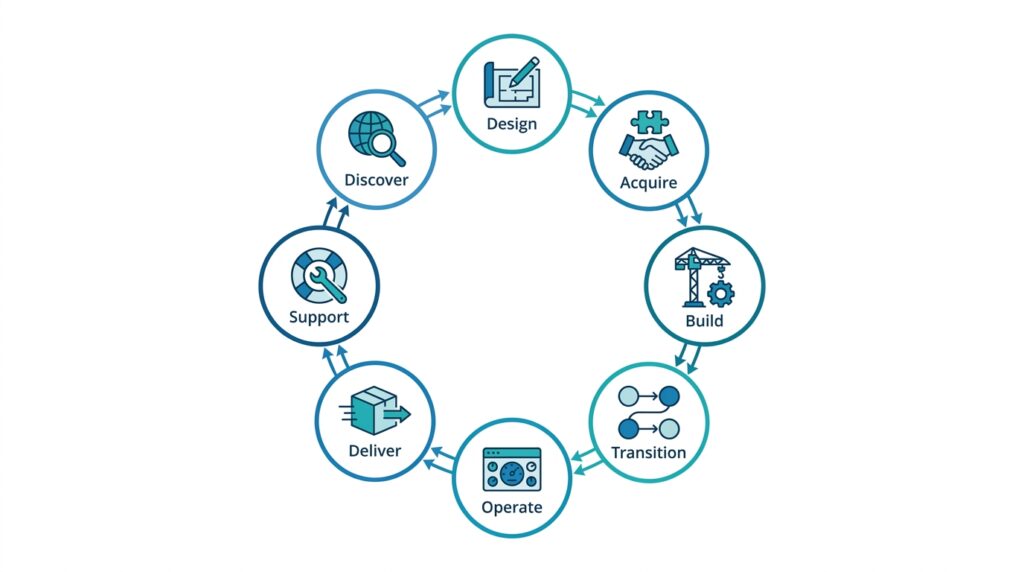
ITIL Version 5 takes this further. The Service Value Chain is replaced by the Product and Service Lifecycle Model (PSLM), an iterative, eight-activity model:
- Discover — sense market, user, and operational signals; identify opportunities and constraints.
- Design — shape the product or service against business outcomes, experience targets, and risk posture.
- Acquire — make build-buy-partner decisions for technology, talent, and supplier capability.
- Build — develop, integrate, and validate the product or service, including AI components.
- Transition — release, deploy, and onboard with operational readiness and observability in place.
- Operate — run the service reliably; this is where SRE practices, monitoring, and incident response live.
- Deliver — fulfil consumer interactions, requests, and ongoing value realization.
- Support — resolve issues, capture learning, and feed insight back into Discover and Design.
The model is explicitly non-linear. Insight from Support is expected to flow directly into Discover and Design. That is a meaningful change for practitioners who built their careers on stage-gated transitions: under ITIL 5, the lifecycle is a feedback system, not a relay race.
Core Architectural Changes Practitioners Need to Internalize
1. From Service Value System to ITIL Value System
The ITIL 4 Service Value System (SVS) has been broadened and renamed the ITIL Value System. The Guiding Principles, governance, continual improvement, and the four dimensions remain — but the value chain inside it is now the Product and Service Lifecycle Model, with explicit links between practices, lifecycle activities, and outcomes.
2. The AI Capability Model (6C)
ITIL 5 introduces the ITIL AI Capability Model, structured around six capabilities: Creation, Curation, Clarification, Cognition, Communication, and Coordination. This is the framework’s response to the operational reality that AI is no longer a discrete tool — it is a participant in service delivery, particularly with the rise of agentic AI inside platforms like ServiceNow’s AI Gateway and Salesforce Agentforce. There is also a dedicated ITIL AI Governance extension qualification, the only standalone extension in the new scheme.
3. Practices: Same 34, Reorganized
All 34 management practices from ITIL 4 are retained. Wording and emphasis have been updated. The reorganization is meaningful:
- 22 Product and Service Management Practices — combining what was previously split between service management and technical management groupings.
- 12 General Management Practices — strategic, governance, and organizational practices that cut across the lifecycle.
The “Technical Management Practices” grouping from ITIL 4 has been dissolved and absorbed into the unified product/service management group, reflecting the elimination of the artificial boundary between Dev and Ops.
4. Experience as a First-Class Citizen
A new ITIL Experience publication establishes structured guidance for designing, measuring, and improving the end-to-end service journey, including the introduction of Experience Level Agreements (XLAs) as a complement to traditional SLAs. This is significant for organizations in the US, UK, and Canadian markets where customer experience metrics increasingly drive board-level decisions and regulatory expectations (for example, the UK’s Consumer Duty regime in financial services).
5. A Streamlined Qualification Scheme — and the ITIL 5 Foundation
The certification path begins, as before, with ITIL 5 Foundation (formally ITIL Foundation (Version 5)). It remains a closed-book, multiple-choice exam (40 questions, 65% pass mark, 60 minutes), with a phased localization plan covering Spanish, Brazilian Portuguese, Chinese, and additional languages over time.
From Foundation, three role-aligned designations exist:
- ITIL Practice Manager — Foundation + one Practice Manager bundle (MSF, PIC, or CAI) + Transformation.
- ITIL Managing Professional — Foundation + Product + Service + Experience + Transformation.
- ITIL Strategic Leader — Foundation + Strategy + Transformation.
ITIL Transformation is mandatory across all three designations but only needs to be completed once. Most advanced exams are now open book, signaling a deliberate shift away from rote memorization toward applied judgment.
ITIL 4 vs ITIL Version 5: A Practitioner’s Comparison Table
| Dimension | ITIL 4 (2019) | ITIL Version 5 (2026) |
|---|---|---|
| Primary scope | IT service management | Digital product and service management |
| Core architectural model | Service Value System (SVS) | ITIL Value System |
| Value chain | Service Value Chain — 6 activities (linear-leaning) | Product and Service Lifecycle Model — 8 iterative activities |
| Lifecycle activities | Plan, Improve, Engage, Design & Transition, Obtain/Build, Deliver & Support | Discover, Design, Acquire, Build, Transition, Operate, Deliver, Support |
| AI guidance | Not formally addressed | AI-native; ITIL AI Capability Model (6C) + AI Governance extension |
| Experience focus | Mentioned within practices | Dedicated ITIL Experience module; XLAs |
| Practices | 34 practices in 3 groups (general, service, technical management) | 34 practices in 2 groups (22 Product & Service Management, 12 General Management) |
| Guiding Principles | 7 principles | Same 7 principles, retained unchanged |
| Four Dimensions | Retained | Retained |
| Certification entry point | ITIL 4 Foundation | ITIL 5 Foundation (with Bridge for ITIL 4 holders) |
| Designations | Managing Professional, Strategic Leader, Practice Manager, Master | Same designations, restructured around new modules; Transformation mandatory across all |
| Exam style (advanced modules) | Mostly closed book | Open book for Product, Service, Experience, Strategy, Transformation |
| Renewal | 3-year renewal (since Jan 2023) | 3-year renewal continues; CPD remains the most cost-efficient route |
| Underlying assumption | Stable services, project delivery, periodic change | VUCA environment, continuous delivery, agentic and AI-augmented operations |
How to Migrate from ITIL 4 to ITIL 5
This is the section practitioners actually need. The migration is technically simple — PeopleCert designed it that way — but operationally, there are decisions that affect budget, sequencing, and team capability.
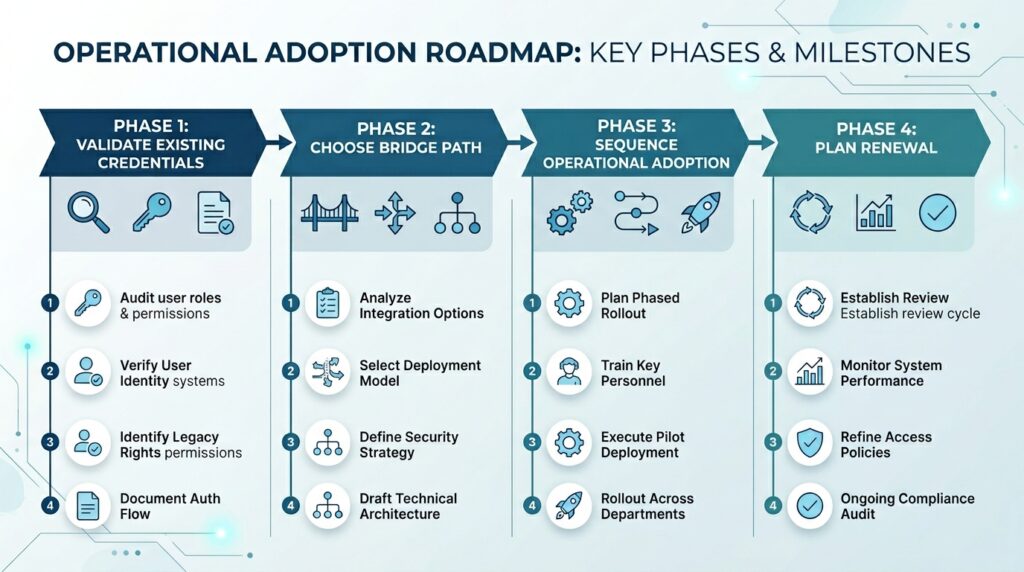
Step 1 — Confirm What You Already Hold Is Valid
If your team holds ITIL 4 Foundation, Managing Professional, Strategic Leader, or Master, none of those credentials expire because of Version 5. They remain valid prerequisites and qualifications. Migration is a strategic choice, not a compliance one.
Step 2 — Choose the Right Bridge Path Per Role
The fastest, most cost-efficient route depends on the existing credential:
- ITIL 4 Foundation holders → ITIL Foundation Bridge (Version 5). Short, focused exam covering only what is new at Foundation level. Final retirement of this bridge is scheduled for 31 December 2027 — plan accordingly.
- ITIL 4 Managing Professional holders → ITIL Managing Professional Transition (Version 5). Single transition module covering Experience, Product, Service, and Transformation content.
- ITIL 4 Strategic Leader holders → ITIL Transformation (Version 5) module. Completing it auto-upgrades the designation.
- ITIL 4 Master holders → ITIL Managing Professional Transition (Version 5), same as MP holders.
- No prior ITIL credential → ITIL 5 Foundation directly, no prerequisites required.
Step 3 — Sequence Organizational Adoption, Not Just Certification
Certification is the easy part. Operational adoption is where most programs stall. A pragmatic sequence we have seen work in mid-to-large enterprises:
- Map your current value streams against the new eight-activity lifecycle. Gaps almost always appear in Discover (most ITIL 4 organizations underweight market and user signals) and in Acquire (build-versus-buy decisions are often informal).
- Inventory AI usage across services. Identify which AI components are governed, which are shadow deployments, and where the ITIL AI Capability Model would force visibility you do not currently have.
- Reframe SLAs around outcomes by introducing XLAs alongside (not replacing) existing SLAs. This is a multi-quarter exercise; do not treat it as a renaming.
- Reorganize practice ownership to reflect the dissolved technical/service management split. If you have separate “infrastructure ITSM” and “service desk ITSM” governance forums, expect to merge them.
- Pilot in one product line first. Selecting a digital-native product (a customer-facing app, a data platform) usually surfaces fewer organizational antibodies than starting with legacy back-office services.
Step 4 — Plan the Renewal Mechanics
Version 5 certificates carry a three-year renewal cycle, identical to ITIL 4. Holding any certification within the same product suite or logging 20 CPD points annually through PeopleCert Plus satisfies the requirement. For teams managing several certified practitioners, CPD logging is materially cheaper than re-examination.
Expert Insights: What Only Field Experience Reveals
These are observations that surface only when you have run several ITIL transitions in real organizations.
1. The hardest change is not technical — it is the dissolution of the practice silo. The merger of technical and service management practices into a single Product and Service Management group looks like a documentation change. In practice, it forces a reorganization of standing committees, on-call rotations, and budget ownership. CIOs in regulated industries (banking, healthcare, utilities in the US, UK, and Canada) routinely underestimate the political work this requires.
2. The Discover stage will expose you. Most ITSM organizations have no formal Discover capability — that work has historically lived in product management or even marketing. Adding it to the ITIL lifecycle means service owners need new muscles around hypothesis testing, user research, and signal interpretation. Expect this to be the most uneven adoption stage in your first twelve months.
3. Open-book advanced exams change how you prepare your team. The shift to open-book formats for Product, Service, Experience, Strategy, and Transformation makes pure cramming ineffective. Candidates who succeed are those who have actually applied the practices — meaning training budgets are better spent on guided application than on bootcamp-style memorization.
4. AI Governance is the module most underestimated by leadership. With the EU AI Act in force, the UK’s pro-innovation AI framework evolving, and US sectoral regulators (FTC, HHS, financial regulators) tightening expectations, the ITIL AI Governance extension has become the nearest thing to a defensible operational baseline for AI accountability. Leaders who treat it as optional are creating audit risk.
5. Do not migrate everything at once. Run ITIL 4 and ITIL Version 5 in parallel for at least one cycle. Use the Bridge module to upgrade your most active practitioners first, leave less-active certifications on ITIL 4 until natural renewal points, and avoid the trap of scheduling a 90-day “big bang” recertification — it almost never produces practitioners who can actually use the new lifecycle in their day jobs.
6. ServiceNow, Jira Service Management, and BMC Helix are already aligning, but unevenly. Treat your ITSM tooling roadmap as an explicit dependency of your ITIL 5 program. Asking whether your platform supports value stream mapping, AI governance hooks, and XLA tracking before you commit to a migration timeline will save you from a tooling backlog you did not plan for.
Honest Limitations and Trade-Offs
Trustworthy adoption requires acknowledging what the new framework does not solve.
- It is still framework guidance, not implementation prescription. ITIL 5, like every prior version, tells you what good looks like; it does not tell you how to make it work in your specific tooling, regulatory, or cultural context. Organizations that expected a more prescriptive playbook will be disappointed.
- The product/service unification creates ambiguity in handoffs with non-IT product organizations. If your enterprise has a separate digital product organization with its own product management discipline (often with a Pragmatic, SVPG, or similar lineage), expect overlap and friction. ITIL 5 does not arbitrate.
- The AI Capability Model is new and unproven at scale. The 6C model is conceptually sound, but real-world reference implementations are still emerging. Early adopters will be doing a substantial amount of pattern-defining themselves.
- Certification cost remains a barrier. Foundation-level exam fees alone are non-trivial per practitioner, and full designations involve multiple modules. For organizations certifying large teams, the cumulative spend warrants comparison against alternative ITSM frameworks (for example, IT4IT, COBIT, or VeriSM) as part of a pluralistic strategy.
- Open-book advanced exams reduce signaling value. Some hiring managers will weigh open-book ITIL 5 advanced certifications differently from the closed-book ITIL 4 equivalents. This is a signaling concern more than a substantive one — but it exists.
For organizations evaluating which framework to adopt, ITIL 5 is one of several credible options. Decisions should be informed by published guidance from PeopleCert, peer-reviewed research on ITSM maturity (HDI, Forrester, and Gartner produce relevant studies), and independent practitioner communities such as the itSMF chapters in the US, UK, and Canada.
Frequently Asked Questions
1. Is ITIL Version 5 the same as ITIL v5 or ITIL 5? Yes. PeopleCert’s official label is ITIL (Version 5), but the terms ITIL 5, ITIL v5, and ITIL version 5 are used interchangeably across the industry, including by accredited training partners. They all refer to the same 2026 release.
2. Do I need to retake my ITIL 4 Foundation if I want ITIL 5 Foundation? No. ITIL 4 Foundation is a recognized prerequisite for all advanced ITIL 5 modules. If you specifically want the ITIL 5 Foundation credential, the ITIL Foundation Bridge (Version 5) is the focused, lower-cost path designed exactly for this case. The bridge module is currently scheduled to retire on 31 December 2027, so there is a clear window.
3. How long does it take a competent ITIL 4 practitioner to prepare for the ITIL 5 Foundation Bridge? There is no mandated training time, and self-study is permitted at Foundation level. Practicing ITSM professionals typically require focused study of the new content areas — the Product and Service Lifecycle Model, the AI Capability Model, value streams, and updated terminology — rather than a full Foundation rebuild. Allocating dedicated study time across two to four weeks is a reasonable planning assumption for most experienced candidates.
4. Will ITIL 5 actually reduce IT operating costs? The framework itself does not reduce costs — disciplined application of it can. The cost levers most commonly realized in ITIL 5 adoptions are: AI-augmented incident triage and resolution under the AI Capability Model, reduced rework from tighter feedback loops between Support and Discover, and more accurate investment decisions in the Acquire stage. None of these are automatic. They depend on tooling maturity, data quality, and operational discipline. Treat any vendor claim of guaranteed cost reduction with skepticism.
5. Should our organization adopt ITIL 5 if we have not yet fully implemented ITIL 4? This is a judgment call. If your ITIL 4 implementation is stable and producing value, finish what you started and migrate at a natural inflection point. If your ITIL 4 program has stalled — often because it was over-scoped or treated as a documentation exercise — then ITIL 5 offers an opportunity to relaunch with a tighter, product-centric scope. Either way, do not adopt a framework version because it is the newest. Adopt it because it answers a question your operating model is currently failing to answer.
Conclusion: A Framework That Finally Matches How Modern IT Actually Works
ITIL Version 5 is the most consequential update to the framework since ITIL 4 in 2019, but its real significance is not in the new vocabulary or the rebranded models. It is in the closing of a long-standing gap between how the framework described work and how technology organizations actually deliver it.
The unification of product and service management, the iterative eight-stage lifecycle, the embedded AI governance, and the explicit treatment of experience as a measurable outcome are not innovations on paper — they are formalizations of practices the strongest IT organizations have been quietly adopting for years.
For experienced practitioners in the US, UK, and Canada, the strategic posture is clear: treat ITIL 5 as a planned upgrade, not a forced migration. Use the bridge paths where they fit. Sequence operational adoption around your most product-centric work first. Take AI governance seriously, because regulators already do. And remember that the framework is a tool — its value is measured entirely by what your teams do with it on Monday morning, not by what is printed on the certificate.
The organizations that will get the most out of ITIL Version 5 are not the ones that race to recertify. They are the ones that use this transition as the excuse they finally needed to unify product and service teams, govern AI deliberately, and put experience on the same dashboard as availability.
That work was always overdue. ITIL 5 simply makes it harder to keep postponing it.