A practitioner’s guide to closing the digital skills gap in an era where competence with technology is no longer optional, but a baseline requirement for economic, civic, and educational participation.
Table of Contents
A practitioner’s guide to closing the digital skills gap in an era where competence with technology is no longer optional, but a baseline requirement for economic, civic, and educational participation.
Introduction: Why “Knowing How to Use a Computer” Is No Longer Enough
If you have ever felt confident in your tech skills only to be blindsided by a multi-factor authentication prompt, a phishing email that almost worked, a collaborative document that broke when three people edited it simultaneously, or an AI tool that produced results you couldn’t verify—you have already encountered the modern digital literacy gap.
This is not a beginner’s problem. It is an intermediate-to-advanced problem, and it is the silent productivity tax of the contemporary workplace. Across the United States, Canada, and the United Kingdom, employers consistently report that workers can use digital tools but struggle to evaluate, secure, integrate, and teach them—the four skills that actually distinguish digital fluency from digital familiarity.
And the cost of that gap is not theoretical. Misdirected emails, misconfigured sharing permissions, credential reuse across platforms, and uncritical reliance on AI-generated content create operational, legal, and reputational exposure every week. The organizations that treat digital literacy as a training checkbox rather than a strategic capability are the ones absorbing those costs invisibly—until an incident makes them visible to everyone.
This tutorial is designed for that gap. Not “how to send an email,” but how to architect a personal and organizational approach to digital literacy that holds up under the conditions of remote work, AI proliferation, regulatory scrutiny, and increasingly sophisticated cyber threats. We will work through recognized frameworks (DigComp 2.2, UNESCO’s Digital Literacy Global Framework, Northstar Digital Literacy), governance models (COBIT vs. ITIL), and the hard-earned field lessons that separate theory from practice.

1. The Scale of the Problem: Context Every Decision-Maker Needs
Before diving into frameworks and skills, it is worth grounding this discussion in the operational reality that makes digital literacy a strategic priority rather than a nice-to-have.
The workforce readiness gap is structural, not anecdotal
Reports from the OECD’s Programme for the International Assessment of Adult Competencies (PIAAC), the UK Department for Education’s Essential Digital Skills surveys, and Statistics Canada’s Canadian Internet Use Survey consistently show the same pattern: a significant portion of the working-age population in all three countries lacks the digital skills necessary for full participation in the modern labor market. The gap is not confined to older workers or lower-income populations; it extends into mid-career professionals who are functionally competent with consumer technology but underperforming with enterprise tools, data management, and security practices.
The economic dimension
Digital skills gaps translate directly into measurable costs: lost productivity from workarounds, increased IT support ticket volume, security incidents caused by human error, and slower adoption of new platforms after procurement. For public-sector organizations and educational institutions, the cost also includes reduced service delivery quality and inequitable access to digital government services. These are not speculative concerns—they are documented in workforce development reports from institutions like the World Economic Forum, Brookings Institution, and the UK’s Learning and Work Institute.
The digital divide is not just about access anymore
The first generation of digital divide research focused on connectivity—who has internet access and who does not. That question remains relevant, particularly in rural areas of all three countries, but the contemporary divide is increasingly about capability. Two people with identical devices and broadband connections will extract vastly different value from those resources depending on their digital literacy skills. Access without literacy is infrastructure without capacity.
This distinction matters for program design. Organizations that invest in devices and connectivity without investing equally in skills training consistently find that adoption stalls. The hardware arrives; the behavioral change does not.
2. Defining Digital Literacy: Beyond the “Computer Skills” Misconception
The first error most organizations make is treating digital literacy as a synonym for computer skills. They are not the same construct. Computer skills are operational—”I can format a cell in Excel.” Digital literacy is interpretive, evaluative, and ethical: the capacity to find, assess, create, communicate, and act on information using digital technologies in a way that is appropriate to context.
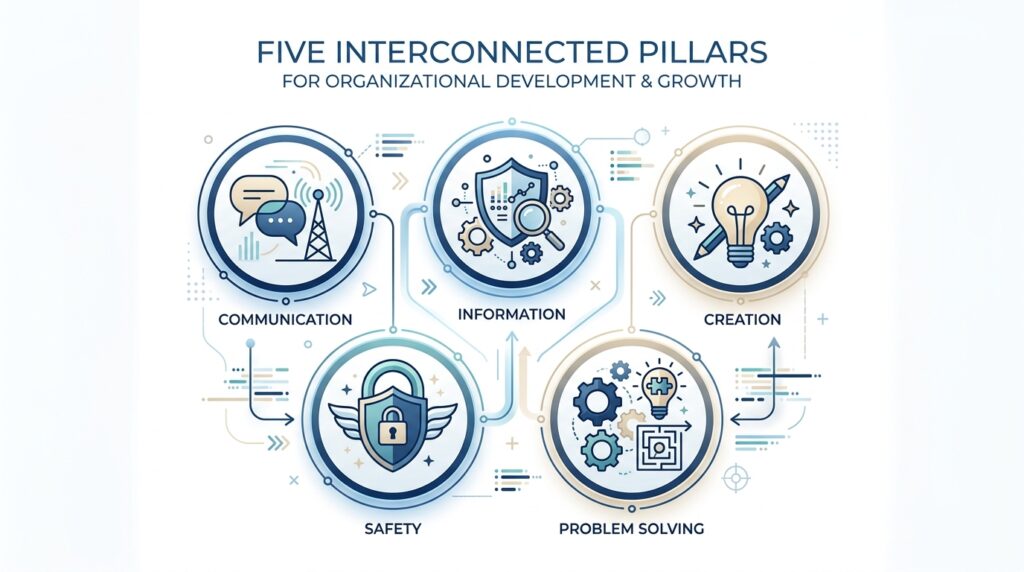
The most widely accepted contemporary definition comes from UNESCO’s Digital Literacy Global Framework (DLGF), which extends the European Commission’s DigComp 2.2 model. Both frameworks define digital literacy across five interlocking competence areas: information and data literacy (locating, evaluating, and managing digital content), communication and collaboration (interacting through digital technologies, including netiquette and identity management), digital content creation (producing and integrating original digital artifacts with awareness of copyright and licensing), safety (protecting devices, personal data, well-being, and the environment), and problem solving (identifying needs, troubleshooting, and creatively applying digital tools).
The relationship between literacy and digital literacy
Traditional literacy and digital literacy are not separate constructs running in parallel; they are nested. Digital literacy presupposes traditional literacy (reading, numeracy, critical thinking) and then layers on the technical, social, and ethical dimensions specific to digital environments. A person who reads well but cannot evaluate the credibility of a source on social media is not digitally literate. A person who can install software but cannot recognize a phishing attempt is not digitally literate either.
This nesting has practical consequences for program design. It explains why digital literacy interventions fail when they focus only on tools. Tools change on an 18-month cycle. Frameworks of evaluation last decades. Programs that teach buttons rather than judgment produce graduates who are immediately obsolete.
Authoritative reference frameworks worth knowing
Five frameworks dominate the field across the US, Canada, and UK: DigComp 2.2 (European Commission, the de facto standard across EU member states and increasingly referenced in UK policy), UNESCO’s Digital Literacy Global Framework, JISC Digital Capabilities Framework (widely adopted across UK higher education), ISTE Standards (common in US K–12 and higher education contexts), and UNESCO’s Media and Information Literacy (MIL) curricula. Each serves a different audience, but they share the same underlying architecture—literacy as a multi-dimensional competence, not a single skill.
3. Digital Literacy Skills: The Intermediate-to-Advanced Competence Map
At the intermediate-to-advanced level, digital literacy skills are not a checklist of applications you have used. They are demonstrable capacities to perform tasks that require judgment under uncertainty. The working competence map below draws from DigComp’s proficiency levels 5 through 8—the “advanced” and “highly specialized” tiers—and translates them into the language of daily professional practice.
3.1 Information and Data Literacy (Advanced)
The foundational skill at this level is source triangulation: the discipline of verifying a claim across at least three independent, traceable sources before propagating it in any professional context. In practice, this means checking not just whether a claim appears on multiple websites, but whether those websites share a common upstream source. Three outlets citing the same press release is one source, not three.
Beyond verification, advanced practitioners develop metadata interrogation habits—reading file properties, EXIF data on images, document revision histories, and URL structures to assess provenance. They also cultivate algorithmic awareness, which means understanding that search results, social media feeds, and AI outputs are personalized, ranked, and filtered by systems with their own optimization objectives. The search result you see is not the search result your colleague sees, and neither of you is seeing an objective truth.
Data hygiene rounds out this domain: structuring, naming, versioning, and archiving files in ways that survive team turnover. The professional who names a file Final_v3_REAL_use-this-one.docx is exhibiting a data literacy deficit that compounds every time someone new joins the team.
3.2 Communication and Collaboration (Advanced)
Channel selection discipline is the overlooked skill here. Knowing when synchronous communication (video call, live chat) is appropriate versus asynchronous (email, shared document, project ticket) saves hours per week and reduces the chronic meeting fatigue that remote and hybrid teams report. The general principle: use synchronous for alignment and relationship-building; use asynchronous for decisions, records, and deep work.
Identity and reputation management across professional platforms (LinkedIn, GitHub, ORCID, sector-specific directories) is increasingly a career asset rather than vanity. Recruiters, collaborators, and grant reviewers search these platforms, and what they find—or do not find—shapes opportunity.
Inclusive communication belongs here, not in an afterthought paragraph. Producing accessible content (alt text, captions, plain-language drafting, proper heading structure) by default rather than by request is an advanced digital literacy behavior with regulatory backing under the ADA, AODA, and UK Equality Act 2010.
3.3 Digital Content Creation (Advanced)
Licensing literacy has become unexpectedly urgent. The proliferation of AI-generated content has introduced genuine legal ambiguity: under current US, Canadian, and UK copyright regimes, the ownership status of AI-assisted work is unsettled. Professionals who create content—writing, design, code, multimedia—need a working understanding of Creative Commons variants, proprietary licenses, and the evolving case law around generative AI outputs. This is no longer a niche concern for lawyers; it is a content creation concern for anyone publishing.
Tool-chain integration—the ability to move content between tools without loss of fidelity (Markdown to docx to PDF; Figma to code; raw data to visualization to report)—separates efficient professionals from those who spend hours reformatting. The skill is not knowing any single tool deeply; it is understanding interchange formats, export limitations, and conversion trade-offs.
Critical use of generative AI now belongs in every content creator’s toolkit: prompting effectively, evaluating outputs for accuracy and bias, fact-checking claims, and disclosing AI-assisted work where professional or institutional norms require it. Treating AI output as a first draft rather than a final product is the literacy threshold.
3.4 Safety (Advanced)
The advanced safety practitioner begins with threat modeling: identifying what you are protecting, from whom, and at what cost before selecting tools. A journalist protecting sources faces a different threat model than a small business protecting customer data, and the tools that serve one may be inappropriate for the other.
Authentication hygiene at this level means password managers as a non-negotiable baseline, hardware security keys for high-value accounts, and multi-factor authentication (MFA) configured with app-based or hardware-based methods rather than SMS, which remains the weakest commonly accepted form due to SIM-swapping vulnerabilities.
Privacy posture means reading and acting on privacy settings in light of the regulatory environment: GDPR (UK and EU), PIPEDA (Canada), and the patchwork of US state laws including CCPA/CPRA. The practical skill is not memorizing regulations—it is knowing that regulations exist, that they differ by jurisdiction, and that your default platform settings are almost never configured for compliance.
3.5 Problem Solving (Advanced)
Diagnostic literacy is the ability to read error messages, log files, and stack traces well enough to formulate a useful question—not necessarily to solve the problem yourself, but to describe it precisely enough that the right person or resource can. The gap between “it doesn’t work” and “the POST request returns a 403 after the token refresh fails” is the gap between helplessness and agency.
Search craft is the discipline of constructing queries that surface authoritative answers rather than affiliate-driven content farms. Advanced practitioners know how to use operators, filter by source type, and recognize when a search result is advertising masquerading as information.
Continuous self-assessment closes the loop: identifying your own skill gaps before they become operational liabilities. The Dunning-Kruger effect is particularly active in digital skills because it is easy to confuse familiarity with competence.
4. Northstar Digital Literacy: A Standardized Assessment Worth Understanding
Of all the assessment instruments in the English-speaking world, Northstar Digital Literacy is one of the most operationally mature. Developed originally by the Saint Paul Community Literacy Consortium and now stewarded by Literacy Minnesota, Northstar literacy assessments are used by adult education programs, public libraries, workforce development boards, and increasingly by employers across the US and Canada to validate baseline-to-intermediate digital competence.
What Northstar actually tests
The Northstar assessment library covers three broad categories. The first, Essential Computer Skills, includes modules on basic computer use, internet navigation, email, and operating system fundamentals for both Windows and Mac. The second, Essential Software Skills, covers the productivity suite: Microsoft Word, Excel, PowerPoint, and Google Docs. The third, Using Technology in Daily Life, extends into applied contexts: digital footprint awareness, information literacy, career search skills, social media, online banking, supporting K–12 distance learning, and telehealth.
Each module is performance-based: candidates demonstrate tasks in simulated environments rather than answer multiple-choice trivia. This is the methodological feature that distinguishes Northstar Digital Literacy from many competitor certifications—and it is also why the credential carries weight with workforce agencies that need to see evidence of capability, not just test-taking aptitude.
Northstar online learning vs. Northstar assessment
A point of frequent confusion: Northstar online learning refers to the self-paced learning modules that prepare candidates for the Northstar assessment. They are complementary but distinct products. The learning modules teach; the assessment certifies. Programs that conflate the two—using the learning modules as if they were the credential—miss the value of the formal proctored certification and give learners a false sense of validated competence.
Where Northstar fits, and where it doesn’t
Northstar is a strong fit for adult basic education, workforce reentry, library-based training programs, immigrant and refugee services, and entry-level workforce screening. It is a weaker fit for specialized technical roles, advanced cybersecurity, software engineering, or research environments—contexts where vendor-specific certifications (CompTIA, Cisco, AWS, Google) or competency-based frameworks like DigComp at proficiency levels 7 and 8 are more appropriate.
An honest limitation worth stating: Northstar excels at certifying foundational and intermediate skills against a stable rubric. It is not designed to certify the evaluative, AI-aware, judgment-heavy competence covered in Section 3.4 of this article. Treat it as a floor, not a ceiling.
A semantic note also worth making: the Northstar credential validates individual foundational competence, but organizations frequently confuse this with strategic direction. Certifying that your workforce can use a spreadsheet is not the same as knowing where your enterprise is heading. For the latter, you need an explicit strategic compass—what practitioners call defining your digital north in a transformation journey. Treat Northstar as a measure of where your people are; treat your digital north as a declaration of where your organization is going.

A semantic note worth making: the Northstar credential validates individual foundational competence, but organizations frequently confuse this with strategic direction. They are not the same thing. Certifying that your workforce can use a spreadsheet is not the same as knowing where your enterprise is heading. For the latter, you need an explicit strategic compass—what we have written about elsewhere as how to define your digital north in your digital transformation journey. Treat Northstar as a measure of where your people are; treat your digital north as a declaration of where your organization is going.
5. Digital Literacy in Education: Curriculum Integration That Actually Works
Digital literacy in education has moved from “computer class once a week” to a cross-curricular requirement, and the regulatory landscape across all three target countries reflects that shift. In the UK, the Education Inspection Framework references digital competence within broader curriculum quality assessments. In Canada, provincial curricula—notably Ontario and British Columbia—embed digital literacy outcomes from kindergarten through grade 12. In the US, ISTE Standards inform many state-level adoptions, though implementation remains uneven across districts and funding levels.
The integration models that work
After years of observing programs across K–12, higher education, and corporate learning and development, three integration patterns consistently outperform alternatives.
The embedded model writes digital literacy outcomes into existing subject standards. Students evaluate sources in History, manage datasets in Science, and produce multimedia in English. JISC promotes this approach in UK higher education, and its strength is transfer: learners practice digital skills in disciplinary context rather than in isolation. The constraint is that it requires faculty development at scale—every instructor becomes a digital literacy instructor, whether they signed up for that or not.
The spine course model places a required digital literacy course early in a program, with reinforcement built into subsequent courses. Community colleges in the US and many UK universities use this approach. It is measurable, gradable, and accountable. The risk is that it isolates digital literacy from disciplinary context, and students treat it as a box to check rather than a capability to integrate.
The studio and coaching model creates a dedicated digital literacy support unit—modeled on the writing center concept, but for digital skills—that provides on-demand coaching to students and faculty. It scales support without bottlenecking on courses, and it meets learners where they are rather than where a curriculum assumes they should be. The constraint is institutional funding: these units depend on sustained investment and are often the first thing cut during budget contractions.
What instructors and institutions get wrong
The most common failure in the field is not pedagogical—it is organizational. When the library, IT department, the writing center, and faculty each assume someone else owns literacy and digital literacy, no one does. The institutions that succeed have a named owner (often a director of digital learning or equivalent) and a published competency framework that departments can map their courses against. Without that ownership structure, digital literacy lives in everyone’s job description and no one’s performance review.
The same diffusion-of-responsibility pattern shows up at the enterprise level, where digital literacy splits across HR, IT, L&D, and the change management office until none of them owns it. That broader operating-model challenge is the focus of a companion piece on digital transformation strategies that actually get implemented, which addresses how to assign clear accountability for digital capabilities across an organization rather than letting them fall between structural seams.
6. Governance Frameworks: COBIT vs. ITIL for Digital Literacy Programs
Once a digital literacy program scales beyond a single department, the question stops being pedagogical and becomes governance. Who decides what tools we adopt? Who is accountable when training fails to land? How do we measure value? This is where two enterprise frameworks become relevant: COBIT (Control Objectives for Information and Related Technologies, from ISACA) and ITIL (Information Technology Infrastructure Library, from AXELOS/PeopleCert).
Both are mature, widely adopted, and frequently confused. They are not substitutes; they are complementary, but they answer fundamentally different questions.
Comparative table: COBIT vs. ITIL
| Dimension | COBIT (latest: COBIT 2019) | ITIL (latest: ITIL 4) |
|---|---|---|
| Primary purpose | Governance of enterprise IT — aligning IT with business objectives, risk, and compliance | Service management — delivering, supporting, and improving IT services |
| Orientation | “What” should be done and “why” (governance and management objectives) | “How” services are delivered and improved (practices and value streams) |
| Steward | ISACA | PeopleCert (formerly AXELOS) |
| Core construct | Governance and Management Objectives organized into five domains | Service Value System with 34 management practices |
| Scope | Enterprise-wide governance, risk, compliance | Service lifecycle and value co-creation |
| Audit and compliance fit | Strong — explicitly designed to map to regulations (e.g., SOX, GDPR) | Moderate — supports compliance but is not audit-first |
| Typical owner | CIO, CRO, internal audit, GRC functions | Service desk lead, IT operations, service management office |
| Best fit for digital literacy programs | Setting policy, defining accountability, ensuring regulatory alignment | Operating the help desk, training delivery, incident response |
| Learning curve | Steep, conceptual, board-level vocabulary | Moderate, operational, practitioner vocabulary |
Use cases: when to reach for each
Reach for COBIT when you are designing the policy layer of a digital literacy program—who is accountable, what risks the program addresses, how it aligns with broader information governance. COBIT is the natural choice in regulated sectors (financial services, healthcare, public sector in the UK, US, or Canada) where auditors will ask how IT-enabled training maps to enterprise risk. It is also the right tool when you need to make the business case for digital literacy investment to a board that thinks in terms of risk, value, and resource optimization.
Reach for ITIL when you are designing the operational layer—how training requests are routed, how incidents (a learning platform outage, an access provisioning failure) are managed, how continuous improvement is built into service delivery. ITIL provides the vocabulary for service level agreements, change management, and problem management that digital literacy support teams need when they operate as an IT-adjacent service.
Honest caveat: both frameworks are heavyweight. A single school district or small nonprofit will rarely benefit from full implementation. The smart move is to borrow specific objectives or practices rather than adopt either framework wholesale. Selective application beats ceremonial adoption. Governance frameworks answer how you operate—but they do not answer where you are going. Before COBIT or ITIL becomes useful, an organization needs a defensible strategic direction. That upstream work is something we address separately in the context of defining your digital north for a transformation journey.
7. Digital Literacy Examples: Documented Programs Worth Studying
Below are illustrative digital literacy examples—programs publicly documented through their host organizations, government reports, or academic case studies. They are presented with analytical commentary on what makes each model instructive; readers should consult the primary sources for current outcomes data.
Public library partnerships in the United States
Public library systems across major US metropolitan areas have partnered with Northstar Digital Literacy to offer proctored assessments and training tracks. These programs typically pair library staff trained as Northstar proctors with adult education partners and workforce development boards. The model’s strength is structural: libraries are trusted community institutions with physical locations, open hours, and no enrollment barriers. Reports from the American Library Association and the Institute of Museum and Library Services have documented libraries as anchor institutions for adult digital literacy over the past two decades.
What makes this model distinctive is its accessibility architecture. It is free at point of use, walk-in friendly, and does not require prior registration in a formal education program. For populations that face barriers to traditional education—working adults, recent immigrants, people experiencing homelessness—the library pathway removes the enrollment friction that stops many people before they start.
Good Things Foundation in the United Kingdom
Good Things Foundation operates the National Digital Inclusion Network in the UK, supporting a network of community partners that deliver digital skills training to people experiencing digital exclusion. Their Learn My Way platform offers free online courses aligned with the UK Government’s Essential Digital Skills Framework. The case is instructive because it addresses both dimensions of the modern digital divide simultaneously: skills training paired with device access and connectivity support. A program that teaches digital skills to someone who cannot afford broadband at home is solving half the problem; Good Things Foundation’s model attempts to solve both halves.
ABC Life Literacy Canada and digital skills
ABC Life Literacy Canada has run digital literacy programs aimed at adult learners, often delivered through community-based organizations. The programs illustrate the integration model where literacy and digital literacy are taught together rather than sequenced—an approach particularly important for adults whose foundational literacy and digital literacy gaps reinforce one another. Teaching someone to fill out an online job application is simultaneously a reading task, a digital navigation task, and a privacy-awareness task. Programs that separate those strands lose the context that makes learning stick.
Higher education: JISC and the UK university sector
The JISC Digital Capabilities Framework has been adopted by numerous UK universities to structure both student and staff digital literacy development. The framework’s most instructive design decision, documented in JISC’s own research and service reports, is its dual focus: institutions assess and develop staff digital capabilities alongside student capabilities, explicitly recognizing that students cannot exceed the digital fluency of the educators who teach them. Any institution that invests in student digital literacy without equally investing in faculty digital literacy will hit a ceiling within two to three years.

8. Real-World Impact: What Happens When Digital Literacy Succeeds—and When It Fails
The case for investing in digital literacy is strongest when examined through the lens of what happens in its absence.
When digital literacy fails: the cost is operational and human
Security incidents attributable to human error—clicking phishing links, reusing passwords, misconfiguring sharing permissions—remain the dominant attack vector across organizations of every size. Regulatory penalties under GDPR, PIPEDA, and US state privacy laws are increasingly triggered not by sophisticated external attacks but by employee-level digital literacy failures: accidental data exposure, improper handling of personal information, and failure to follow established data-handling protocols.
Beyond security, low digital literacy suppresses the return on technology investment. Organizations that deploy new platforms (cloud collaboration suites, CRM systems, analytics tools) without corresponding literacy investment consistently report low adoption, shadow IT proliferation, and reversion to familiar but less effective workflows. The technology was purchased; the behavior change was not.
When digital literacy succeeds: compounding returns
The organizations and communities that invest in digital literacy as an ongoing capability—rather than a one-time onboarding event—observe compounding returns. Workers who can critically evaluate AI-generated content avoid costly errors. Teams with strong data hygiene spend less time searching for files and more time using them. Employees who understand privacy regulations reduce the organization’s compliance exposure. Civic participants who can navigate digital government services reduce the burden on in-person service infrastructure.
The return is not always dramatic. Often it is invisible—the incident that did not happen, the workaround that was not needed, the onboarding that took two weeks instead of six. Measuring the absence of a problem is inherently difficult, which is one reason digital literacy programs struggle to justify their budgets to executives who think in terms of visible return on investment.
A pattern across all six of these insights: each one fails at the organizational level when digital literacy is treated as a standalone HR or L&D initiative rather than as a workstream inside a broader transformation effort. Literacy programs that are disconnected from transformation strategy reliably underdeliver, regardless of pedagogical quality. For readers responsible for the broader picture, our companion field guide on digital transformation strategies that actually get implemented treats this integration problem head-on, including the organizational design and change-management work that determines whether literacy investments compound or evaporate.
9. Expert Insights: What Years in the Field Actually Teach You
Frameworks tell you what good looks like. Field experience tells you what gets in the way of good. The following insights are the kind that rarely appear in textbooks because they are uncomfortable, contextual, and earned by repetition.
Insight 1: The biggest blocker is rarely skill—it is confidence.
Adults with intermediate digital literacy frequently underestimate themselves and avoid tasks they could complete. The intervention that moves the needle is not more training modules; it is structured, low-stakes practice with a peer. Pair-based learning consistently outperforms individual e-learning for adults rebuilding digital confidence because it normalizes not knowing—both people are learning, and neither is performing for an evaluator.
Insight 2: “Digital natives” are a myth that costs organizations real money.
Younger workers are fluent with consumer applications—social media, messaging, mobile interfaces—and frequently less fluent than older colleagues with enterprise applications, document management, structured data, and formal written communication. Designing training programs on the assumption that anyone under 30 is already proficient is one of the most reliably wrong assumptions in workforce development. It leads to younger employees who are unsupported and older employees who are patronized.
Insight 3: Vendor-led training optimizes for the vendor, not the learner.
Free training from a software vendor will teach you that vendor’s product. It will not teach you when not to use the product, when a competitor is better suited, or when the underlying problem does not need software at all. Treat vendor training as supplementary to vendor-neutral frameworks like DigComp or Northstar—never as the foundation of a literacy strategy.
Insight 4: Measure transfer, not completion.
Completion rates are easy to measure and almost meaningless as a proxy for capability. The metric that matters is transfer: whether learners apply skills 30, 60, and 90 days after training in their actual work. The cheapest reliable proxy is a follow-up task assigned at 60 days and evaluated by a peer or manager. Programs that do not measure transfer are, in practice, training theater—activity that looks like investment but produces no durable change.
Insight 5: AI literacy is now table stakes, not a specialization.
Generative AI tools have collapsed the boundary between “general digital literacy” and “AI literacy.” Any digital literacy program that does not address prompt construction, output verification, hallucination patterns, data privacy implications of AI tools, and disclosure norms for AI-assisted work is already obsolete. DigComp 2.2 and UNESCO’s DLGF have incorporated AI-related competences; most institutional curricula have not yet caught up.
Insight 6: Accessibility improves everything for everyone.
Captions help people in noisy environments. Alt text helps when images fail to load on slow connections. Plain language helps non-native speakers, tired readers, and people scanning on mobile devices. Treating WCAG 2.2 AA compliance as a baseline rather than a stretch goal is not just the ethical choice—it is the practical one, and it has regulatory backing under the Americans with Disabilities Act, the Accessibility for Ontarians with Disabilities Act, and the UK Equality Act 2010.
8. Frequently Asked Questions
Q1. Is digital literacy the same as computer literacy?
No. Computer literacy is a subset focused on operating computer hardware and software. Digital literacy is broader—it encompasses information evaluation, communication, content creation, safety, and problem solving across any digital environment, including mobile, cloud, and AI. Treating them as synonyms causes programs to teach buttons instead of judgment.
Q2. How is Northstar Digital Literacy different from other certifications like ICDL or IC3?
Northstar Digital Literacy is performance-based, modular, and oriented toward adult basic education and workforce contexts in North America. ICDL (International Certification of Digital Literacy) is a globally distributed certification with stronger uptake in Europe, Asia, and parts of Africa. IC3 (Internet and Computing Core Certification) is widely used in US K–12 and entry-level workforce contexts. The choice depends on geography, audience, and whether your stakeholders recognize the credential. None of the three deeply address advanced AI literacy or critical evaluation at the level Section 2 of this tutorial outlines.
Q3. Can I become digitally literate through self-study alone?
Yes—but with two caveats. First, self-study works best when you map your learning to an external framework (DigComp, Northstar, JISC) rather than to whatever YouTube serves you. Second, self-study struggles to develop the evaluative dimension because you are simultaneously the student and the assessor. Periodic external feedback—through assessments, peer review, or formal courses—is what converts familiarity into validated competence.
Q4. How does digital literacy connect to cybersecurity?
Cybersecurity awareness is a component of digital literacy under the “Safety” domain in DigComp and DLGF. The connection is consequential: most successful cyberattacks on individuals and organizations exploit human judgment, not technical vulnerabilities. Phishing, social engineering, and credential reuse are digital literacy failures before they are security failures. A workforce with strong digital literacy is a workforce with a smaller attack surface.
Q5. What’s the right starting point for an organization with no digital literacy program?
In the field, the sequence that works is: (1) assess the current state using a validated instrument (Northstar for foundational, DigComp self-assessment for broader); (2) identify the highest-risk gap—often security hygiene or data handling; (3) pilot a focused intervention with one team and measure transfer at 60 days; (4) scale what worked, document what didn’t, and revisit the assessment annually. Resist the urge to buy a platform first. Platforms without a competence framework produce activity, not capability.
10. Future Outlook: Where Digital Literacy Is Heading
Digital literacy is not a static construct. The competences that defined it five years ago are necessary but no longer sufficient, and the competences emerging now will reshape the field over the next decade.
AI co-creation will redefine “content creation” competence
As generative AI moves from novelty to infrastructure, the “digital content creation” domain will increasingly center on editorial judgment rather than production skill. The scarce capability will not be producing text, images, or code—AI handles that—but evaluating, verifying, refining, and taking responsibility for AI-assisted outputs. Digital literacy programs that fail to develop this evaluative layer will produce professionals who are prolific but unreliable.
Regulatory complexity will demand higher baseline literacy
The regulatory landscape is expanding, not simplifying. The EU AI Act, the proposed US federal privacy legislation, Canada’s proposed Artificial Intelligence and Data Act (AIDA), and the UK’s evolving approach to AI governance are all introducing new compliance requirements. Professionals at every level—not just compliance officers—will need a working understanding of what these regulations require, because the behaviors being regulated (data handling, AI use, consent management) are performed by individuals, not departments.
The credentialing landscape will fragment further
Expect more micro-credentials, digital badges, and stackable certificates alongside traditional certifications. Northstar, DigComp, ICDL, and IC3 will coexist with vendor-specific AI literacy certifications, sector-specific digital credentials, and university-issued micro-credentials. The challenge for learners and employers alike will be evaluating credential quality—a digital literacy skill in itself.
Organizational digital literacy will become a governance metric
Forward-looking organizations are beginning to treat workforce digital literacy as a measurable governance indicator alongside cybersecurity posture, compliance readiness, and operational resilience. COBIT’s emphasis on enterprise-wide capability measurement positions it well for this role. Within five years, it is probable that board-level reporting on digital capability maturity will become standard practice in regulated industries.

11. Practical Recommendations: A Decision Framework for Practitioners
This section consolidates the tutorial into actionable guidance, organized by audience.
For individual professionals
Start by mapping your current capabilities against a recognized framework. DigComp’s self-assessment tool is free and sufficiently detailed for self-directed professionals. Northstar’s modules work well if you prefer performance-based validation over self-reporting. Once you identify gaps, prioritize the safety and information literacy domains first—these carry the highest personal and professional risk.
Build AI literacy now, not later. At a minimum, learn to prompt effectively, verify AI outputs against primary sources, understand the data privacy implications of using AI tools with sensitive information, and disclose AI-assisted work where professional norms or institutional policies require it.
For organizational leaders and L&D teams
Do not start by purchasing a platform. Start by commissioning a baseline assessment using Northstar (for foundational skills) or a DigComp-aligned instrument (for broader competence). Identify the highest-risk gap—usually security hygiene or data handling—and pilot a focused intervention with one team. Measure transfer at 60 days, not completion on day one.
Assign a named owner for digital literacy. If it lives in everyone’s job description, it lives in no one’s performance review, and it will stall. The owner needs enough organizational authority to coordinate across IT, HR, L&D, and operational teams.
If you are integrating digital literacy into a broader transformation initiative, read it alongside our companion guide on digital transformation strategies for practitioners, which covers the operating-model and governance structures that prevent literacy gains from being reabsorbed by old workflows.
For educators and program designers
Choose an integration model (embedded, spine course, or studio/coaching) that matches your institutional culture and funding structure. Do not attempt to bolt on a model designed for a well-funded UK university to an underfunded US community college—context determines feasibility.
Invest equally in staff digital literacy and student digital literacy. JISC’s dual-focus approach is instructive: students cannot exceed the digital fluency of their instructors. If your faculty are not comfortable with the tools and frameworks you expect students to master, the program will plateau.
12. Conclusion: Literacy Is a Practice, Not a Possession
The reason this tutorial is structured around frameworks, governance, and field-tested insights rather than tool tutorials is simple: tools expire. The capacity to evaluate, to communicate clearly, to protect yourself and your organization, to create with integrity, and to solve problems under uncertainty—those compound. They are the substrate that makes any specific tool useful.
If you take three things from this tutorial, take these:
- Map your competence to a framework. DigComp, UNESCO DLGF, JISC, or Northstar—pick one and use it as the spine of your development plan.
- Distinguish governance from operation. Use COBIT to set policy; use ITIL to run the service. Borrow what you need from each.
- Measure transfer, not completion. Whatever you build, build it to be observable in real work, not just in a course catalog.
Digital literacy is not a credential you collect once and display on a shelf. It is a discipline you practice—reassessed every time the tools change, the threats evolve, and the standards rise. The professionals who treat it as a practice are the ones who remain employable, effective, and trustworthy in a digital economy that no longer offers any other option.
References and recommended primary sources
For readers building or auditing a digital literacy program, the following source types will provide verifiable data and current standards:
- European Commission Joint Research Centre publications on DigComp 2.2
- UNESCO Institute for Statistics — Digital Literacy Global Framework documentation
- JISC — Digital Capabilities Framework and Building Digital Capability service reports
- Literacy Minnesota — Northstar Digital Literacy program documentation
- ISACA — COBIT 2019 design and implementation guides
- PeopleCert / AXELOS — ITIL 4 foundation and practice guides
- Good Things Foundation — UK digital inclusion research
- Pew Research Center and Office for National Statistics (UK) — population-level digital skills data
- Statistics Canada — digital skills and connectivity reports
This article is intended as a practitioner’s tutorial. For program design, accreditation, or compliance decisions, consult primary sources and qualified professionals in your jurisdiction.