Is your organization truly prepared for the next major cyber threat? With the average cost of a data breach reaching $4.4 million in 2025 (IBM Cost of a Data Breach Report) (Source: Cost of Data Breach), traditional security approaches are no longer sufficient. NIST best practices provide a structured and proven methodology for protecting your critical assets, and the latest CSF 2.0 update introduces capabilities that every organization should understand and implement by 2026. Fuente
The National Institute of Standards and Technology (NIST) sets key security standards. These standards benefit both government and private companies. By following these proven guidelines, you can ensure your work meets the highest national standards. This will help you reduce risks and address the growing threat of cyberattacks.
In this article we will address the key points recommended by NIST, which will allow you to strengthen your security system and learn how to protect your digital assets.
Key Takeaways
- Understand the fundamental framework for federal and private data security.
- Learn to identify and mitigate operational risks in a timely and efficient manner.
- Align your organization with nationally recognized security standards.
- Enhance your overall defense against constantly evolving cyber threats.
- Create a proactive security culture in your workplace.
What is the NIST Cybersecurity Framework?
The NIST Cybersecurity Framework (CSF), published by the National Institute of Standards and Technology, is the most widely used voluntary security framework in the world. Originally developed in 2014 through Executive Order 13636 to protect critical infrastructure, it has since been adopted by organizations of all sizes, in both the public and private sectors, in more than 60 countries.

This framework does not prescribe specific technologies. Instead, it provides a common language and a structured methodology for understanding, managing, and mitigating cybersecurity risks. This makes it flexible enough to work for a five-person startup as well as a Fortune 500 company.
Key NIST publications you should know:
| Publication | Focus Area | Why It Matters |
| NIST Cybersecurity Framework 2.0 | General Security Framework | Core strategy document and high-level security roadmap. |
| NIST SP 800-53 Rev. 5 | Security and Privacy Control Catalog | Over 1,000 controls for federal agencies and private enterprises. |
| NIST SP 800-63B | Digital Identity and Authentication | Standards for password management and Multi-Factor Authentication (MFA). |
| NIST SP 800-207 | Zero Trust Architecture (ZTA) | Modern network security model based on “never trust, always verify.” |
| NIST SP 800-218 (SSDF) | Secure Software Development Framework | Industry standards for DevSecOps and secure coding lifecycles. |
| NIST SP 800-30 Rev. 1 | Risk Assessment Guide | Methodology for identifying and evaluating organizational threats. |
| NIST SP 800-34 Rev. 1 | Contingency Planning | Business continuity and disaster recovery (BCDR) strategies. |
| NIST SP 800-52 Rev. 2 | TLS Guidelines | Standards for encryption in transit across web communications. |
| FIPS 197 | Advanced Encryption Standard (AES) | Global standard for encryption at rest. |
| FIPS 140-3 | Validation of Cryptographic Modules | Requirements for hardware security modules (HSMs) and software crypto. |
CSF 2.0: What Changed from 1.1?
Released in February 2024, CSF 2.0 represents the most significant update to the framework since its inception. Understanding these changes is critical for any organization conducting a gap assessment in 2026.
The most important change: a new sixth function — GOVERN
The original CSF 1.1 had five functions: Identify, Protect, Detect, Respond, and Recover. CSF 2.0 adds GOVERN as the foundational sixth function, recognizing that cybersecurity is fundamentally a matter of enterprise risk management, not just a technical discipline.
Other significant changes include:
- Broader scope: CSF 2.0 explicitly targets all organizations, not just critical infrastructure operators.
- Supply chain risk: New emphasis on managing cybersecurity risks from third-party vendors and software supply chains.
- Improved implementation guidance: Introduction of “Implementation Examples” and “Informative References” tied to each function.
- Profiles and tiers: Stronger guidance on using organizational profiles to benchmark current vs. target security posture.
- Integration with other frameworks: Clearer mappings to NIST SP 800-53, ISO/IEC 27001, and CIS Controls v8.
Practical implication: If your organization’s last security assessment was conducted against CSF 1.1, your framework documentation is outdated. A re-assessment against CSF 2.0 should be a priority action in 2026.
The Six Core Functions Explained
The CSF 2.0 organizes cybersecurity activities into six high-level functions. These are not sequential steps — they operate concurrently and feed into each other continuously.
| Function | Primary Goal | Key Outcome | Core NIST Reference |
|---|---|---|---|
| GOVERN | Establish cybersecurity strategy | Informed risk decisions at executive level | CSF 2.0 GV section |
| IDENTIFY | Understand your environment | Complete asset and risk visibility | SP 800-30 Rev. 1 |
| PROTECT | Implement safeguards | Limit or contain cyber incident impact | SP 800-53 Rev. 5 |
| DETECT | Identify cybersecurity events | Timely discovery of anomalies | SP 800-137 |
| RESPOND | Take action on detected incidents | Contain and eradicate threats | SP 800-61 Rev. 3 |
| RECOVER | Restore capabilities | Restore normal operations post-incident | SP 800-34 Rev. 1 |
GOVERN: Cybersecurity Governance and Risk Strategy
The GOVERN function is the foundation of CSF 2.0 and represents the biggest conceptual shift from previous versions. It establishes that cybersecurity decisions must be rooted in enterprise risk management and driven from the top down.
What GOVERN requires in practice
Organizational Context (GV.OC): Document the internal and external factors that influence your cybersecurity risk posture. This includes regulatory requirements (HIPAA, PCI-DSS, SOX, GDPR), contractual obligations, and business objectives.
Risk Management Strategy (GV.RM): Establish a formal, board-approved risk tolerance statement. This answers the question: “How much cybersecurity risk is our organization willing to accept?” Without this, security teams lack the mandate to enforce controls that may impact business operations.
Roles and Responsibilities (GV.RR): Define who owns cybersecurity risk. CSF 2.0 explicitly states that cybersecurity risk ownership belongs to senior leaders, not just IT. This aligns with SEC cybersecurity disclosure rules that took effect in 2023, which require public companies to report material cyber incidents within four business days.
Policy Management (GV.PO): Maintain a cybersecurity policy library that is reviewed at least annually and updated after significant incidents or regulatory changes.
Oversight (GV.OV): Establish a mechanism — typically a cybersecurity committee or steering group — to review and adjust the cybersecurity strategy based on ongoing risk assessments.
Supply Chain Risk Management (GV.SC): One of the most significant additions in CSF 2.0. You must understand the cybersecurity risks posed by your vendors, suppliers, and third-party service providers. This includes:
- Maintaining a complete vendor inventory with associated risk tiers
- Requiring vendors to provide evidence of security controls (SOC 2 reports, penetration test summaries, security questionnaires)
- Including cybersecurity requirements in contracts and reviewing compliance annually
- Monitoring for vendor breaches that could affect your organization (e.g., SolarWinds, MOVEit-style supply chain attacks)
IDENTIFY: Asset Management and Risk Assessment
You cannot protect what you cannot see. The IDENTIFY function is about developing a comprehensive understanding of your organization’s environment so that cybersecurity risks can be managed effectively.
Asset Inventory and Management
Per NIST SP 800-53 Rev. 5 control CM-8, organizations must maintain a current, accurate inventory of all information system components. In practice this means:
- Hardware assets: All servers, workstations, laptops, mobile devices, IoT devices, and network equipment. Tools like Lansweeper, ServiceNow CMDB, or Tenable.io can automate discovery.
- Software assets: All installed applications, including version numbers, licensing status, and end-of-support dates. Unpatched, end-of-life software is one of the most common attack vectors.
- Data assets: Where your sensitive data lives, who owns it, how it is classified, and what regulatory requirements apply to it.
- Cloud assets: All SaaS applications, IaaS infrastructure, and cloud storage buckets. Shadow IT — unauthorized cloud services used by employees — is a growing risk that requires tools like Cloud Access Security Brokers (CASB) to detect.
Risk Assessment Process (NIST SP 800-30 Rev. 1)
A structured risk assessment follows five steps:
- Prepare for the assessment — define scope, assumptions, and information sources
- Conduct the assessment — identify threat sources, threat events, vulnerabilities, and likelihood/impact
- Communicate results — produce a risk register with findings prioritized by risk level
- Maintain the assessment — update continuously, not just annually
- Respond to findings — feed results into the risk response process
Risk scoring framework:
| Risk Level | Likelihood x Impact | Required Response |
|---|---|---|
| Critical | High x High | Immediate remediation (24–48 hours) |
| High | High x Medium or Medium x High | Within 7 days |
| Medium | Medium x Medium | Within 30 days |
| Low | Low x any | Scheduled maintenance window |
Practical tip: Use NIST’s Common Vulnerability Scoring System (CVSS) scores as an input for vulnerability prioritization, but do not rely on them exclusively. A CVSS 9.8 vulnerability on an isolated, air-gapped system may be less urgent than a CVSS 7.0 vulnerability on an internet-facing application handling payment data.
PROTECT: Identity, Access, Network, and Data Security
The PROTECT function encompasses the technical and administrative safeguards that limit or contain the impact of a cybersecurity event. This is typically where most security spending is concentrated.
Identity and Access Management (IAM)
Per NIST SP 800-63 Digital Identity Guidelines, identity and authentication are the first line of defense for your systems.
Enforce Multi-Factor Authentication (MFA) the right way
Not all MFA is equal. NIST SP 800-63B categorizes authenticators into three assurance levels (AAL1, AAL2, AAL3) and provides specific guidance on which methods are acceptable:
| MFA Method | NIST Assurance Level | Recommendation |
|---|---|---|
| FIDO2/Passkeys (WebAuthn) | AAL3 | Strongest — recommended for privileged accounts |
| Hardware tokens (YubiKey, PIV) | AAL3 | Excellent for high-security environments |
| Authenticator apps (TOTP/HOTP) | AAL2 | Acceptable for most enterprise use cases |
| Push notifications | AAL2 | Acceptable; train users against MFA fatigue attacks |
| SMS/Voice OTP | Below AAL2 | NIST explicitly discourages this — vulnerable to SIM-swapping |
| Email OTP | Below AAL2 | Not recommended for sensitive access |
Critical point: NIST SP 800-63B specifically states that SMS-based OTP is “restricted” due to the risk of SIM swapping, SS7 attacks, and device compromise. If your organization still uses SMS as a primary MFA method, migrating to authenticator apps or hardware tokens should be a high-priority action.
MFA fatigue attacks (also called push bombing) have become a significant threat vector. Attackers repeatedly send MFA push notifications hoping the user approves out of frustration. Mitigations include: number matching (the user must enter the number shown on the login screen into the authenticator app), geographic context alerts, and rate-limiting push requests.
Privileged Access Management (PAM)
Privileged accounts — domain administrators, database administrators, cloud root accounts — represent the highest-value targets for attackers. NIST SP 800-53 Rev. 5 controls AC-2, AC-6, and AC-17 address privileged account management:
- Apply the principle of least privilege: users and systems should have only the minimum access required to perform their function.
- Implement just-in-time (JIT) access: privileged access is granted on demand for a specific task and time window, then revoked automatically. Solutions like CyberArk, BeyondTrust, and Azure PIM support this model.
- Enforce privileged access workstations (PAWs): dedicated, hardened devices used exclusively for administrative tasks, with no internet browsing or email access.
- Audit privileged account activity continuously and alert on anomalous behavior (e.g., an admin account accessing systems it has never accessed before at 2 AM).
Securing Network Perimeters: Zero Trust Architecture (NIST SP 800-207)
The traditional perimeter-based security model — “trust everything inside the network, distrust everything outside” — is obsolete. Modern work environments with remote workers, cloud services, and BYOD devices mean the network perimeter no longer exists as a reliable trust boundary.
NIST SP 800-207 defines Zero Trust Architecture (ZTA) around seven core tenets:
- All data sources and computing services are considered resources.
- All communication is secured regardless of network location.
- Access to individual enterprise resources is granted on a per-session basis.
- Access to resources is determined by dynamic policy — identity, device health, service, and behavioral attributes are all considered.
- The enterprise monitors and measures the integrity and security posture of all owned and associated assets.
- All resource authentication and authorization is dynamic and strictly enforced before access is allowed.
- The enterprise collects as much information as possible about the current state of assets and uses it to improve security posture.
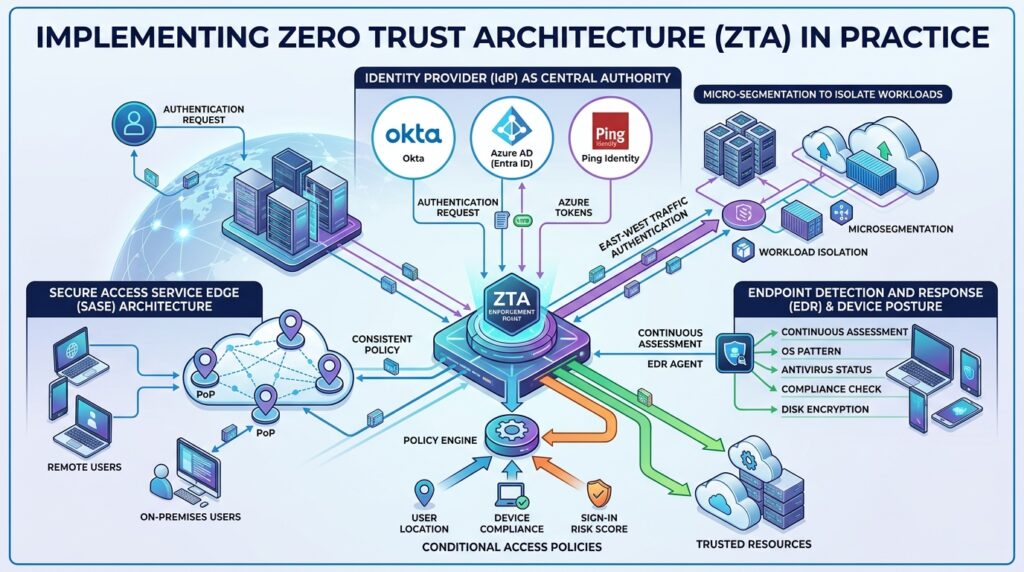
Implementing ZTA in practice:
- Deploy an Identity Provider (IdP) such as Okta, Azure AD (Entra ID), or Ping Identity as the central authentication authority.
- Implement micro-segmentation to isolate workloads — even east-west traffic within your data center should be authenticated and authorized.
- Use a Secure Access Service Edge (SASE) architecture to enforce consistent policy for both on-premises and remote users.
- Deploy Endpoint Detection and Response (EDR) to continuously assess device health and posture before granting access.
- Apply Conditional Access policies that evaluate risk signals (user location, device compliance, sign-in risk score) before granting access to resources.
Firewall configuration best practices (aligned with NIST SP 800-41 Rev. 1):
- Configure stateful inspection on all firewalls — stateful inspection tracks the state of network connections and makes access decisions based on context, not just packet headers.
- Apply an implicit deny-all default rule, then explicitly permit required traffic.
- Review and prune firewall rules at least quarterly — unused rules are a common source of unintended access.
- Log all firewall events and integrate logs into your SIEM.
- Implement Web Application Firewalls (WAF) for all internet-facing web applications.
- Segment networks using VLANs or software-defined networking (SDN) to limit lateral movement.
DETECT: Continuous Monitoring and Anomaly Detection
Security Information and Event Management (SIEM)
A SIEM platform aggregates logs from across your environment — firewalls, endpoints, identity systems, cloud services — and applies correlation rules and analytics to identify security events. Key SIEM capabilities to implement:
- Log collection: Ensure all critical systems are sending logs. Common gaps include cloud workloads, SaaS applications, and OT/IoT devices.
- Use case coverage: Build detection rules for the MITRE ATT&CK framework’s most common techniques — credential dumping, lateral movement, data exfiltration, and command-and-control communication.
- Baseline behavioral analytics: Use User and Entity Behavior Analytics (UEBA) to establish normal behavior patterns and alert on deviations. For example, a user who normally works 9–5 in New York suddenly logging in at 3 AM from Eastern Europe is a high-confidence anomaly.
- Mean Time to Detect (MTTD): Industry benchmark is under 24 hours for high-severity events. According to IBM’s 2024 report, the average organization takes 194 days to identify a breach — a massive gap that SIEM tuning directly addresses.
NIST SP 800-137 (Information Security Continuous Monitoring) recommends establishing a Continuous Monitoring Strategy that defines:
- What metrics to monitor (security controls, vulnerabilities, events)
- At what frequency (real-time, daily, weekly, monthly)
- Who is responsible for responding to findings
Real-Time Threat Detection Comparison
| Capability | Traditional Monitoring | Modern Real-Time Detection |
|---|---|---|
| Response Time | Hours to days | Seconds to minutes |
| Data Analysis | Static log reviews | Dynamic behavioral analysis |
| Threat Coverage | Known signatures only | Known + unknown (anomaly-based) |
| Automation | Manual correlation | Automated SOAR playbooks |
| False Positive Rate | High | Reduced via ML tuning |
| Primary Goal | Compliance reporting | Active threat mitigation |
Vulnerability Scanning
- Run authenticated vulnerability scans against all assets at least weekly using tools like Tenable Nessus, Qualys, or Rapid7 InsightVM.
- Track remediation progress in a vulnerability management platform and measure against SLA targets by severity level.
- Subscribe to threat intelligence feeds (CISA Known Exploited Vulnerabilities catalog, vendor advisories) to prioritize vulnerabilities that are actively being exploited in the wild.
RESPOND: Incident Response Planning
An effective incident response capability is the difference between a contained, recoverable incident and a catastrophic breach. NIST SP 800-61 Rev. 3 (Computer Security Incident Handling Guide) defines the incident response lifecycle.
Creating a Comprehensive Incident Response Plan (IRP)
Your IRP must address the following phases:
1. Preparation
- Define and document the Incident Response Team (IRT) with primary and backup contacts.
- Establish out-of-band communication channels (if email and Slack are compromised, how do you communicate?).
- Pre-authorize legal counsel, forensics retainers, and breach notification vendors.
- Conduct tabletop exercises at least twice per year. Simulate realistic scenarios: ransomware, insider threat, cloud account compromise.
2. Detection and Analysis
- Define what constitutes a “security incident” vs. a “security event” for your organization.
- Establish incident severity tiers (P1 through P4) with defined escalation paths and response SLAs.
- Document indicators of compromise (IOCs) and tactics, techniques, and procedures (TTPs) from threat intelligence.
3. Containment
- Short-term containment: isolate affected systems without destroying forensic evidence. This may mean network isolation rather than shutting down compromised hosts.
- Long-term containment: apply patches, reset credentials, and implement additional controls while maintaining business operations.
- Preserve forensic evidence following chain-of-custody procedures — critical if law enforcement involvement is anticipated.
4. Eradication
- Identify the root cause and all affected systems.
- Remove malware, close attack vectors, and apply patches.
- Conduct threat hunting to confirm the attacker has been fully evicted.
5. Post-Incident Activity
- Complete a written lessons-learned report within two weeks of incident closure.
- Update detection rules, playbooks, and security controls based on findings.
- Review whether breach notification obligations apply (GDPR 72-hour requirement, SEC four-day disclosure, HIPAA 60-day notification, etc.).
Incident response phase summary:
| Phase | Objective | Key Actions | Success Metric |
|---|---|---|---|
| Preparation | Readiness | Training, tooling, retainers | Tabletop score, plan completeness |
| Detection | Identification | Monitoring, alerts, triage | MTTD < 24 hours |
| Containment | Limitation | Isolate systems, preserve evidence | Lateral spread prevented |
| Eradication | Removal | Remove malware, patch, reset | Root cause confirmed |
| Recovery | Restoration | Restore from clean backups | RTO/RPO met |
| Post-Incident | Learning | Lessons learned, control updates | Report completed < 14 days |
RECOVER: Disaster Recovery and Resilience
Recovery planning ensures your organization can restore operations quickly following an incident. NIST SP 800-34 Rev. 1 (Contingency Planning Guide) provides the foundational framework.
Key Recovery Metrics
Define and test these metrics for each critical system:
- Recovery Time Objective (RTO): Maximum acceptable downtime. Example: “Our payment processing system must be restored within 4 hours of an outage.”
- Recovery Point Objective (RPO): Maximum acceptable data loss measured in time. Example: “We can tolerate losing no more than 1 hour of transaction data.”
Backup Strategy: The 3-2-1-1-0 Rule
The traditional 3-2-1 backup rule (3 copies, 2 different media, 1 offsite) has been extended to 3-2-1-1-0 to address ransomware threats:
- 3 copies of data
- 2 different storage media types
- 1 copy offsite
- 1 copy offline (air-gapped), which ransomware cannot encrypt
- 0 backup errors — all backups must be verified and tested regularly
Ransomware reality: Most ransomware attacks now specifically target backup systems before encrypting production data. Offline, immutable backups are the single most effective technical control against ransomware recovery failure.
Testing Your Recovery
A backup that has never been tested is not a backup — it is a hope. Testing requirements:
- Restore individual files monthly to confirm backup integrity.
- Conduct full system restoration tests at least annually for all Tier-1 critical systems.
- Test multi-site failover if you operate a hot/warm standby site.
- Document actual RTO and RPO achieved during tests and compare against targets.
NIST Password Security Guidelines (SP 800-63B)
NIST SP 800-63B: Digital Identity Guidelines is the most authoritative source for modern password policy. The 2024 draft update (SP 800-63B-4) reinforces and expands prior guidance.

What NIST Currently Recommends
On password length and complexity:
- Minimum of 8 characters for standard user accounts.
- Minimum of 15 characters for privileged (admin) accounts.
- Allow all printable ASCII characters and Unicode — including spaces.
- Do not require or enforce complexity rules (mandatory special characters, numbers, mixed case) as research shows these lead to predictable substitution patterns (e.g., “P@ssw0rd”).
- Encourage passphrases: longer sequences of random words (e.g., “correct-horse-battery-staple”) are both more secure and more memorable.
On password rotation:
- Do not enforce periodic password changes (e.g., every 90 days) unless there is a confirmed compromise. Research demonstrates that forced rotation leads to weak, incremental password changes (e.g., “Password1” → “Password2”).
- Do force immediate password changes when: the password appears in a known data breach corpus, phishing is suspected, or account compromise is confirmed.
- Check new passwords against known compromised password lists such as the Have I Been Pwned (HIBP) database at time of creation and periodically thereafter.
On password storage:
- Never store passwords in plain text.
- Never use weak or fast hashing algorithms (MD5, SHA-1, unsalted SHA-256) — these are trivially crackable with GPU-based rainbow table attacks.
- Use memory-hard hashing algorithms: bcrypt, scrypt, Argon2id (NIST-recommended per SP 800-63B-4), or PBKDF2 with at least 600,000 iterations for HMAC-SHA256.
- Always use a unique, random salt per password.
Updated policy comparison:
| Policy Area | Legacy Approach | NIST SP 800-63B Approach |
|---|---|---|
| Password Length | 8 characters with complexity rules | 8+ for users; 15+ for privileged accounts |
| Complexity Requirements | Mandatory special chars, numbers, mixed case | Not required; focus on length and entropy |
| Password Rotation | Every 30–90 days | Only upon confirmed or suspected compromise |
| Breach Checking | Rarely implemented | Required — check against breached password lists |
| Storage Algorithm | MD5, SHA-1, unsalted hashes | Argon2id, bcrypt, scrypt with unique salt |
| MFA | Optional | Required for all privileged and sensitive accounts |
Secure Coding Standards: NIST SSDF (SP 800-218)
The Secure Software Development Framework (SSDF), published as NIST SP 800-218, provides a comprehensive set of practices for integrating security into the software development lifecycle. It was elevated to prominence by the White House Executive Order on Improving the Nation’s Cybersecurity (EO 14028) in 2021, which mandated SSDF adoption for software sold to the federal government.
SSDF Practice Groups
PO — Prepare the Organization
- Define security requirements for all software projects before development begins.
- Establish and maintain a secure development environment with access controls, audit logging, and integrity checking on build pipelines.
PS — Protect the Software
- Protect all code throughout the development lifecycle using version control (Git), branch protection rules, and signed commits.
- Implement supply chain security — verify the integrity of all third-party libraries and dependencies.
- Generate and maintain a Software Bill of Materials (SBOM) for all software products. An SBOM is a machine-readable inventory of all components, libraries, and dependencies in a software product, enabling rapid response when a vulnerability is discovered in a dependency (e.g., Log4Shell, XZ Utils).
PW — Produce Well-Secured Software
- Implement automated security testing in CI/CD pipelines:
| Tool Type | What It Tests | When to Run | Example Tools |
|---|---|---|---|
| SAST | Source code for vulnerabilities | Every commit/pull request | SonarQube, Semgrep, Checkmarx |
| DAST | Running application behavior | Pre-production / staging | OWASP ZAP, Burp Suite Enterprise |
| IAST | Hybrid — instruments running code | QA testing phase | Contrast Security, Seeker |
| SCA | Open-source dependency vulnerabilities | Every build | Snyk, OWASP Dependency-Check, Black Duck |
| Container scanning | Docker images and Kubernetes configs | Build / registry push | Trivy, Grype, Prisma Cloud |
| Secret scanning | Hardcoded credentials in code | Every commit | GitGuardian, Trufflehog, GitHub Advanced Security |
- Address OWASP Top 10 (2025) vulnerabilities as baseline requirements:The OWASP Top 10 for 2025 highlights a shift toward ecosystem-wide risks, focusing on software supply chain integrity, cloud-native misconfigurations, and systemic resilience. Addressing these issues as fundamental requirements ensures that applications are secure by design, not just in their code, but throughout their entire lifecycle.TOP 10 for 2025:
- A01:2025 – Broken Access Control
- A02:2025 – Security Misconfiguration
- A03:2025 – Software Supply Chain Failures
- A04:2025 – Cryptographic Failures
- A05:2025 – Injection
- A06:2025 – Insecure Design
- A07:2025 – Authentication Failures
- A08:2025 – Software and Data Integrity Failures
- A09:2025 – Security Logging and Monitoring Failures
- A10:2025 – Mishandling of Exceptional Conditions
RV — Respond to Vulnerabilities
- Establish a Vulnerability Disclosure Policy (VDP) and, ideally, a public bug bounty program.
- Track and remediate vulnerabilities in a documented process with SLA targets by severity.
- Distribute patches quickly and communicate transparently with users when security updates are required.
Data Encryption: NIST Standards for Data at Rest and in Transit
Encryption at Rest
FIPS 197 (AES) defines the standard for symmetric encryption. All sensitive data stored on servers, databases, hard drives, and cloud storage should be encrypted using:
- AES-256 for highest sensitivity (PII, PHI, financial data, credentials)
- AES-128 for standard sensitivity — still computationally infeasible to break by brute force
Encryption at rest should be implemented at multiple layers for defense-in-depth:
- Full-disk encryption (BitLocker, FileVault, dm-crypt) for all endpoints and servers
- Database encryption using Transparent Data Encryption (TDE) in SQL Server, Oracle, or MySQL
- Field-level encryption for the most sensitive individual fields (SSNs, credit card numbers, passwords)
- Cloud storage encryption with customer-managed keys (CMK) using AWS KMS, Azure Key Vault, or Google Cloud KMS
Encryption in Transit
NIST SP 800-52 Rev. 2 governs TLS usage for federal systems and provides best practices for all organizations:
- Use TLS 1.3 for all new implementations — TLS 1.3 eliminates a number of weak cipher suites and reduces handshake latency.
- Maintain TLS 1.2 support only for legacy compatibility where necessary; disable all TLS 1.0 and 1.1 (deprecated, vulnerable to BEAST, POODLE).
- Disable SSL 3.0 entirely — it has been completely broken since the POODLE attack in 2014.
- Enforce HSTS (HTTP Strict Transport Security) on all web applications with a minimum max-age of one year.
- Implement certificate pinning for mobile applications and APIs where the certificate authority is known.
- Use end-to-end encryption for internal messaging and file transfer — assume your internal network can be compromised.
Cryptographic Key Management
Per NIST SP 800-57, cryptographic keys must be managed through their entire lifecycle:
| Key Lifecycle Phase | Required Controls |
|---|---|
| Key Generation | Use a FIPS 140-3 validated random number generator; generate keys in a secure environment |
| Key Distribution | Never transmit keys in plaintext; use key wrapping or key exchange protocols |
| Key Storage | Use Hardware Security Modules (HSM) or cloud KMS with access logging |
| Key Rotation | Rotate annually for standard use, quarterly for high-value data |
| Key Revocation | Immediately revoke and replace keys upon suspected compromise |
| Key Destruction | Cryptographically shred (overwrite) keys using NIST SP 800-88 media sanitization guidelines |
Common mistake: Many organizations encrypt data correctly but store the encryption keys on the same server as the encrypted data. If an attacker compromises the server, they have both the ciphertext and the keys. Always store keys in a separate, access-controlled system.
NIST vs ISO 27001: Key Differences
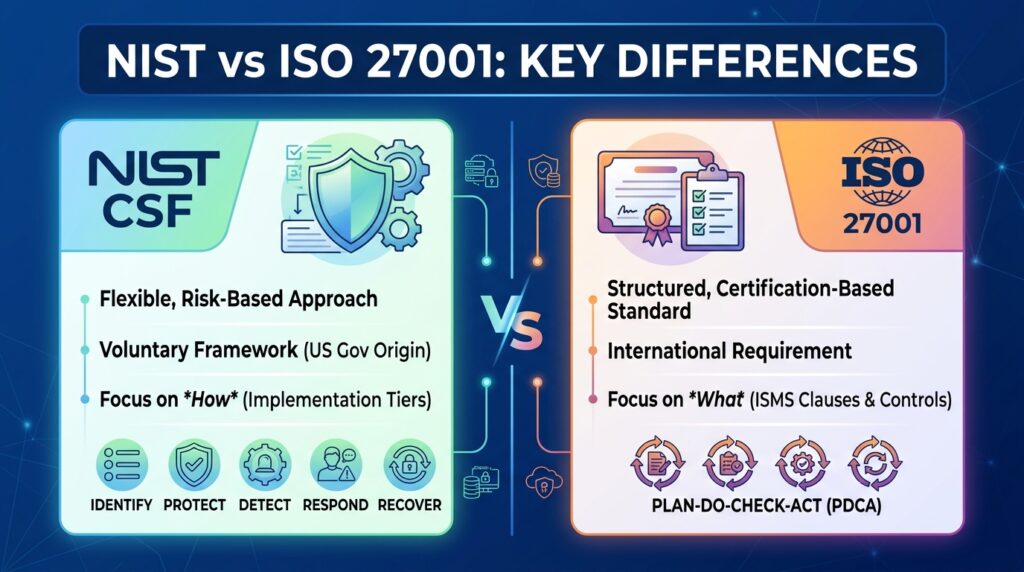
This comparison is one of the highest-volume search queries in the cybersecurity compliance space. Understanding the differences helps organizations decide which framework — or which combination — is right for their situation.
| Dimension | NIST CSF 2.0 | ISO/IEC 27001:2022 |
|---|---|---|
| Origin | U.S. government (NIST) | International (ISO/IEC) |
| Mandatory? | Voluntary (except some U.S. federal contractors) | Voluntary, but certifiable |
| Certification | No formal certification | Yes — third-party audit and certificate |
| Scope | Cybersecurity risk management | Information Security Management System (ISMS) |
| Structure | 6 Functions, Categories, Subcategories | 10 clauses + Annex A controls |
| Flexibility | Highly flexible; outcome-based | More prescriptive; process-based |
| Cost | Free to use | Certification costs $30K–$100K+ |
| Best For | U.S. organizations; risk-based approach | Global organizations; customer-facing certification |
| Overlap | ~80% control overlap with ISO 27001 | ~80% control overlap with NIST CSF |
Recommendation: For U.S.-based organizations with no international sales requirements, NIST CSF 2.0 aligned with NIST SP 800-53 Rev. 5 provides a comprehensive and well-supported framework. For organizations selling to European enterprises, government agencies in multiple countries, or those seeking a demonstrable, auditable certification, pursue ISO 27001 — the frameworks are complementary and many controls satisfy both simultaneously.
“Organizations with global operations or customers in regulated industries often find that NIST CSF alone is not sufficient to satisfy contractual or procurement requirements. In those cases, ISO 27001 certification provides the internationally recognized, auditable credential that NIST lacks — and since both frameworks share approximately 80% of their control objectives, implementing them in parallel is far more efficient than treating them as separate projects. See our complete guide to ISO 27001 compliance and what certification actually requires →“
Security Awareness Training
Technical controls are only as effective as the people operating them. According to Verizon’s 2024 Data Breach Investigations Report, the human element contributes to 68% of breaches. Building a security-aware culture is therefore a critical control, not an afterthought.
Simulated Phishing Programs
A phishing simulation program serves two purposes: it measures your organization’s susceptibility to phishing attacks, and it provides a real-world training moment when users fall for simulated attacks.
Effective phishing simulation program design:
- Run simulations at least monthly using a variety of templates (credential harvesting, malware delivery, BEC/wire fraud scenarios).
- Vary the sophistication level — some campaigns should be obvious, others should closely mimic real threats your industry faces.
- When a user clicks a simulated phishing link, redirect immediately to a brief (5-minute) interactive training module rather than a punitive message.
- Track and trend your click rate over time. A well-run program typically reduces click rates from 20–30% to under 5% within 12 months.
- Include targeted spear-phishing simulations for high-risk roles (executives, finance, HR, IT admins) — these individuals are disproportionately targeted by real attackers.
Security Training Program Requirements (NIST SP 800-50)
- Onboarding training: Security awareness training must be completed before new employees are granted access to systems.
- Annual refresher training: All employees, including executives and board members.
- Role-based training: IT staff, developers, and privileged users require more in-depth technical training commensurate with their access level.
- Just-in-time training: Deliver relevant security content at the moment of risk — for example, when a user is about to click an unusual link or install unauthorized software.
Building a Security Culture
Training programs fail when security is perceived as a burden imposed by IT. Building genuine security culture requires:
- Executive modeling: When the CISO and CEO visibly comply with security policies (including inconvenient ones like hardware token MFA), the rest of the organization follows.
- Positive reinforcement: Reward employees who report phishing or suspicious activity — never punish. Organizations with a blame-free reporting culture detect incidents significantly faster.
- Clear communication: Translate security policies into plain language. Instead of “Do not use unauthorized removable media,” say “Don’t plug personal USB drives into work computers — if you need to transfer a file, use [approved tool].”
- Metrics and transparency: Share security metrics (phishing click rates, patching compliance, incident counts) with the broader organization. Visibility creates accountability.
Implementation Roadmap and Checklist
Use this prioritized checklist to begin or mature your NIST CSF 2.0 implementation:
“For early-stage companies and SaaS startups, the full NIST SP 800-53 control catalog can feel overwhelming as a starting point. SOC 2 compliance offers a more scoped, customer-facing trust framework that maps directly to several NIST CSF functions — particularly PROTECT and DETECT — and is often the first compliance milestone enterprise customers require before signing a contract. Explore the top SOC 2 compliance solutions built for startups →“
Phase 1 — Foundation (Months 1–3)
- Conduct a formal CSF 2.0 gap assessment against your current state
- Complete a full asset inventory (hardware, software, data, cloud)
- Establish a risk register and begin formal risk assessment (SP 800-30)
- Document cybersecurity roles and responsibilities
- Implement MFA for all user accounts (start with privileged, then all users)
- Enable full-disk encryption on all endpoints
- Establish a security awareness training program
Phase 2 — Core Controls (Months 4–6)
- Deploy EDR on all endpoints
- Implement a centralized SIEM with log collection from critical systems
- Deploy a vulnerability management program with weekly scanning
- Document and test your Incident Response Plan
- Implement PAM for all privileged accounts
- Verify backup and recovery processes — run a recovery test
- Conduct your first phishing simulation campaign
Phase 3 — Advanced Maturity (Months 7–12)
- Begin Zero Trust Architecture migration (IdP, conditional access, micro-segmentation)
- Implement SBOM for all internally developed software
- Integrate SAST, DAST, and SCA into all CI/CD pipelines
- Establish a third-party/vendor risk management program
- Implement a formal continuous monitoring strategy (SP 800-137).
- Conduct a full tabletop simulation exercise with executive management.
Phase 4 — Continuous Improvement (ongoing)
- Quarterly firewall rule reviews and access control audits.
- Annual penetration tests performed by a qualified third party.
- Comprehensive annual review and update of all security policies.
- Annual review of vendor risk assessments.
- Quarter-over-quarter tracking and comparison of MTTD and MTTR metrics.
Key findings
- The NIST Cybersecurity Framework 2.0 introduces a sixth function—GOVERN—which elevates cybersecurity to the level of an enterprise risk management responsibility, not just an IT function. Organizations still using Cybersecurity Framework 1.1 should update their assessments.
- Multi-factor authentication (MFA) is essential, but not all MFA is created equal. The NIST SP 800-63B protocol explicitly discourages the use of SMS-based one-time passwords (OTPs). Migrating to FIDO2 or other authentication applications is recommended.
- Zero Trust Architecture (NIST SP 800-207) is the recommended network security model for 2026, replacing perimeter-based trust.
- Password rotation policies should be eliminated unless they are due to a confirmed or suspected breach. Focus on passphrase length, leak list verification, and appropriate storage algorithms.
- Backup immutability (offline or network-isolated copies) is the most important recovery control against ransomware.
- Supply chain risk management, a key focus of CSF 2.0, requires formal security programs for suppliers, not just contractual clauses.
- The SSDF (SP 800-218) and SBOMs are now fundamental requirements for any organization that develops or acquires software.
Conclusion
Cyber resilience is an organizational capability built through deliberate, sustained investment in governance, visibility, and process — not through isolated tool purchases or periodic compliance exercises. NIST CSF 2.0 provides the most comprehensive and well-tested public framework available for building that capability, but only when implemented as a genuine operational commitment rather than a documentation project.
IBM’s 2025 Cost of a Data Breach Report offers a precise measurement of what this commitment returns: organizations using AI and automation extensively reduced their average breach cost by nearly $1.9 million compared to those without these capabilities, and shortened their breach lifecycle by 68 days. The global average cost declined for the first time in five years — not because threats diminished, but because mature detection and containment programs demonstrably work. That financial case should inform every conversation about security investment at the executive and board level.
The organizations that consistently contain breaches faster and at lower cost share measurable characteristics: complete asset visibility so detection tools know what to watch, behavioral monitoring so anomalies surface before damage escalates, tested recovery procedures so restoration is procedural rather than improvised, security integrated into the development pipeline so vulnerabilities are caught before they reach production, and a security culture where every employee understands their role.
The most consequential first step is always the gap assessment: measure your current posture against CSF 2.0’s six functions with honesty, identify the highest-risk gaps, and execute Phase 1. Every phase of the roadmap reduces risk. The framework does the rest.
FAQ
NIST SP 800-63B recommends FIDO2/WebAuthn (passkeys) and hardware tokens as the strongest authenticators (AAL3). Time-based one-time password (TOTP) authenticator apps are acceptable for most enterprise use cases (AAL2). NIST explicitly discourages SMS-based OTP due to SIM-swapping and SS7 vulnerabilities. NIST SP 800-63B recommends a minimum of 8 characters for standard user accounts and 15 or more for privileged accounts. More importantly, NIST recommends against mandatory complexity rules (special characters, mixed case) in favor of longer passphrases. New passwords should be checked against known breached password lists. Zero Trust Architecture (ZTA) is a security model that eliminates implicit trust based on network location. Every access request — whether from inside or outside the network — must be authenticated, authorized, and continuously validated. NIST SP 800-207 defines the ZTA model and implementation guidance. NIST CSF 2.0 is a U.S.-originated voluntary framework focused on cybersecurity risk management. ISO 27001 is an international standard with a formal certification process. NIST is more flexible and outcome-based; ISO 27001 is more prescriptive and requires a third-party audit for certification. Approximately 80% of controls overlap between the two. Organizations with global operations or customer-facing certification requirements often pursue both. A Software Bill of Materials (SBOM) is a machine-readable inventory of all components, libraries, and dependencies in a software product. NIST SP 800-218 (SSDF) requires SBOMs to enable organizations to rapidly identify and respond when a vulnerability is discovered in a dependency. The 2021 White House Executive Order on Cybersecurity mandated SBOMs for software sold to the federal government. NIST recommends AES-256 (FIPS 197) for data at rest and TLS 1.3 (NIST SP 800-52 Rev. 2) for data in transit. Cryptographic keys must be managed through their full lifecycle using an HSM or cloud KMS, and never stored alongside the data they protect. Deprecated protocols (SSL, TLS 1.0/1.1) must be disabled entirely. What MFA methods does NIST recommend in 2026?
What does NIST recommend for password length in 2026?
What is Zero Trust Architecture and which NIST publication covers it?
How does NIST CSF 2.0 differ from ISO 27001?
What is an SBOM and why does NIST require it?
What are the minimum encryption requirements per NIST standards?