Table of Contents
Introduction: Why Most IT Governance Programs Stall — and How to Avoid That Fate
If you have been tasked with leading a COBIT implementation, you already understand the uncomfortable truth most consultancies will not state plainly: the majority of IT governance initiatives fail not because the framework is flawed, but because the implementation gets reduced to a documentation exercise. Boards demand evidence of governance maturity. Regulators in the United States, Canada, and the United Kingdom — from the SEC’s cybersecurity disclosure rules to OSFI’s Guideline B-13 to the FCA’s operational resilience requirements — are tightening expectations around technology risk oversight. And IT leaders are caught between strategic ambition and operational reality.
This guide is built precisely for that gap. It is not an introduction to COBIT — there are plenty of those — but a working roadmap for governance, risk, and compliance professionals who need to translate the ISACA COBIT framework into measurable organizational change. We will walk through the COBIT design and implementation lifecycle phase by phase, examine how COBIT interacts with adjacent frameworks like ITIL, NIST CSF, and ISO/IEC 27001, and surface the operational lessons that typically only emerge after several full deployments.

What COBIT Actually Is — and What It Isn’t
COBIT, maintained by ISACA, is a framework for the governance and management of enterprise information and technology (EGIT). The current iteration, COBIT 2019, builds on COBIT 5 by introducing design factors, focus areas, and a tailored governance system concept that allows the framework to flex to enterprise context rather than imposing a generic template.
One distinction must be internalized up front: COBIT is not a process methodology, a control catalog, or a cybersecurity standard. It is a meta-framework that orchestrates how the enterprise governs technology — sitting above and integrating with operational frameworks rather than replacing them. ITIL describes how to run a service desk; ISO 27001 describes how to certify an information security management system; NIST CSF describes how to organize cyber capabilities. COBIT describes how the board and executive team ensure that all of those capabilities are aligned with enterprise objectives, properly resourced, risk-adjusted, and auditable.
Practitioners who treat COBIT as ITIL with extra paperwork end up with shelfware. Those who treat it as the connective tissue between strategy, risk, compliance, and operational delivery extract real, board-visible value.
Pre-Implementation: The Foundation Most Teams Skip
Before launching any COBIT implementation guide activities, three foundational conditions must be in place. Skipping these is the single most common reason programs collapse around month nine.
1. Securing Genuine Executive Sponsorship
Sponsorship is not a signature on a charter. Genuine sponsorship means a named C-level executive — typically the CIO, CRO, or CFO depending on the driver — who is willing to make trade-off decisions when implementation surfaces uncomfortable findings. In financial services across the U.S., Canada, and U.K., sponsorship often sits jointly with the CISO due to converging cyber and operational resilience mandates.
2. Identifying the Real Drivers (Not the Stated Ones)
The stated driver is usually “we need to improve IT governance.” The real driver is almost always one of: an audit finding, a board-level cyber concern, a failed regulatory examination, an M&A integration, a cloud migration outpacing controls, or a CIO who wants to professionalize a function. Naming the real driver early calibrates scope honestly.
3. Honest Readiness Assessment
A pragmatic capability and culture assessment — not a glossy maturity heat map — should precede any process redesign. If your organization cannot reliably perform basic change management today, no amount of framework adoption will produce overnight maturity.
The Step-by-Step COBIT Design and Implementation Lifecycle
ISACA structures the implementation lifecycle around seven phases, organized in three concentric rings: continual improvement, change enablement, and program management. The phases below follow that official structure, with practitioner commentary added.
Phase 1 — Establish the Drivers (“What Are the Drivers?”)
This phase translates the real organizational pressures identified in pre-work into a formal governance case. Outputs include a stakeholder map, a problem statement, and an articulated value proposition for governance improvement.
Field reality: Expect resistance from middle management who interpret governance as bureaucracy. The case must be framed in their language — fewer surprise audits, clearer escalation, faster investment approvals — not in framework jargon.
Phase 2 — Determine Scope and Goals Cascade (“Where Are We Now?”)
Here you operationalize COBIT 2019’s goals cascade: enterprise goals → alignment goals → governance and management objectives. The cascade is what prevents COBIT from becoming an abstract academic exercise. It also produces the input for the design factors workshop, which tailors the governance system to enterprise size, threat landscape, regulatory profile, and technology adoption strategy.
Common error: Teams skip the design factor analysis and adopt the full set of forty governance and management objectives. This is unworkable. A well-tailored COBIT 2019 implementation typically focuses on a prioritized subset, with the remainder maintained at baseline capability.
Phase 3 — Define the Target State (“Where Do We Want to Be?”)
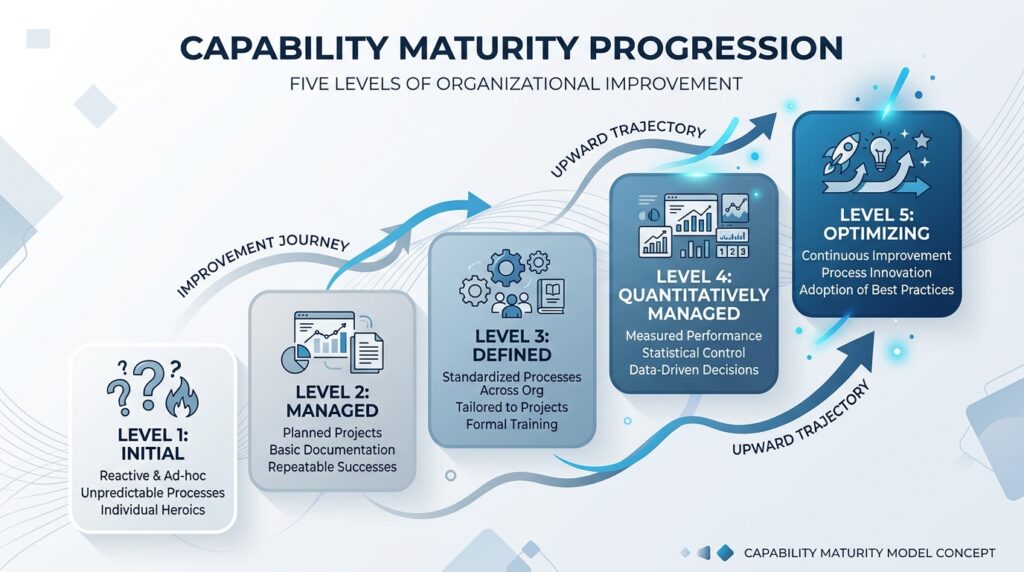
The target state is expressed in capability levels (process capability) and design considerations. Be ruthless about realism. A target capability of Level 4 or 5 across thirty objectives within twelve months is fiction. Level 3 in your highest-priority objectives, Level 2 baseline elsewhere, is a defensible eighteen-to-twenty-four-month plan.
Phase 4 — Build Improvements (“What Needs to Be Done?”)
This is where roadmaps, business cases, and project plans are produced. Treat this phase as portfolio shaping, not a single program. Bundle related improvements — for example, all changes affecting the APO12 Managed Risk and APO13 Managed Security objectives — into coherent workstreams with shared governance.
Phase 5 — Implement Improvements (“How Do We Get There?”)
Execution. This phase is where most programs encounter the gap between policy and practice. Expect process owners to push back when new RACIs reduce their decision rights. Expect tooling integration to consume more time than budgeted. Expect at least one workstream to require descoping.
Phase 6 — Operate and Measure (“Did We Get There?”)
Metrics defined here must be auditable, repeatable, and aligned to the goals cascade established in Phase 2. Vanity metrics — number of policies issued, training completion rates without comprehension testing — undermine credibility with auditors and the board.
Phase 7 — Monitor and Sustain (“How Do We Keep the Momentum Going?”)
The continual improvement ring is what separates a one-off compliance project from a living governance system. Embed COBIT review cadences into existing governance committees rather than creating new ones; new committees are the first casualty of any cost-reduction cycle.
COBIT vs ITIL: Comparative Analysis with Use Cases
A persistent question in U.S., Canadian, and U.K. enterprises — particularly those running mature service management functions — is whether COBIT and ITIL overlap or compete. They do neither. They operate at different altitudes.
| Dimension | COBIT 2019 | ITIL 4 |
|---|---|---|
| Primary purpose | Governance and management of enterprise I&T | IT service management and value co-creation |
| Scope | Enterprise-wide, board to operations | Service lifecycle and value streams |
| Audience | Boards, executives, GRC, internal audit | Service managers, operations, support teams |
| Maintained by | ISACA | PeopleCert (formerly AXELOS) |
| Output orientation | Governance objectives, capability levels, KPIs | Service value chain activities, practices |
| Regulatory linkage | Strong — designed to support audit and compliance | Indirect — supports operational resilience |
| Certification path | COBIT 2019 Foundation, Design and Implementation | ITIL 4 Foundation through Strategic Leader |
| Best suited for | Demonstrating governance maturity to regulators and boards | Improving service quality and operational efficiency |
Use Case 1 — Regulated Financial Services (U.S./Canada/U.K.)
A mid-sized bank facing regulatory examination uses COBIT to demonstrate board-level governance over technology risk, evidence alignment between IT investment and business strategy, and produce the artefacts examiners expect. ITIL simultaneously governs how incidents, changes, and problems are managed day-to-day. Both run; neither replaces the other.
Use Case 2 — Cloud-Native Technology Company
A SaaS firm with a strong DevOps culture adopts ITIL 4 practices selectively — change enablement, service request management, incident management — without full ITIL formality. COBIT is introduced later, often after Series C funding or pre-IPO, to satisfy board-level governance requirements and SOC 2 auditor expectations.
Use Case 3 — Public Sector / Government Agency
In federal U.S. agencies, U.K. central government, and Canadian Crown corporations, COBIT frequently underpins enterprise IT governance reporting, while ITIL underpins shared service delivery. The two are typically paired with NIST CSF or HMG security standards depending on jurisdiction.
COBIT for Information Security: The Cybersecurity Dimension
The COBIT cybersecurity framework integration is one of the most actively used elements of COBIT 2019, particularly through the dedicated Information Security focus area publication.
Why COBIT for Information Security Works
Cybersecurity has historically suffered from being treated as a technical discipline rather than a governance one. Boards approve cyber budgets without a clear line of sight from spend to risk reduction. CISOs report metrics that are operationally meaningful but strategically opaque. COBIT’s goals cascade resolves this disconnect by tying security objectives directly to enterprise objectives and risk appetite statements.
The most relevant governance and management objectives for security practitioners are typically:
- EDM03 — Ensured Risk Optimization, which positions cyber risk as a board-level concern.
- APO12 — Managed Risk, which provides the analytical structure for risk identification and response.
- APO13 — Managed Security, which defines the information security management system at a governance level.
- DSS05 — Managed Security Services, which addresses operational security service delivery.
- MEA03 — Managed Compliance with External Requirements, which is increasingly relevant under SEC, FCA, and OSFI scrutiny.
Implementing the NIST Cybersecurity Framework Using COBIT
For organizations subject to U.S. federal requirements, critical infrastructure designations, or supply chain obligations, implementing the NIST Cybersecurity Framework using COBIT is now a well-established pattern. ISACA has published mapping guidance that aligns the NIST CSF functions — Govern, Identify, Protect, Detect, Respond, Recover — to COBIT governance and management objectives.
The practical approach in most engagements:
- Use NIST CSF as the externally facing structure — it is what regulators, customers, and cyber insurers recognize.
- Use COBIT 2019 as the internal governance and accountability backbone — it is what produces auditable evidence of how cyber outcomes are owned, measured, and improved.
- Map the two frameworks once, maintain the mapping under change control, and use it to avoid duplicate effort during audits.
The introduction of the Govern function in NIST CSF 2.0 narrowed the gap between the two frameworks considerably and makes integrated implementation more straightforward than it was under NIST CSF 1.1.

Difference Between COBIT 5 and COBIT 2019
This is one of the most frequently asked questions during implementation planning, particularly in organizations that adopted COBIT 5 between roughly 2012 and 2018 and are now considering an update.
Structural Evolution
COBIT 5 introduced the integrated EGIT model, the goals cascade, and seven enablers. It had thirty-seven processes organized into governance and management domains. It was prescriptive in its enabler model and offered limited flexibility for enterprise context.
COBIT 2019 retained the foundational concepts but introduced significant evolutions:
- Design factors that explicitly tailor the governance system to enterprise context — risk profile, threat landscape, sourcing strategy, technology adoption, IT implementation methods, and others.
- Focus areas that allow targeted application to specific topics such as information security, DevOps, SMEs, and risk.
- Forty governance and management objectives (replacing thirty-seven processes), with refined definitions and more granular practices.
- Updated capability scheme more aligned with ISO/IEC 33000-series concepts.
- A more open framework model, allowing community contributions and faster updates than the previous edition.
Practical Implications
Migration from COBIT 5 to COBIT 2019 is rarely a re-implementation. It is more accurately a refresh: existing process documentation maps to the new objectives with effort but without wholesale rework. The most valuable element of the upgrade is the design factor methodology, which produces a far more defensible scope than COBIT 5 typically did.
If your organization deployed COBIT 5 well, the migration is incremental. If COBIT 5 was deployed poorly, COBIT 2019 is an opportunity to reset honestly rather than perpetuate flawed scoping.
Difference Between COBIT and ISO 27000
The COBIT versus ISO/IEC 27000-series comparison surfaces in nearly every information security governance program, particularly in U.K. and Canadian enterprises where ISO certification is commonly contractually required.
Different Purposes, Complementary Roles
ISO/IEC 27001 is a certifiable management system standard for information security. It defines requirements for an Information Security Management System (ISMS) and produces an externally recognized certificate when audited by an accredited body. ISO/IEC 27002 provides the associated control guidance.
COBIT is a governance framework, not a certifiable standard. There is no “COBIT certified” enterprise — only certified individuals.
The practical distinction:
- ISO 27001 answers: Do you have a working, audited information security management system?
- COBIT answers: Does the enterprise govern information and technology — including security — in a way that is aligned with strategy, optimizes risk, and demonstrates accountability?
Why Mature Organizations Use Both
In regulated sectors across the U.S., Canada, and U.K., it is common to see:
- ISO 27001 maintained for certification, customer assurance, and supply chain requirements.
- COBIT 2019 used internally for governance maturity, board reporting, and as the integrating layer above ISO 27001, NIST CSF, ITIL, and other operational frameworks.
- COBIT compliance serving as an internal governance posture rather than an external certification claim.
Treating ISO 27001 and COBIT as competing options is a category error. They operate at different layers of the governance stack.
Expert Insights: Lessons That Only Emerge After Several Implementations
These observations come from patterns seen repeatedly in COBIT engagements across financial services, healthcare, public sector, and technology firms.
1. The Goals Cascade Is the Most Underused Asset
Most teams document the goals cascade once, then never reference it again. This is a strategic mistake. The cascade is the most defensible artefact you can take into a board meeting or regulatory examination, because it shows directly how IT activity ladders up to enterprise objectives. Update it annually as part of strategic planning, not as a one-time implementation deliverable.
2. Capability Levels Are Earned, Not Declared
Self-assessed capability levels are worth approximately what self-assessed performance reviews are worth. Independent assessment — internal audit, external advisory, or a structured peer review — produces credible levels. Boards and regulators have learned to discount unvalidated maturity claims.
3. Tooling Should Follow Process Design, Not Drive It
Procurement of GRC platforms before process design is a recurring failure pattern. Tools shape behavior; if they are configured against immature processes, they encode immaturity. Design the governance system first, configure tooling to support it second.
4. The Hardest Conversations Are About Decision Rights
Implementing COBIT properly forces explicit conversations about who decides what — investment prioritization, risk acceptance, exception approval, vendor selection. These conversations are politically charged and frequently avoided. The programs that succeed are the ones where these conversations are surfaced early and chaired by the executive sponsor, not delegated to consultants.
5. Audit Should Be a Partner, Not an Audience
Internal audit teams are often treated as the consumers of governance evidence. The most effective implementations treat audit as a design partner during Phases 2 and 3, ensuring the resulting governance system produces the evidence audit will need to test. This single practice can shorten audit cycles materially.
6. Be Honest About Limitations
COBIT is not a silver bullet. It is heavy on documentation requirements, requires significant process maturity to apply meaningfully, and can become an end in itself if not constantly tied back to enterprise outcomes. A small organization with limited resources may be better served by a lighter-weight approach — perhaps NIST CSF combined with selective ITIL practices — until governance scale becomes warranted.
Common Pitfalls and How to Avoid Them
- Treating COBIT as a project rather than a capability. Budget for sustainment, not just deployment.
- Adopting the full framework without tailoring. Use design factors. Prioritize ruthlessly.
- Confusing policy issuance with governance. A policy that is not measured is decoration.
- Ignoring culture. Frameworks fail in cultures that punish surfacing problems.
- Allowing consultants to own the artefacts. Internal teams must own and maintain the governance system, or it dies at the end of the engagement.
Frequently Asked Questions
1. How long does a typical COBIT implementation take?
For a mid-sized enterprise tailoring COBIT 2019 to a prioritized subset of objectives, the foundational implementation typically spans twelve to twenty-four months from pre-work to operational maturity. Larger, more regulated environments — banks, insurers, federal agencies — often run multi-year programs phased by domain. Anyone promising a six-month enterprise-wide deployment is selling something else.
2. Do we need COBIT if we already have ISO 27001 and ITIL?
Not necessarily, but most organizations eventually adopt some level of COBIT-aligned governance because ISO 27001 covers information security only, and ITIL covers service management only. COBIT addresses the governance layer above both — investment alignment, risk optimization, board accountability — that neither standard fully covers. The decision usually depends on regulatory pressure and board expectations rather than operational need.
3. Is COBIT certification required, and who should pursue it?
There is no enterprise certification for COBIT. Individual certifications — COBIT 2019 Foundation, COBIT 2019 Design and Implementation, and the various focus area badges — are valuable for governance, risk, audit, and senior IT management professionals. They are particularly common credentials in audit firms, GRC consulting, and large enterprise IT functions.
4. How does COBIT support cybersecurity disclosure and operational resilience requirements?
In the U.S., the SEC’s cybersecurity disclosure rules require registrants to describe their cyber risk management, strategy, and governance. In Canada, OSFI’s Guideline B-13 imposes technology and cyber risk management expectations on federally regulated financial institutions. In the U.K., the FCA and PRA operational resilience rules require firms to identify important business services and set impact tolerances. COBIT 2019 produces the governance artefacts — accountability mapping, risk appetite linkage, board reporting structures — that materially simplify compliance with all three regimes.
5. Can a small or mid-sized organization realistically implement COBIT?
Yes, but with calibrated scope. COBIT 2019’s focus areas for SMEs and the design factor methodology specifically allow lightweight tailoring. A small organization should not attempt to implement all forty governance and management objectives. A subset of ten to fifteen, tied to genuine business risk and regulatory exposure, is realistic and defensible. The framework was designed to scale down as well as up — the implementation discipline is what determines success.
Conclusion: Governance as a Living Capability, Not a Document Set
The organizations that get genuine value from a COBIT implementation share a common trait: they treat governance as a living capability rather than a documentation deliverable. They invest in sponsorship, tailor scope honestly, integrate with adjacent frameworks rather than competing with them, and embed review cadences into the operating rhythm of the enterprise.
The regulatory environment across the U.S., Canada, and the U.K. has moved decisively toward expecting demonstrable, auditable IT governance. Boards are no longer satisfied with assurance that “we have policies.” They expect evidence that technology decisions are aligned with strategy, that risk is optimized rather than merely catalogued, and that accountability is unambiguous when something fails.
COBIT, properly implemented, produces that evidence. Improperly implemented, it produces binders. The difference between the two outcomes is almost never the framework itself. It is the rigor, sponsorship, and honesty applied during the implementation lifecycle described in this guide.
If your organization is at the start of that journey, the most valuable next step is not selecting a tool or hiring a consultancy. It is convening the executive sponsor, the CISO, the head of internal audit, and the head of enterprise risk in a single room and answering one question honestly: what is the real driver for this program, and what will good look like in twenty-four months? Everything else flows from that conversation.