If you’ve ever ended your workday wondering why everything took longer than it should have, you’re not alone. Across industries, small and medium-sized businesses are quietly bleeding hours, revenue, and customer loyalty to outdated processes — and most owners don’t notice until the damage is already visible on the balance sheet.
Having spent over a decade advising financial institutions, cooperatives, and growing companies on technology adoption, I’ve seen the same pattern repeat itself: businesses wait until a crisis forces their hand, when in reality the warning signs were there months — sometimes years — earlier. This article walks you through the most reliable indicators that your business needs digital transformation, backed by real operational patterns I’ve observed firsthand, so you can act before a competitor (or a customer complaint) forces the issue.
What “Digital Transformation” Actually Means for Your Business
Before diving into the warning signs, let’s clear up a common misconception. Digital transformation isn’t about buying the newest software or jumping on every tech trend. It’s the strategic integration of digital technology into every area of your business — operations, customer experience, decision-making, and culture — to fundamentally change how you deliver value.
For a small business, this could mean replacing a spreadsheet-based inventory system with cloud-based ERP software, or it could mean something as foundational as moving customer records out of a filing cabinet and into a secure CRM. The scale differs; the principle doesn’t.

1. Your Team Is Drowning in Manual, Repetitive Tasks
If your employees are manually entering the same data into multiple systems, copying information between spreadsheets, or printing documents just to scan them again, you’re looking at the clearest sign of all. Manual processes don’t just waste time — they introduce human error at every touchpoint.
A simple way to evaluate this: track how many hours per week your team spends on tasks that involve re-entering, re-formatting, or re-checking data that already exists somewhere else in your systems. If that number exceeds 5 hours per employee per week, automation should be a priority conversation this quarter, not next year.
2. You Can’t Get Real-Time Visibility Into Your Business
Can you answer, right now, how much inventory you have, what your cash flow looks like, or which products are your best sellers this month? If the honest answer involves “let me check with someone” or “give me until tomorrow,” your business is operating on delayed, fragmented data.
Modern customers and markets move fast. Decisions based on last month’s numbers — or worse, gut feeling — put you at a structural disadvantage against competitors who can pivot in real time.
3. Your Customer Experience Feels Disconnected
Today’s customers expect consistency whether they reach you through your website, social media, phone, or in person. If your sales team doesn’t know what a customer asked your support team last week, or if your online store and physical inventory aren’t synced, customers notice — and they leave.
| Customer Experience Indicator | Traditional Business | Digitally Transformed Business |
|---|---|---|
| Channel consistency | Information siloed by department | Unified customer view across all channels |
| Response time | Hours to days | Minutes, often automated |
| Personalization | Generic, one-size-fits-all | Data-driven, tailored offers |
| Self-service options | Phone or in-person only | Chatbots, portals, FAQs available 24/7 |
| Order/service tracking | Manual follow-up required | Real-time tracking and notifications |
4. Your Technology Stack Is a Patchwork of Disconnected Tools
Many SMEs accumulate software over the years — one tool for invoicing, another for inventory, a separate spreadsheet for HR, and a different app for marketing. None of them talk to each other. This is what I call “digital fragmentation,” and it’s one of the most expensive hidden costs in business today, because every disconnection point requires manual reconciliation.
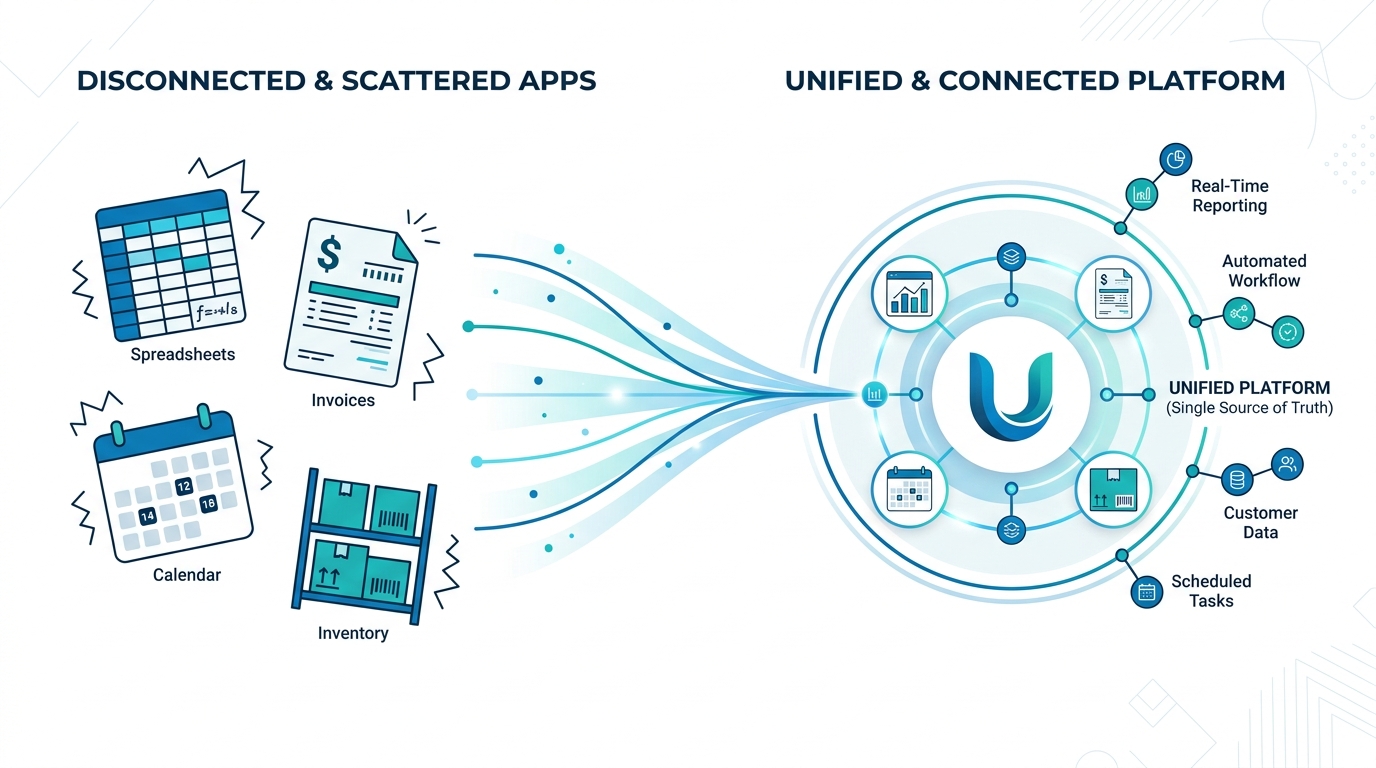
5. Competitors With Smaller Budgets Are Outperforming You
If a smaller competitor is consistently winning customers, ranking higher in search results, or simply appearing more “modern” than your business, it’s rarely because of a bigger budget. More often, it’s because they’ve adopted tools and workflows that let them respond faster, market smarter, and serve customers more efficiently per dollar spent.
6. Your Data Lives in Silos — or Doesn’t Exist at All
A business that can’t easily answer “which marketing channel brought us the most paying customers this quarter?” is flying blind. Data silos — where sales, marketing, finance, and operations each keep separate records that don’t talk to each other — prevent you from seeing the full picture and making informed strategic decisions.
| Sign of Data Silos | Business Impact | Digital Solution |
|---|---|---|
| Sales and finance use separate systems | Delayed, inaccurate revenue reporting | Integrated CRM + accounting platform |
| Marketing can’t see sales conversion data | Wasted ad spend on ineffective channels | Shared analytics dashboard |
| No centralized customer database | Inconsistent service, duplicate outreach | Cloud-based CRM |
| Inventory tracked manually per location | Stockouts or overstock | Real-time inventory management system |
7. Your Cybersecurity Posture Is an Afterthought
Small businesses are increasingly targeted by cybercriminals precisely because they’re assumed to have weaker defenses than large enterprises. If you’re still relying on shared passwords, unencrypted file storage, or no formal backup strategy, you’re carrying a level of risk that digital transformation — done properly — directly addresses through access controls, encryption, and automated backups.
8. You’re Unable to Scale Without Proportionally Scaling Costs
One of the clearest signs your operations need modernization is this: every time revenue grows, your costs grow at almost the same rate, because growth means hiring more people to do the same manual tasks rather than letting technology absorb the additional volume. A well-architected digital infrastructure should let you handle 30% more transactions without needing 30% more staff.
Quick Self-Assessment: How Many Signs Apply to You?
| Sign | Applies to My Business? |
|---|---|
| Manual, repetitive data entry across teams | ☐ |
| No real-time visibility into key metrics | ☐ |
| Disconnected customer experience across channels | ☐ |
| Fragmented, non-integrated software tools | ☐ |
| Smaller competitors outperforming digitally | ☐ |
| Data trapped in silos or spreadsheets | ☐ |
| Weak or informal cybersecurity practices | ☐ |
| Costs scale proportionally with growth | ☐ |
If you checked three or more boxes, digital transformation isn’t a future consideration — it’s an operational priority.
Where to Start
You don’t need to overhaul everything at once. The most successful transformations I’ve guided started with a single, high-impact area: usually customer data centralization or workflow automation, since these tend to produce visible results within the first 90 days and build internal momentum for further change. Start by mapping your current processes, identify the three biggest time-wasters, and evaluate tools that integrate with what you already use rather than replacing everything from scratch.
Digital transformation, when approached deliberately, isn’t about chasing technology trends. It’s about removing the friction that’s quietly limiting how much your business can grow, serve, and earn.