Table of Contents
Choosing between MySQL and PostgreSQL is rarely a purely technical decision. It is a strategic one that affects hiring, licensing exposure, cloud cost structure, application architecture, and—often underestimated—the operational sanity of your engineering team three years from now. If you are evaluating this decision for a new product, a migration, or a platform consolidation, the answer is not “the better database.” The answer is “the database whose trade-offs match your workload, your team’s expertise, and your business risk profile.”
This article is built for engineering leaders, senior backend developers, DBAs, and CTOs who need a substantive, vendor-neutral analysis—not a feature list ranked by GitHub stars.
The Real MySQL or PostgreSQL Question
Before discussing features, frame the decision correctly. The MySQL vs PostgreSQL debate is essentially a choice between two design philosophies:
- MySQL was engineered for read-heavy, web-scale simplicity. Its core promise is predictability, ease of replication, and a forgiving learning curve. It became the backbone of the LAMP stack precisely because it makes the easy things effortless.
- PostgreSQL was engineered as an object-relational system with strict standards compliance. Its core promise is correctness, extensibility, and depth. It rewards teams that want to push the database to do more than store rows.
Picking the wrong one rarely causes immediate failure. It causes friction—slow migrations, unexpected production incidents at 2 a.m., and the kind of architectural debt that takes a quarter to unwind.
Architectural Foundations: The Core MySQL and PostgreSQL Difference
Understanding the MySQL and PostgreSQL difference at the architectural level explains nearly every downstream behavior.
Storage Engine and Process Model
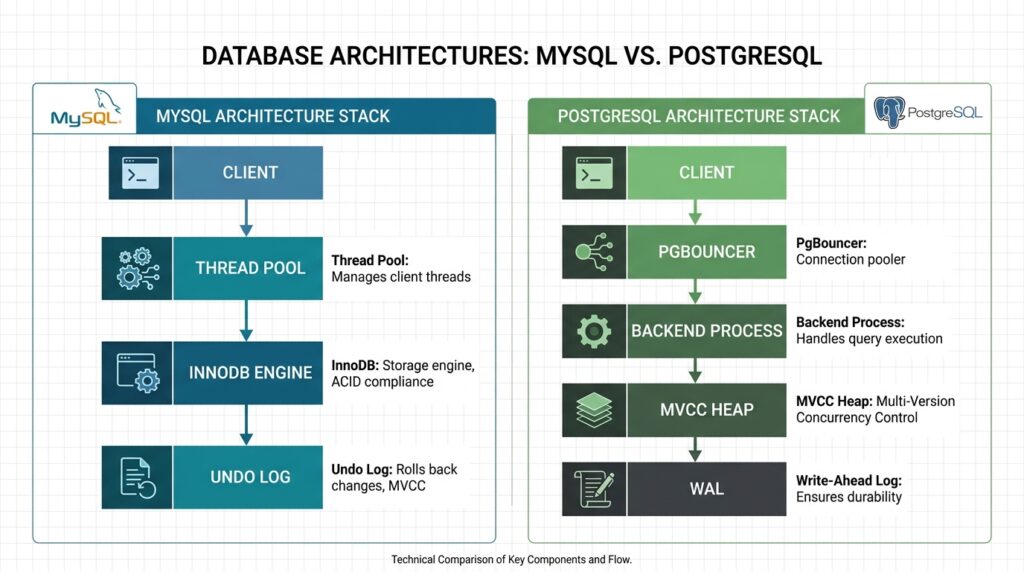
MySQL uses a pluggable storage engine architecture. InnoDB is the modern default and handles ACID transactions, row-level locking, and foreign keys. Other engines (MyISAM, MEMORY, Archive) exist but are largely legacy or specialized. MySQL uses a thread-per-connection model, which makes it relatively cheap to scale to thousands of concurrent connections without external pooling.
PostgreSQL uses a single, unified storage engine built around MVCC (Multi-Version Concurrency Control). It uses a process-per-connection model, where each client connection forks a backend process. This is more memory-intensive per connection, which is why production PostgreSQL deployments almost always sit behind a connection pooler such as PgBouncer or Pgpool-II. Treat this as a non-negotiable operational requirement, not an optional optimization.
A note on scope: this analysis addresses server-side OLTP databases, where concurrency is managed across networked clients and connection pools. Concurrency at the device layer—mobile applications, embedded systems, or local-first architectures—follows entirely different rules, and the candidate set narrows to embedded engines rather than client-server systems. If that is your context, the same evaluation framework applied to embedded databases is covered in SQLite vs ObjectBox: Which one to choose for high-concurrency projects?.
Concurrency and Isolation
Both databases implement MVCC, but with different philosophies:
- PostgreSQL stores multiple row versions in the same table, requiring periodic
VACUUMto reclaim dead tuples. Tuningautovacuumis one of the most consequential operational skills for a PostgreSQL DBA. - InnoDB stores prior row versions in the undo log (rollback segment), which simplifies cleanup but introduces its own contention patterns under heavy long-running transactions.
The default isolation levels also differ. MySQL’s InnoDB defaults to REPEATABLE READ; PostgreSQL defaults to READ COMMITTED. This is not a footnote—it is a frequent source of subtle bugs when teams migrate code between the two without auditing transactional assumptions.
Performance: Looking Past the Benchmarks
Anyone telling you definitively that “X is faster than Y” is selling something. Real-world MySQL vs PostgreSQL performance is workload-dependent.
Where MySQL tends to excel:
- High-volume simple read queries with primary-key lookups
- Workloads dominated by short, transactional OLTP patterns
- Applications with massive numbers of concurrent connections without a pooler
- Read-replica scaling for content-heavy web applications
Where PostgreSQL tends to excel:
- Complex analytical queries with multiple joins, CTEs, and window functions
- Workloads that benefit from advanced indexing (GIN, GiST, BRIN, partial, expression indexes)
- Concurrent write-heavy workloads where MVCC reduces lock contention
- JSON-heavy applications using
jsonbwith GIN indexes
It is also worth noting that MariaDB performance characteristics, while inherited from MySQL, have diverged meaningfully. MariaDB ships its own optimizer enhancements, alternative storage engines (Aria, ColumnStore), and parallel replication implementations. If your evaluation includes the broader MySQL ecosystem, treat MariaDB as a distinct option with its own performance profile rather than a drop-in clone—particularly because some features have diverged at the SQL and replication-protocol level.
A practical lesson from production: benchmarks rarely predict your application’s behavior. Run pgbench and sysbench if you must, but the only benchmark that matters is a replay of your actual query patterns against representative data volumes.
Postgres Data Types vs. MySQL Data Types
One of the most underappreciated factors in the MySQL or PostgreSQL decision is the type system itself. PostgreSQL’s type system is significantly richer, and this richness translates directly into application-level simplicity.
| Category | PostgreSQL | MySQL | Practical Implication |
|---|---|---|---|
| JSON | json, jsonb (binary, indexable) | json (stored as text, limited indexing) | PostgreSQL is the clear choice for JSON-heavy schemas |
| Arrays | Native array types for any base type | Not supported (requires JSON workaround) | Postgres simplifies many-to-one relationships and tagging patterns |
| UUID | Native uuid type | Stored as CHAR(36) or BINARY(16) | Postgres has cleaner ergonomics and indexing |
| Network types | inet, cidr, macaddr | None (use VARCHAR) | Postgres enables direct IP range queries |
| Geometric/Spatial | Built-in geometric types; PostGIS extension | Spatial extensions in InnoDB | PostGIS is the industry standard for geospatial workloads |
| Range types | int4range, tsrange, daterange, etc. | Not supported | Postgres dramatically simplifies booking, scheduling, and pricing systems |
| Enums | Native ENUM type, modifiable | Native ENUM, but altering values is painful | Both supported; Postgres handles evolution better |
| Full-text search | Built-in tsvector/tsquery | FULLTEXT indexes (InnoDB/MyISAM) | Postgres FTS is more flexible; MySQL is simpler to start with |
| Custom types | User-defined types, domains, composites | Limited | Postgres supports true domain modeling at the DB layer |
If your domain involves time ranges, geospatial data, IP networks, or schema-flexible JSON documents, the type system difference alone often justifies PostgreSQL. If your schema is essentially rows of scalar values, the practical advantage shrinks considerably.
Postgres Advantages Over MySQL
PostgreSQL’s strengths are most visible when applications grow in complexity. The postgres advantages over mysql typically compound over time rather than appearing on day one.
| Advantage | What It Means in Production |
|---|---|
| Strict standards compliance | Closer adherence to SQL standards reduces portability surprises and makes ORM-generated SQL more predictable. |
| Transactional DDL | Schema migrations can be wrapped in transactions and rolled back atomically. This single feature has saved more incidents than most teams realize. |
| Advanced indexing | Partial, expression, covering, GIN, GiST, and BRIN indexes enable optimizations that simply do not exist in MySQL. |
Robust JSON (jsonb) | Indexable, queryable, and performant document storage that competes with dedicated document databases. |
| Extensions ecosystem | PostGIS, TimescaleDB, pgvector, pg_partman, and others extend the database into geospatial, time-series, vector search, and partitioning domains. |
| Concurrent index builds | CREATE INDEX CONCURRENTLY allows index creation without blocking writes. |
| Logical replication | Native, granular replication of specific tables or rows since version 10. |
| Foreign data wrappers | Query external data sources (other databases, APIs, files) as if they were local tables. |
| Better complex query optimization | The query planner handles deep joins, subqueries, and CTEs more reliably. |
MySQL Advantages Over Postgres
The mysql advantages over postgres are real and frequently underweighted by teams who default to PostgreSQL out of habit.
| Advantage | What It Means in Production |
|---|---|
| Operational simplicity | Lower learning curve for developers and DBAs. Easier defaults that work well for a high percentage of standard workloads. |
| Connection scalability | The thread-per-connection model handles thousands of concurrent connections without a mandatory connection pooler. |
| Mature replication tooling | Native asynchronous, semi-synchronous, and Group Replication options have been battle-tested at hyperscale for over a decade. |
| Read-heavy performance | Often shows lower latency for simple, indexed lookups under high concurrency. |
| Ecosystem and hosting ubiquity | Every major hosting provider, CMS, and PHP application supports it natively. WordPress, Magento, and most legacy enterprise stacks assume MySQL. |
| Storage engine flexibility | The pluggable engine architecture allows specialized choices (e.g., MyRocks for compression-heavy workloads). |
| Lower memory footprint per connection | Significant in container-dense deployments without pooling infrastructure. |
| Familiarity and hiring pool | A larger pool of developers has shipped production MySQL than production PostgreSQL. This is a real, often decisive, business factor. |
Operational Realities: Replication, HA, and Backups
The mysql vs postgresql evaluation must extend beyond the SQL layer to operational characteristics.
Replication
MySQL’s replication is mature, well-documented, and has many production-tested topologies: asynchronous, semi-synchronous, multi-source, and Group Replication for true multi-primary clusters. The tooling—Orchestrator, ProxySQL, MySQL Router—is battle-tested at scale.
PostgreSQL offers streaming physical replication (byte-level WAL shipping) and logical replication (row-level changes by table). High-availability tooling such as Patroni, repmgr, and pg_auto_failover is excellent but generally requires more deliberate orchestration than the MySQL equivalents.
Backups and Point-in-Time Recovery
Both support PITR. PostgreSQL relies on pg_basebackup and WAL archiving, often coordinated through tools like pgBackRest or WAL-G. MySQL relies on mysqldump, Percona XtraBackup, or binary log replay. There is no clear winner here—the tools are mature on both sides—but the ergonomics differ enough that team familiarity should weigh in your decision.
Schema Migrations
This is where lived experience diverges sharply from documentation:
- PostgreSQL’s transactional DDL is a quiet superpower. Wrapping a multi-statement migration in
BEGIN/COMMITmeans a failure leaves the schema untouched. Teams operating PostgreSQL rarely appreciate this until they manage MySQL. - MySQL 8.0 introduced instant DDL for many
ALTER TABLEoperations, which is genuinely transformative compared to older versions. For older MySQL deployments or operations that still require copying the table, tools such as pt-online-schema-change or gh-ost remain essential.

Managed Services: Where the Cloud Reshapes the Decision
For most modern businesses, the question is not “MySQL or PostgreSQL on bare metal” but “which managed service should we run?”
Managed Postgres options include Amazon RDS for PostgreSQL, Amazon Aurora PostgreSQL, Google Cloud SQL for PostgreSQL, Azure Database for PostgreSQL Flexible Server, Crunchy Bridge, and Neon. Each has different trade-offs around extension support, version cadence, replica behavior, and pricing models.
For MySQL, the equivalents are Amazon RDS for MySQL, Amazon Aurora MySQL, Google Cloud SQL for MySQL, Azure Database for MySQL Flexible Server, and PlanetScale (which uses Vitess for horizontal sharding).
A practical observation: Aurora’s storage layer significantly changes the performance profile of both engines compared to vanilla deployments. Benchmarks against community editions are not transferable to Aurora, and vice versa. Validate against the exact platform you intend to run.
When evaluating a managed postgres offering, scrutinize:
- Which extensions are supported (
pg_stat_statements, PostGIS,pg_cron,pgvector) - Major version upgrade strategy and downtime characteristics
- Logical replication permissions for ETL and CDC pipelines
- Connection pooling—native or BYO PgBouncer
- IOPS, storage scaling, and read replica lag SLAs
MySQL and PostgreSQL Performance Monitoring Tools
You cannot operate either database competently without observability. The category of mysql and postgresql performance monitoring tools has matured significantly, and the choice of tooling often matters as much as the database itself.
Cross-platform commercial and open-source options:
- Datadog Database Monitoring — broad platform, strong query-level visibility for both engines
- Percona Monitoring and Management (PMM) — open source, deep MySQL roots, with mature PostgreSQL support
- SolarWinds Database Performance Analyzer (DPA) — wait-time analysis methodology, well-regarded in enterprise contexts
- Prometheus with
mysqld_exporterorpostgres_exporter— open-source, integrates with existing observability stacks
PostgreSQL-specific:
pg_stat_statements(the foundation; enable it on day one)pgBadgerfor log analysispganalyzeand EDB Postgres Enterprise Manager for higher-level insights
MySQL-specific:
Performance Schemaandsysschema (built-in, often underused)- MySQL Enterprise Monitor
- Percona Toolkit (
pt-query-digestis a staple)
The most common operational mistake is treating monitoring as a post-incident concern. Slow query logs, query digests, and wait-event analysis should be in place before the application goes to production—not after the first incident report.
Insights From the Field
A short list of lessons that experienced practitioners tend to share, often quietly:
- The “best database” debate is usually a proxy for a team capability debate. A team with deep PostgreSQL operational experience will run PostgreSQL better than MySQL, and vice versa. Honest self-assessment of in-house expertise is more predictive of success than feature comparisons.
- PostgreSQL’s flexibility is a double-edged sword. The same extensibility that allows PostGIS, TimescaleDB, and pgvector also encourages teams to push too much business logic into the database. Stored procedures and complex triggers can become operational burdens that outlive the engineers who wrote them.
- MySQL’s defaults are friendlier to inexperienced operators. This is genuinely valuable for early-stage teams. PostgreSQL’s defaults assume a more sophisticated operator and frequently require tuning (
shared_buffers,work_mem,effective_cache_size, autovacuum) before production-grade performance emerges. - Migration cost is asymmetric and underestimated. Migrating from MySQL to PostgreSQL is often easier than the reverse, because PostgreSQL’s stricter type system and standards compliance act as a superset. Teams routinely budget weeks for what becomes a multi-quarter project—particularly when ORMs, stored procedures, and CDC pipelines are involved.
- Connection management is the silent killer of PostgreSQL deployments. Production PostgreSQL without PgBouncer is a question of when, not if, the connection storm will arrive. Build it into the architecture from the beginning.
- Long-running transactions are the silent killer of both. In PostgreSQL, they prevent
VACUUMfrom reclaiming bloat. In MySQL, they grow the undo log and degrade purge performance. Application-level discipline around transaction scope matters more than database tuning. - “Postgres for new systems, MySQL for compatibility” is a defensible default. Greenfield applications usually benefit from PostgreSQL’s correctness and feature depth. Legacy ecosystems—WordPress, Magento, older enterprise platforms—are MySQL-native and fighting that grain rarely pays off.
FAQ
Is PostgreSQL always the better choice for new business applications?
No. For applications with simple schemas, predictable read-heavy patterns, or strong dependencies on the LAMP/PHP ecosystem, MySQL remains a defensible and often superior choice. The “PostgreSQL by default” guidance applies most strongly to applications with complex domain models, JSON-heavy schemas, geospatial requirements, or analytical query patterns. For straightforward CRUD applications, either choice is professionally sound.
Can MySQL handle complex analytical queries like PostgreSQL?
It can, but with caveats. MySQL 8.0 introduced window functions, CTEs, and a substantially improved optimizer, closing much of the historical gap. However, PostgreSQL still tends to handle deeply nested queries, complex joins, and large CTEs more efficiently because of its more mature query planner and richer indexing options. For genuinely analytical workloads, neither is the right answer—columnar systems such as ClickHouse, Snowflake, BigQuery, or Redshift will outperform either OLTP database by orders of magnitude.
How much does the choice of managed Postgres or managed MySQL service affect the comparison?
Significantly. A managed service abstracts away much of the operational complexity that traditionally favored MySQL (replication, failover, backups). Once both run on equally mature managed platforms, the decision shifts back toward feature fit—data types, query complexity, and ecosystem alignment. That said, not all managed services are equal. Aurora reshapes performance characteristics. Some managed PostgreSQL services restrict extensions or replication permissions. Validate the specific platform, not the engine in the abstract.
Conclusion
The MySQL vs PostgreSQL decision is not a contest of which database is objectively superior. Both are mature, production-grade systems supporting some of the largest applications on the internet. The right framing is:
- Choose PostgreSQL when your domain is complex, your schema benefits from rich types and extensions, your team has the operational maturity to manage MVCC and connection pooling, and correctness matters more than convenience.
- Choose MySQL when operational simplicity, connection scalability without pooling, ecosystem compatibility, and team familiarity outweigh the appeal of advanced features.
The most expensive mistake is not choosing the “wrong” database. It is choosing a database your team cannot operate confidently. Audit your in-house expertise, your application’s actual query patterns, your hosting strategy, and your three-year roadmap. The decision will largely make itself.
For verifiable performance characteristics, consult the official documentation at postgresql.org/docs and dev.mysql.com/doc, independent benchmarks from organizations such as the Transaction Processing Performance Council (TPC), and engineering blog posts from companies operating these systems at scale. Treat marketing benchmarks—from any vendor—with appropriate skepticism.