Table of Contents
Introduction
Choosing the wrong framework for an enterprise project doesn’t just slow down development — it cascades into architectural debt, hiring bottlenecks, and migration costs that surface years later. If you are a tech lead, solutions architect, or CTO weighing Angular, React, or Vue for a long-lived business application, you have probably noticed that most online comparisons stop at superficial benchmarks or popularity polls. They rarely address what actually matters when you are shipping software that will be maintained by dozens of engineers across multiple time zones for the next decade.
This article cuts through the noise. It is a structured technical analysis grounded in real-world enterprise constraints: governance, scalability, hiring market dynamics, ecosystem maturity, and total cost of ownership. By the end, you will have a defensible decision framework rather than a vague “it depends.”
What “Enterprise-Scale” Really Means
Before evaluating frameworks, it is worth defining the term. An enterprise-scale application is not merely a “big” app. It typically exhibits:
- Long lifecycles of five to fifteen years, often outliving the original engineering team.
- Multi-team ownership that demands strict module boundaries.
- Regulatory and compliance requirements such as SOC 2, HIPAA, GDPR, and ISO 27001.
- Integration complexity with ERPs, identity providers, message brokers, and legacy systems.
- Internationalization, accessibility (WCAG 2.2), and observability as non-negotiable baselines.
These constraints reshape what “best framework” actually means. Developer ergonomics matter, but so do upgrade predictability, security patching cadence, and the availability of senior engineers who can be hired in twelve months.
The Angular Framework
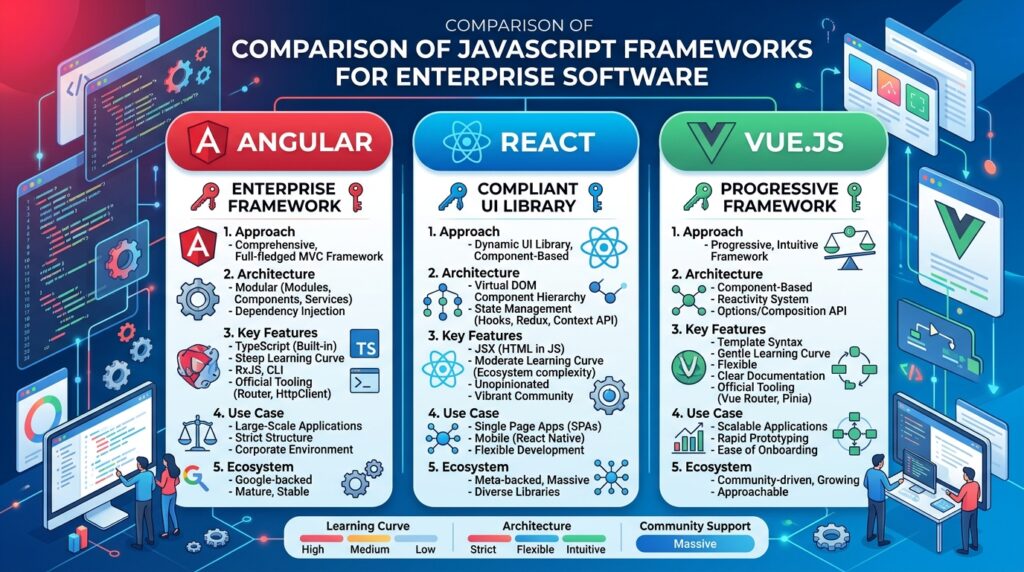
Angular is a TypeScript-first, opinionated framework maintained by Google. Unlike its competitors, it ships as a complete platform: routing, forms, HTTP client, dependency injection, testing utilities, and a CLI are all first-party.
Architectural Strengths
- Hierarchical Dependency Injection (DI) enforces clear separation of concerns and testability, mirroring patterns familiar to backend engineers from Spring or .NET.
- RxJS is deeply integrated, which makes streaming-heavy domains — financial dashboards, IoT telemetry, real-time logistics — more tractable.
- Strict TypeScript is the default rather than a bolt-on. Compile-time guarantees pay measurable dividends in large codebases.
- The Standalone Components API and Signals, introduced in recent versions, modernize the framework while preserving its enterprise-grade structure.
Where it Shines for Business Applications
A typical angular application that benefits from this stack is a complex line-of-business tool: insurance claim platforms, banking back-offices, healthcare records, or government portals. The framework’s prescriptive nature reduces architectural drift across teams — an underrated property when you are onboarding contractors every quarter.
Honest Limitations
- Steep learning curve, particularly for RxJS and DI patterns.
- Heavier bundle baseline compared to Vue or a minimal React setup, though tree-shaking and deferred loading mitigate this in practice.
- Major version upgrades, while smoother than they used to be, still require deliberate planning and regression testing.
The React Framework
React, maintained by Meta, is technically a library rather than a framework. It focuses on the view layer and leaves routing, state management, and data fetching to the broader ecosystem — or to meta-frameworks like Next.js and Remix.
Architectural Strengths
- Component model with hooks is conceptually simple and composable.
- A massive ecosystem: TanStack Query, Redux Toolkit, Zustand, Jotai, React Hook Form, and others cover virtually every concern an enterprise team will encounter.
- React Server Components and streaming SSR — primarily through Next.js — unlock performance patterns that are difficult to replicate in Angular or Vue at the same maturity level.
- Concurrent rendering improves perceived performance for data-heavy interfaces.
Where it Shines for Business Applications
A modern react application is a strong fit when product velocity, content-driven SEO, and design-system flexibility take priority — think B2B SaaS dashboards, customer-facing portals, marketing surfaces with authenticated areas, and headless-CMS-driven products. The hiring pool is also the largest of the three, which materially affects staffing risk in enterprise contexts.
Honest Limitations
- Decision fatigue: every team must independently choose a router, a data layer, a form library, and a styling approach. Without strong governance, this becomes architectural entropy across a large organization.
- Frequent ecosystem churn: libraries fall out of favor faster than enterprise procurement cycles can keep up with.
- TypeScript support is excellent but optional, which produces uneven code quality across teams.
The Vue Framework
Vue, created by Evan You and now maintained by an independent core team, occupies a middle ground. It is more opinionated than React but lighter than Angular, with a famously approachable learning curve.
Architectural Strengths
- Composition API offers React-like flexibility with stricter conventions.
- Single-File Components (.vue) colocate template, logic, and styles in a way that many teams find more maintainable than JSX.
- Pinia for state and Vue Router are first-party and well-integrated, eliminating the bikeshedding that often plagues React adoption.
- Nuxt provides SSR, SSG, and hybrid rendering with strong defaults.
Where it Shines for Business Applications
A vue application tends to excel in mid-sized enterprise contexts: internal tools, admin panels, e-commerce frontends, and progressive enhancements of legacy systems. Vue’s gentle ramp-up makes it especially valuable when teams include developers from non-JavaScript backgrounds — Python, PHP, Java — who must contribute to the frontend without months of onboarding.
Honest Limitations
- Smaller corporate backing than Angular (Google) or React (Meta), which some procurement and risk teams treat as a yellow flag.
- Hiring pool is shallower in many regions, particularly for senior engineers.
- The Vue 2 to Vue 3 migration left a trust scar in parts of the community, even though Vue 3 is now mature and stable.
From AngularJS to Angular: The Migration Lesson Every Architect Should Internalize
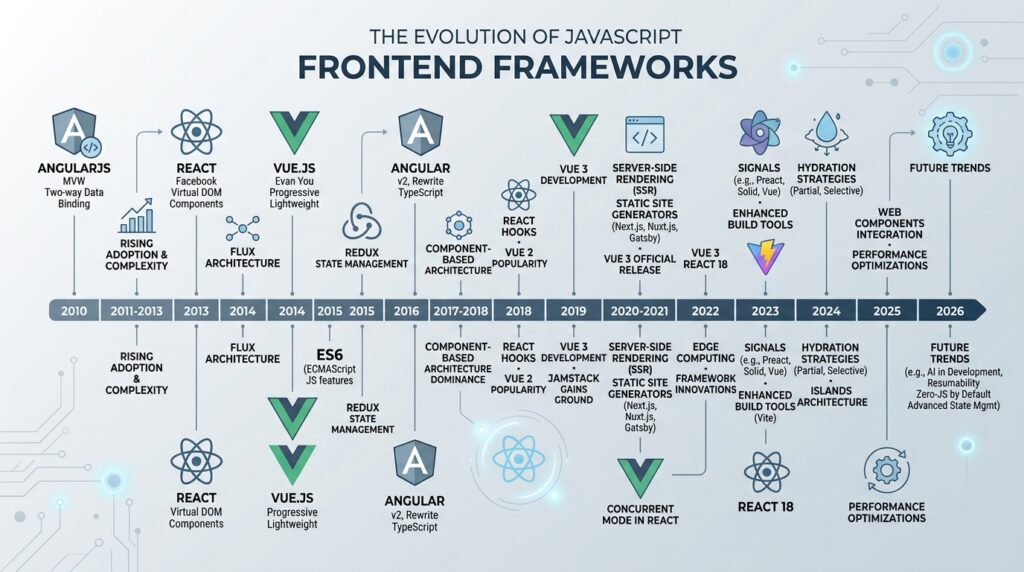
The transition from AngularJS (1.x) to Angular (2+) is one of the most cited cautionary tales in modern frontend history — and one that anyone evaluating frameworks today should understand.
AngularJS, released in 2010, popularized two-way data binding and the SPA pattern. When Google rewrote it from scratch as Angular 2 in 2016, the new framework shared little more than a name with its predecessor. There was no in-place upgrade path; teams faced full rewrites or complex hybrid deployments using ngUpgrade.
Why This Matters for Today’s Decisions
- Long-term support is a real constraint. AngularJS reached end-of-life on December 31, 2021. Organizations that delayed migration faced security exposure and rising maintenance costs.
- “Same name” does not mean “same framework.” Treat any major version jump as architectural risk until proven otherwise.
- Framework neutrality at the boundary — for example, exposing functionality through Web Components or stable internal APIs — reduces lock-in and softens future migrations.
The lesson generalizes: when you select a framework for an enterprise application, you are also implicitly selecting its upgrade philosophy. Angular today follows a predictable six-month release cadence with clear LTS windows; React publishes less frequently but with strong backward compatibility; Vue maintains a similar discipline. All three are mature, but their support models differ in ways that matter to compliance, procurement, and security teams.
Head-to-Head Comparison: Pros and Cons
Angular
| Pros | Cons |
|---|---|
| Complete, batteries-included platform with first-party tooling. | Steeper learning curve, especially RxJS and reactive patterns. |
| Strong TypeScript and DI conventions reduce architectural drift across teams. | Larger initial bundle and higher conceptual overhead. |
| Predictable release cadence and clear corporate stewardship. | Smaller pool of contractors compared to React in most markets. |
| Excellent for complex, form-heavy, real-time business applications. |
React
| Pros | Cons |
|---|---|
| Largest ecosystem and hiring market. | Library, not framework: every team must make and defend many architectural decisions. |
| Highly flexible; integrates with virtually any backend, styling system, or rendering target. | Ecosystem churn can outpace enterprise change-management cycles. |
| Cutting-edge rendering patterns through Server Components and streaming SSR (via Next.js). | Code quality varies sharply with team discipline and governance. |
| Strong community and abundant learning resources. |
Vue
| Pros | Cons |
|---|---|
| Gentle learning curve; teams are productive within days, not weeks. | Smaller corporate sponsorship and a shallower hiring pool. |
| Clean Single-File Component model improves long-term readability. | Fewer specialized enterprise vendors and consultancies. |
| Strong first-party defaults: Pinia, Vue Router, Nuxt. | Historical migration friction (Vue 2 to Vue 3) is still cited in risk reviews. |
| Excellent runtime performance with a small footprint. |
Comparative Table: Mobile Development and Platform Support
| Capability | Angular | React | Vue |
|---|---|---|---|
| Native mobile (iOS/Android) | Via NativeScript or Ionic + Capacitor | Via React Native (first-class) | Via NativeScript-Vue or Quasar + Capacitor |
| Hybrid / PWA | First-class via Angular PWA tooling | Via Next.js, Vite, or community PWA setups | First-class via Nuxt and Quasar |
| Desktop (Windows/macOS/Linux) | Via Electron or Tauri | Via Electron, Tauri, or React Native for Windows/macOS | Via Electron, Tauri, or Quasar |
| Web (SPA) | Native | Native | Native |
| SSR / SSG | Angular Universal | Next.js, Remix | Nuxt |
| TV / Embedded targets | Limited; case-by-case | React Native (Apple TV, Android TV) | Limited; case-by-case |
| Official corporate steward | Meta | Independent core team |
The key takeaway: all three frameworks reach mobile, but the path differs. React Native is the most mature first-party route to native mobile. Angular and Vue rely primarily on Capacitor / Ionic or NativeScript for parity, both of which are production-grade but introduce an additional vendor relationship that procurement should evaluate.
Expert Insights: What Years on the Field Actually Teach
These are the considerations that rarely appear in framework comparisons but consistently determine project outcomes.
1. Hiring is the silent architectural decision
Frameworks do not fail in production — teams do. In most regions, the seniority distribution differs sharply by framework. Before committing, audit your local market: how many senior engineers with five-plus years of experience are available, and at what salary band? This single question reshapes more roadmaps than any technical benchmark.
2. Governance beats framework choice
A well-governed React monorepo will outperform a poorly governed Angular one. Establish, in writing, your conventions for state management, folder structure, testing, accessibility, and code review before the first sprint. Tools such as ESLint custom rules, Nx generators, and architectural fitness functions are how you enforce them at scale.
3. The “boring” framework usually wins
Engineers gravitate toward novelty. Procurement, compliance, and operations gravitate toward stability. For business applications with multi-year horizons, prefer mature APIs, predictable release cadences, and well-documented upgrade paths over the latest paradigm shift.
4. Measure rendering cost where it matters
Synthetic benchmarks such as TodoMVC or the JS Framework Benchmark are interesting but rarely decisive. The real test is your hottest user journey — say, a 200-row editable grid with live validation — implemented as a spike in each candidate framework. A two-day prototype beats a two-week debate.
5. Plan the exit before the entry
Treat the frontend as a replaceable layer. Encapsulate domain logic in framework-agnostic modules and expose shared widgets as Web Components when possible. Frameworks change faster than business requirements, and your future self will thank you.
6. Total cost of ownership extends well past launch
Licensing for component libraries (AG Grid, Kendo UI, DevExtreme), accessibility audits, security scanning, and CI pipelines for a multi-app monorepo often dwarf the initial development cost. Vendor catalogs differ notably across the three frameworks; confirm your required components are covered before signing off on the decision.
Conclusion
There is no universally best framework — but there is a best framework for your context.
Choose Angular when you are building a complex, long-lived business application with multiple teams, strict governance needs, and a domain that benefits from reactive streams and dependency injection. It scales because it is opinionated.
Choose React when product velocity, ecosystem depth, and a deep hiring pool outweigh the cost of architectural decision-making. Pair it with a meta-framework such as Next.js or Remix and enforce strong internal conventions.
Choose Vue when you need productivity, clean conventions, and a gentle learning curve, particularly for mid-sized internal tools or when integrating frontend developers from polyglot backgrounds.
The framework is the visible decision. The invisible decisions — governance, hiring strategy, upgrade discipline, observability, and architectural boundaries — are what determine whether your enterprise application thrives a decade from now. Choose deliberately, document the rationale, and revisit it annually. Your future maintainers are the real customers of this decision.
Frequently Asked Questions
1. Is Angular better than React for large enterprise applications?
Not categorically. Angular’s opinionated structure, first-party tooling, and built-in TypeScript and DI make it well-suited to large teams that benefit from strong conventions. React, however, can match or exceed Angular’s outcomes when paired with disciplined governance and a meta-framework. The right answer depends on team composition, hiring market, and the regulatory profile of the domain.
2. Will Vue scale to thousands of components and dozens of teams?
Yes. Vue 3 with Pinia, Nuxt, and TypeScript supports large codebases, and several major organizations run substantial Vue deployments in production. The constraints are typically organizational — smaller hiring pool, fewer specialized vendors — rather than technical.
3. Should I migrate an existing AngularJS application directly to modern Angular?
If your business logic is tightly coupled to AngularJS controllers and services, a phased migration via ngUpgrade or a structured rewrite is usually preferable to a port to a different framework. If your AngularJS app is already approaching end-of-life and the domain has shifted significantly, evaluating Angular, React, and Vue against current requirements — rather than defaulting to historical lineage — is the more rigorous approach.
4. Which framework offers the best path to mobile development?
React, via React Native, currently offers the most mature first-party path to native mobile. Angular and Vue reach mobile through Capacitor / Ionic or NativeScript, both of which are production-grade but add a vendor relationship to manage. If mobile parity is a primary requirement from day one, React deserves additional weight in the decision.
5. How do I justify the framework choice to non-technical stakeholders?
Frame the decision around risk and total cost of ownership rather than technical preference. Cover hiring availability, vendor support, accessibility and compliance tooling, mobile reach, upgrade predictability, and integration with existing systems. Reference industry studies — Stack Overflow Developer Survey, State of JS, Gartner reports — as supporting but not deciding evidence. The clearer the framing, the easier the conversation.