Table of Contents
Who this is for: Startup founders, CTOs, security engineers, and operations leads navigating their first — or second — SOC 2 certification. This guide skips the basics and goes straight to what actually matters in the field.
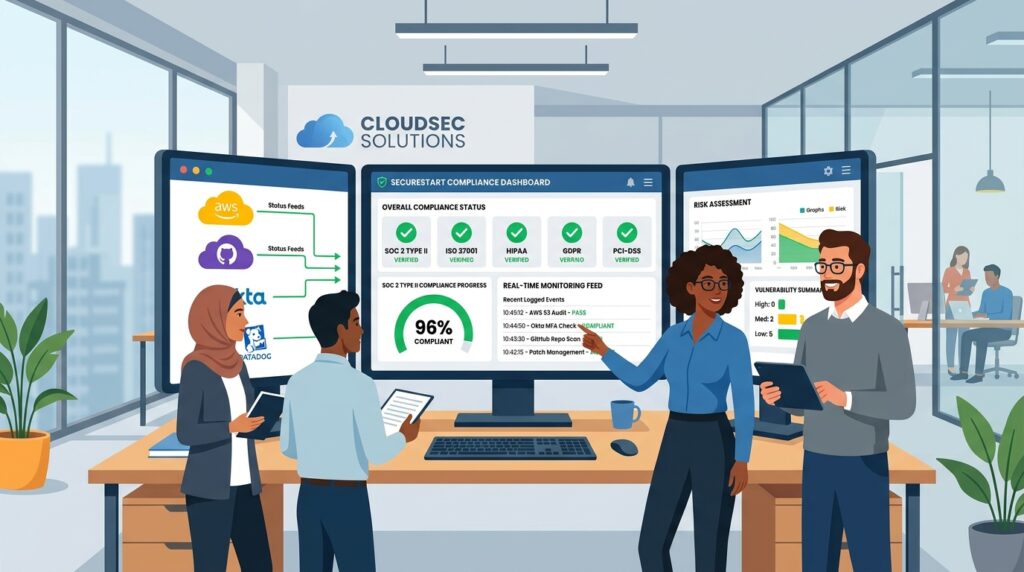
Introduction: The Compliance Wall Every Growing Startup Hits
You just lost a deal. Not because your product failed a demo, not because of pricing, but because the enterprise procurement team sent over a 40-question security questionnaire and your team had no documented answers.
That moment — equal parts frustrating and clarifying — is the reason SOC 2 compliance for startups has moved from “nice to have” to “gate for revenue.” If you’re handling customer data (and nearly every SaaS company is), the question is no longer whether you’ll pursue SOC 2 certification, but how fast you can get there without derailing your engineering roadmap.
This article breaks down the top SOC 2 compliance solutions available today, what the certification process actually looks like under the hood, what the SOC 2 security controls list really demands from your infrastructure, and the hard-won lessons that separate startups that sail through audits from those that fail their first attempt.
What SOC 2 Actually Is — and Why Startups Keep Misunderstanding It
Before evaluating any platform, it’s critical to establish a precise understanding of what you’re building toward. SOC 2 is a framework developed by the American Institute of Certified Public Accountants (AICPA), designed to assess how service organizations manage and protect customer data. It is not a product certification — it’s an audit opinion on your operational processes.
SOC 2 Type 1 vs. SOC 2 Type 2: The Difference That Costs You Deals
This distinction trips up a surprising number of technical founders.
- SOC 2 Type 1 evaluates whether your security controls are designed appropriately at a single point in time. Think of it as a snapshot.
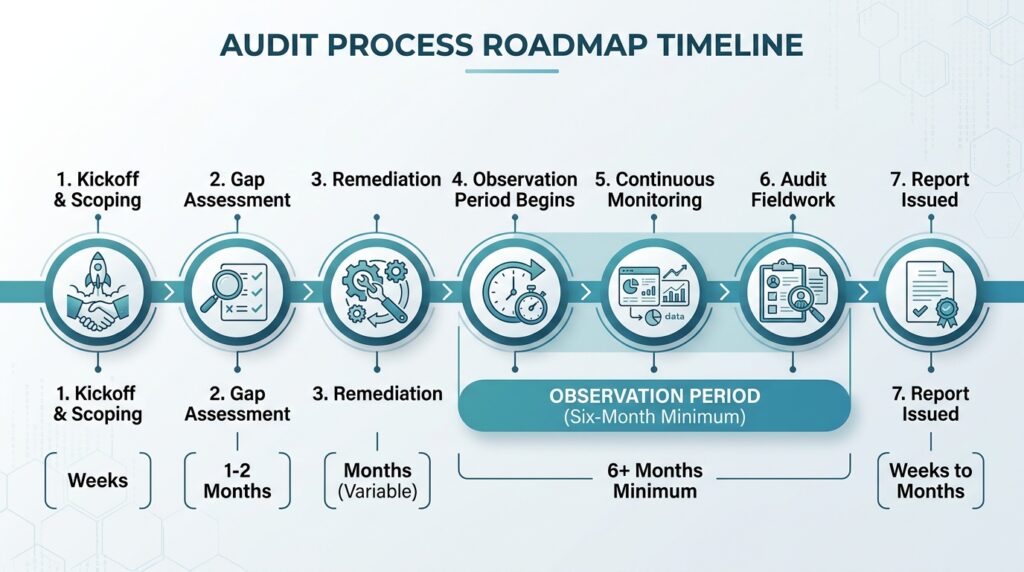
- SOC 2 Type 2 evaluates whether those controls operated effectively over a defined observation period — typically a minimum of six months, though twelve months is the enterprise standard.
In practice, most Fortune 500 procurement teams will only accept a SOC 2 Type 2 report. A Type 1 may help you close early-stage deals and demonstrate intent, but as you move up-market, you’ll need to show sustained, continuous security operations. Many startups make the mistake of investing heavily in Type 1, only to restart the clock six months later for Type 2. The smarter move is to treat Type 1 as the first lap of the same race.
The Five Trust Services Criteria (TSC)
SOC 2 audits are organized around five Trust Services Criteria. Understanding which ones apply to your business shapes every control you implement:
| Trust Services Criteria | Core Question | Typically Required? |
|---|---|---|
| Security (CC) | Are systems protected against unauthorized access? | Always |
| Availability | Are systems available as committed in SLAs? | If uptime is contractual |
| Processing Integrity | Does processing occur completely and accurately? | If data processing is core |
| Confidentiality | Is confidential information protected? | If handling sensitive B2B data |
| Privacy | Is personal information collected and managed properly? | If handling PII/PHI |
The Security criterion is mandatory in every SOC 2 engagement. Most early-stage startups begin with Security alone and expand to Availability or Confidentiality as their customer base demands it.
The SOC 2 Security Controls List: What Your Infrastructure Needs to Cover
This is where abstraction ends and reality begins. An auditor is going to test whether your controls function — not whether you intend for them to function. Here are the key domains your SOC 2 security controls list must address:
Access Control and Identity Management
- Multi-factor authentication (MFA) enforced across all production systems, cloud consoles (AWS, GCP, Azure), and internal tools
- Principle of least privilege applied to all user and service account permissions
- Formal access provisioning and de-provisioning workflows — departure of an employee must trigger immediate revocation
- Privileged access reviews conducted at regular intervals (typically quarterly)
🔗 Go deeper: Privileged access is one of the most technically complex areas of SOC 2 and one of the most frequently cited in audit findings. If your startup handles sensitive customer data or operates in a regulated environment, a purpose-built PAM architecture will save significant remediation time before your observation period begins. → PAM System: The Complete Enterprise Guide to Privileged Access Management
Change Management
- All changes to production systems must flow through a formal change management process, including peer review, approval, and rollback procedures
- Separation of duties between developers writing code and those deploying to production — a critical control that many early-stage teams violate unknowingly
Risk Assessment
- A documented risk assessment process that identifies, evaluates, and treats information security risks
- Evidence that this process occurs at defined intervals, not just at audit kickoff
Incident Response
- A written incident response plan that defines roles, communication procedures, and recovery time objectives
- Evidence that the plan has been tested — tabletop exercises or actual incident post-mortems count
Vendor Management
- Documented review of third-party vendors who process or could access customer data
- Executed Data Processing Agreements (DPAs) or equivalent contracts with those vendors
Monitoring and Logging
- Centralized logging infrastructure that captures access events, configuration changes, and anomalous activity
- Defined log retention policies aligned with audit requirements
SOC 2 Encryption Requirements: More Nuanced Than You Think
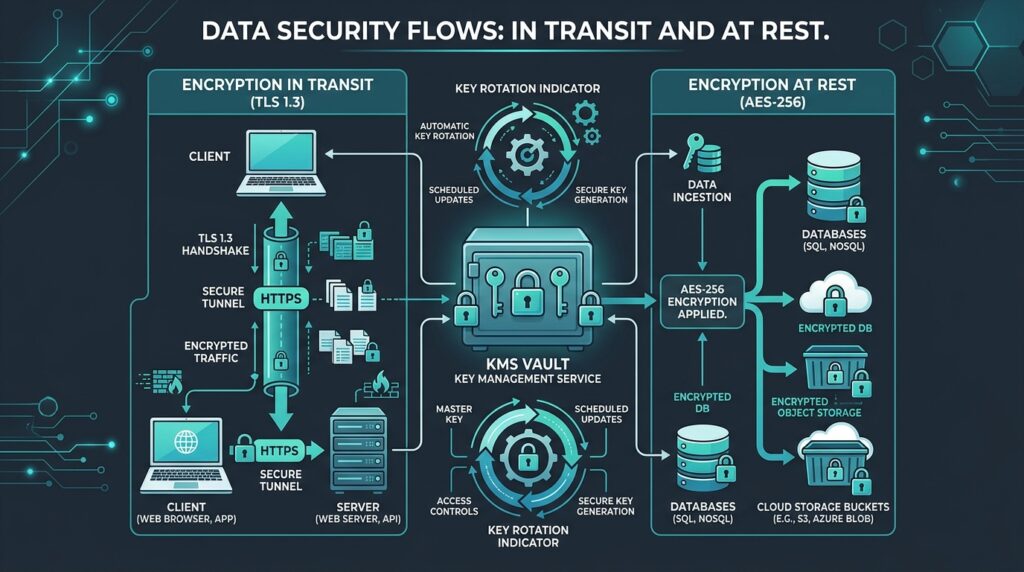
The SOC 2 framework does not prescribe specific encryption algorithms by name — this is a common misconception. Instead, it requires that encryption controls be appropriate for the sensitivity of the data and consistent with your own stated policies. In practice, here is what auditors expect:
Encryption in Transit
- All data transmitted between clients and servers must use TLS 1.2 or higher (TLS 1.3 is now the preferred standard)
- Internal service-to-service communication within your infrastructure should also be encrypted — unencrypted internal traffic is a flag in modern audits
- API endpoints must enforce HTTPS; HTTP-only endpoints are a clear finding
Encryption at Rest
- Databases, object storage (S3 buckets, GCS buckets), and backup systems must use encryption at rest — AES-256 is the industry standard
- Encryption keys must be managed through a dedicated Key Management Service (KMS) — storing encryption keys alongside encrypted data defeats the purpose entirely
- Disk-level encryption on developer laptops and end-user devices must be enforced and evidenced (often through MDM policy reports)
The Key Management Gap
The area where startups consistently fall short is key rotation and access logging for KMS. You can have AES-256 everywhere and still receive a finding if you cannot demonstrate that encryption keys are rotated periodically and that access to key management infrastructure is logged and reviewed. This is a detail that matters significantly in SOC 2 Type 2 engagements.
Top SOC 2 Compliance Companies and Platforms for Startups
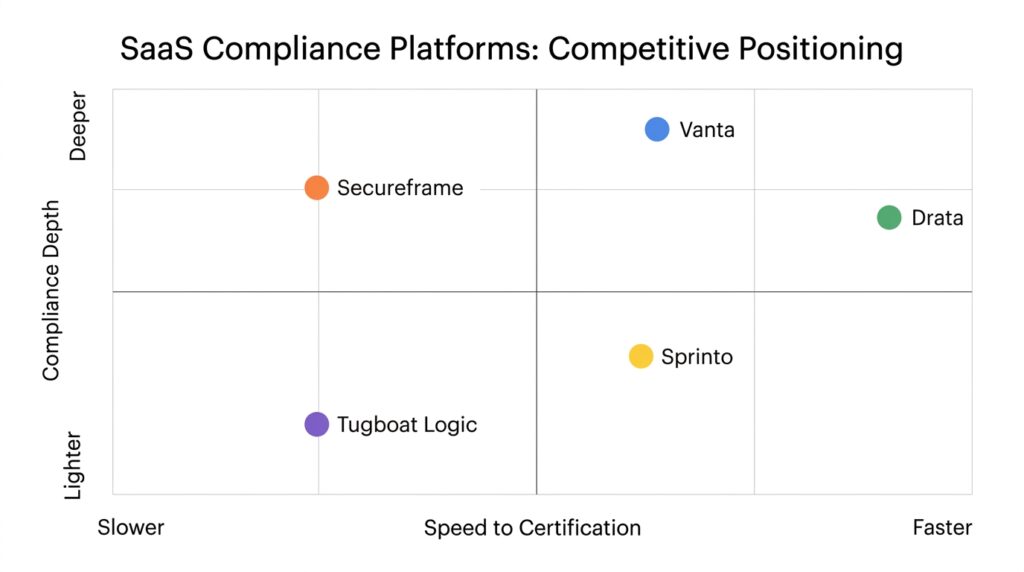
There are two distinct categories of SOC 2 services you’ll encounter: automated compliance platforms (SaaS tools that streamline evidence collection and control monitoring) and audit firms (licensed CPA firms that issue the actual report). You need both, but the platform decision is where you have strategic choices to make. The auditor decision is covered in the Expert Insights section.
Below is an in-depth evaluation of the leading automated compliance platforms.
1. Vanta — The Market Standard for Automated Evidence Collection
Vanta has become the most recognized name in automated SOC 2 compliance for startups, and that reputation is largely earned. Its core value proposition is reducing the manual evidence collection burden by integrating directly with your existing cloud and SaaS infrastructure.
How it works in practice: Vanta connects to AWS, GCP, Azure, GitHub, Okta, Google Workspace, Slack, and dozens of other systems via API. It then continuously pulls evidence — configuration states, access logs, employee security training completion, MFA enforcement status — and maps it to the relevant SOC 2 controls. Instead of manually exporting screenshots and compiling evidence folders before an audit, your evidence library is built passively throughout the year.
Strengths:
- Extensive pre-built integration library — the broadest in the market
- Strong auditor familiarity; many CPA firms have direct Vanta integrations that reduce audit friction
- Intuitive dashboard that non-security personnel can navigate without significant training
- Robust vendor risk management module for managing third-party security questionnaires
Limitations:
- Pricing scales with headcount, which can become expensive faster than expected as teams grow
- Deep customization of controls for non-standard environments requires technical effort or vendor support
- The platform guides you toward a particular interpretation of controls; organizations with complex, highly customized architectures may find it constraining
Best for: Seed to Series B startups that run primarily on mainstream cloud infrastructure and want the fastest path to a well-accepted SOC 2 report.
2. Drata — Continuous Compliance with Strong Multi-Framework Support
Drata has built its reputation on two pillars: an exceptionally polished user experience and genuine multi-framework coverage. For startups operating in healthcare-adjacent markets or managing European customers alongside North American ones, Drata’s ability to manage SOC 2 alongside HIPAA, ISO 27001, GDPR, and PCI DSS from a single platform is a meaningful differentiator.
How it works in practice: Drata’s continuous monitoring engine tests controls against automated checks at regular intervals and flags drift immediately — a configuration change that violates a control triggers an alert, not a quarterly finding. Its Trust Center feature allows you to publish a real-time security posture page for prospects and customers, which has proven to accelerate enterprise sales cycles by reducing the back-and-forth of manual questionnaire responses.
Strengths:
- Seamless multi-framework management reduces duplicated effort when pursuing parallel certifications
- Trust Center functionality is among the best-executed in the market
- Automated evidence collection is deeply integrated and reliable
- Strong customer success support that provides meaningful audit guidance, not just platform support
Limitations:
- Entry-level pricing is higher than some alternatives, which can be a barrier for pre-revenue or early-seed startups
- Certain advanced configuration workflows have a learning curve for non-technical operations staff
Best for: Startups in regulated verticals (healthcare, fintech) or those anticipating multiple compliance frameworks within 18 months of their first SOC 2.
3. Sprinto — Fastest Time-to-Certification for Resource-Constrained Teams
Sprinto occupies a distinct position in the market: it is optimized for speed. If your startup is facing an imminent enterprise deal that requires a SOC 2 report within a compressed timeline, Sprinto’s automated control mapping and guided workflow architecture is designed to eliminate the overhead that typically adds weeks to the process.
How it works in practice: Sprinto performs an automated discovery of your cloud infrastructure, maps your existing configurations to SOC 2 controls, and immediately shows you your gap analysis. Its workflow system then generates specific, prioritized remediation tasks assigned to the appropriate team members. The result is that teams spend less time figuring out what to do and more time actually doing it.
Strengths:
- Genuinely fast implementation — cloud-native startups can reach audit-readiness faster than with most alternatives
- Real-time health check dashboard makes ongoing compliance status visible at a glance
- Strong support for Indian-market CPA firms alongside US auditors — relevant for startups with global engineering teams
Limitations:
- Less suited for complex enterprise environments with significant on-premises infrastructure or non-standard architectures
- Pricing can escalate quickly as team size grows
Best for: Early-stage startups (pre-Series A to Series A) that are cloud-native and need certification on an aggressive timeline.
4. Secureframe — Enterprise-Grade Rigor for Startups Building Upmarket
Secureframe is positioned for startups that are selling to, or preparing to sell to, large enterprise customers who conduct rigorous security reviews of their vendors. The platform’s emphasis on auditor-approved policy templates, deep engineering integrations, and dedicated compliance expert access reflects a philosophy of doing compliance correctly rather than merely quickly.
How it works in practice: Beyond evidence collection, Secureframe provides a centralized policy management system that handles drafting, version control, distribution to employees, and acknowledgment tracking. Its employee onboarding security workflows — automated security training assignment, device compliance checks via MDM integration — address a control area that many platforms handle poorly: the human element.
Strengths:
- Extensive library of auditor-approved policy templates reduces the time spent drafting documentation from scratch
- Dedicated compliance expert access provides guidance that goes beyond platform support
- Strong employee onboarding and device management integrations address controls that pure evidence-collection tools often miss
- Scales effectively as organizations add new products, entities, or compliance frameworks
Limitations:
- Feature depth can feel overwhelming for very early-stage teams with a single engineer handling compliance part-time
- Pricing is positioned toward Series A and beyond
Best for: Series A and later startups that are building enterprise sales motions and need a compliance posture that will hold up under aggressive customer security reviews.
5. Tugboat Logic by OneTrust — Policy-First Compliance for Governance-Heavy Organizations
Acquired by OneTrust and rebranded within their GRC portfolio, Tugboat Logic takes a fundamentally different philosophical approach to SOC 2: it begins with governance and policy architecture rather than evidence collection. For organizations in highly regulated industries where documentation and governance are foundational requirements — not afterthoughts — this methodology produces more durable compliance programs.
How it works in practice: The platform guides you through building a policy framework first, then aligns controls and evidence collection to that framework. Customizable control mapping allows you to align your SOC 2 controls with existing internal frameworks or other certification requirements, reducing redundancy for organizations already operating under NIST CSF or ISO 27001.
Strengths:
- Strongest documentation and governance framework among all platforms reviewed
- Native multi-framework management through OneTrust’s broader GRC ecosystem
- Highly customizable control mapping for organizations with non-standard architectures
- Suitable for organizations with formal GRC requirements beyond SOC 2
Limitations:
- The interface can be complex for teams approaching compliance for the first time
- Deeper value emerges for organizations already operating within a broader GRC program; pure SOC 2-focused startups may not need this depth
Best for: Later-stage startups or scaleups that are integrating SOC 2 into a broader GRC program, or those in industries with formal governance requirements (financial services, government contracting).
Platform Comparison: How to Match the Tool to Your Stage
| Platform | Best Stage | Key Differentiator | Framework Coverage | Relative Cost |
|---|---|---|---|---|
| Vanta | Seed – Series B | Broadest integrations, auditor familiarity | SOC 2, ISO 27001, HIPAA, GDPR | Mid |
| Drata | Series A+ or regulated verticals | Multi-framework + Trust Center | SOC 2, HIPAA, ISO 27001, PCI DSS, GDPR | Mid–High |
| Sprinto | Pre-Series A – Series A | Fastest time to certification | SOC 2, ISO 27001, GDPR | Low–Mid |
| Secureframe | Series A – Series B | Policy depth + human element controls | SOC 2, HIPAA, SOX, ISO 27001 | Mid–High |
| Tugboat Logic / OneTrust | Series B+ / GRC programs | Governance-first, customizable frameworks | SOC 2, ISO 27001, NIST, GDPR | High |
Understanding Pricing Models and What the Real Cost Actually Is
Platform pricing is only one layer of the total cost of SOC 2 compliance. When budgeting, startups consistently underestimate the fully loaded cost because they focus on the SaaS subscription and overlook everything else.
The full cost stack includes:
- Compliance platform subscription — typically annual, tiered by headcount or number of integrations
- Audit firm fees — the CPA firm that issues the actual SOC 2 report. This is a separate, significant cost that platforms do not cover
- Internal time allocation — engineering hours to remediate gaps, security training time, policy review cycles
- Tooling gaps — if your current infrastructure is missing required controls (e.g., no centralized logging, no MDM for endpoints), you may need additional tooling investments
Typical pricing models by provider type:
| Provider Type | Pricing Model | Estimated Observation Period |
|---|---|---|
| Automated SaaS Platform | Annual subscription, tiered by headcount | 3–6 months to audit-ready (Type 1) |
| CPA Audit Firm | Fixed project fee | Type 1: 2–4 weeks of audit work |
| Consultancy-Led Engagement | Project-based or retainer | Type 2: 6–12 months observation window |
The SOC 2 Type 2 observation period is a genuine constraint: no amount of automation compresses the clock on the minimum six-month evidence collection window that auditors require to issue a Type 2 opinion. The platforms accelerate getting ready to start the clock — they cannot shorten the clock itself.
Expert Insights: What 15 Years in the Field Actually Teaches You
The following reflects practitioner-level guidance that goes beyond platform feature comparisons.
Choose Your Auditor Before You Choose Your Platform
This is the single most counterintuitive piece of advice in the SOC 2 ecosystem. Most startups pick a compliance platform first, then find an auditor. The better approach is the reverse: identify two or three CPA firms that specialize in tech-sector SOC 2 audits, understand their preferred evidence formats and platform integrations, and then select the platform that creates the least friction with your chosen auditor.
Some CPA firms have direct integrations with Vanta or Drata, which dramatically reduces the evidence hand-off process. Choosing a platform your auditor doesn’t know well adds time and cost to the audit phase.
🔗 Finding the right security partner: Selecting a qualified audit firm is only part of the decision. Many startups also need third-party security vendors — for penetration testing, managed detection, or security consulting — before they can clear the remediation phase. → The Best 25 Cyber Security Companies in the US
Scope Management Is Where Audits Are Won or Lost
Every system, person, or vendor you include in your audit scope is something an auditor will test controls against. Early-stage startups frequently over-scope their first audit — including every internal tool, every cloud account, every employee workstation — creating an enormous remediation burden.
The strategic move is to define the tightest defensible scope for your first audit: the systems that directly process or store customer data, and the personnel who have access to them. You can expand scope in subsequent audit cycles as your program matures.
Separation of Duties Will Break Your Startup’s Workflow — Plan for It
In a team of five engineers, the person writing code is often the same person deploying to production and holding admin keys to the database. This is operationally sensible at small scale, but it violates the SOC 2 separation of duties control. Auditors will look for evidence that no single individual can make unauthorized changes to production systems without detection.
The fix does not require hiring dedicated operations staff. What it requires is process: branch protection rules in your code repository, required pull request approvals before merging, and deployment pipelines that log and alert on direct production access. Build these before you start your audit observation period, not during it.
Your Penetration Test Findings Are Audit Evidence — Both Ways
Many startups treat their annual penetration test as a box-checking exercise. In a SOC 2 Type 2 context, the pen test report is evidence of your risk identification process. But the remediation status of findings from that report is also audit evidence. If your pen test identified critical vulnerabilities and your audit period shows no remediation activity, that is a finding — regardless of how comprehensive your other controls are.
The discipline is not to do a clean pen test. The discipline is to have a documented, evidenced remediation process that auditors can trace.
Document Everything, Even When It Feels Redundant
The most common reason well-run startups receive unexpected audit findings is not that their controls are weak — it’s that their controls are not documented and evidenced in a way an auditor can evaluate. A control that exists in practice but cannot be demonstrated through documentation is, from an audit perspective, a gap.
This particularly applies to informal controls: the weekly security review your CTO runs in Slack, the verbal policy about not storing customer data locally, the informal process for reviewing access permissions during offboarding. If it’s not written down and evidenced, it doesn’t count.
Common Pitfalls That Derail Startup SOC 2 Audits
Treating SOC 2 as a One-Time Project
SOC 2 Type 2 requires continuous operational evidence. A startup that “turns on compliance” six months before an audit and turns it off afterward will fail their second audit cycle. The controls — access reviews, security training, vulnerability management, vendor assessments — must be executed and evidenced throughout the year.
Ignoring the Employee Offboarding Control
This is the most commonly failed control in startup audits: the requirement to revoke access across all systems within a defined timeframe when an employee leaves. Manual processes break under velocity. The fix is a documented, automated offboarding workflow tied to your HR system, with evidence of execution for every departure.
Collecting Evidence Late
Evidence collected retroactively — or worse, reconstructed — is a red flag for auditors. The observation period evidence must reflect what actually happened during that period, not what should have happened. Continuous monitoring platforms exist precisely to solve this problem, but only if you activate them before the observation period begins.
Underestimating the Encryption Key Management Requirement
As noted in the SOC 2 encryption requirements section, the gap is rarely in whether data is encrypted. The gap is in demonstrating that encryption keys are properly managed, rotated, and access-logged. Review your KMS configuration — AWS KMS, GCP Cloud KMS, or HashiCorp Vault — before your audit observation period begins.
Frequently Asked Questions
What is the real difference between SOC 2 Type 1 and SOC 2 Type 2, and which do enterprise buyers actually require?
SOC 2 Type 1 assesses whether your security controls are appropriately designed at a specific point in time. SOC 2 Type 2 assesses whether those controls operated effectively over an extended observation period — typically six to twelve months. In practice, most enterprise procurement teams, particularly those in financial services, healthcare, and government contracting, require a SOC 2 Type 2 report. A Type 1 may satisfy smaller commercial customers or accelerate early pipeline while your Type 2 observation period is underway, but it should be treated as a stepping stone, not a destination.
How do I know which SOC 2 security controls apply to my startup, and where do I start?
Start with the Security Trust Services Criteria, which is mandatory for every SOC 2 engagement. The AICPA’s Trust Services Criteria document (freely available on aicpa.org) outlines the specific criteria and points of focus. A reputable compliance platform will map these criteria to your infrastructure automatically, giving you a gap analysis on day one. The most critical controls for cloud-native startups typically cluster around: logical access management, change management, risk assessment, and monitoring. Engage a qualified CPA firm or compliance advisor early to help define which additional criteria — Availability, Confidentiality, Privacy, or Processing Integrity — apply to your specific service commitments and contractual obligations.
How long does it realistically take for a startup to get SOC 2 certified, and what can actually be accelerated?
The SOC 2 Type 2 observation period cannot be compressed below six months — this is a structural requirement of the framework itself. What can be accelerated is the time between deciding to pursue SOC 2 and beginning your observation period. With a modern automated compliance platform, a cloud-native startup with a focused scope can move from kickoff to audit-ready within eight to twelve weeks, meaning the observation clock can start sooner. The audit execution phase — once evidence is collected — typically takes two to six weeks depending on scope complexity and auditor capacity. Total calendar time from decision to issued report: nine to fifteen months for a first-time Type 2 engagement is a realistic expectation for most early-stage startups.
Conclusion: SOC 2 Is an Investment, Not a Tax
The startups that build the strongest compliance programs are not the ones who treat SOC 2 as a necessary burden. They are the ones who recognize that the discipline required to pass a rigorous security audit — continuous monitoring, documented processes, clear access controls, regular risk assessment — is the same discipline required to build reliable, enterprise-grade software.
Choosing the right platform is important: Vanta for broad integration coverage and auditor familiarity, Drata for multi-framework efficiency and trust center visibility, Sprinto for speed and simplicity, Secureframe for depth and policy rigor, Tugboat Logic for governance-first organizations. But the platform is a means, not an end.
The end is a security program that your customers can trust, that survives the scrutiny of enterprise procurement, and that scales as your product and team scale. Start the observation clock sooner than you think you need to. Document more than feels necessary. Pick an auditor before you pick a platform.
Your SOC 2 report is not just a certification. It is documented evidence that your organization treats security as an operational discipline — and that is worth more, in closed deals and customer trust, than any individual feature on your product roadmap.
For the most current Trust Services Criteria documentation, refer to the AICPA’s official resources. Compliance requirements and platform features evolve; always validate current capabilities directly with vendors before making purchasing decisions.