Let’s get something out of the way first: digital transformation is not about buying new software. It never was.
“We’ve walked into dozens of environments—from financial operations migrating legacy core systems to international NGOs struggling to synchronize annual operating plans across fragmented regional databases. In almost every case, someone bought a six-figure platform and nobody uses it. The CRM is half-populated. The ERP runs parallel to a spreadsheet the ops manager trusts more. Sound familiar?”
That’s not a technology problem. That’s a sequencing problem. A strategy problem. And frankly, a leadership alignment problem.
This article is the roadmap we actually use. Not theory. Not vendor hype. This is the framework we’ve pressure-tested across B2B engagements with companies doing $5M–$150M in annual revenue. If you’re a business owner, COO, or senior decision-maker at a growing SMB, this was written for you.
Why Most SMB Transformation Projects Fail Before They Start
Here’s the pattern we see over and over:
- A founder or COO reads about automation, AI, or “going digital.”
- They pick a tool — usually whatever a peer recommended or a vendor demo’d well.
- They skip the boring stuff: process mapping, data audits, change management.
- Six months later, adoption is low, costs are high, and trust in “digital projects” is burned.
The failure isn’t in the technology. It’s in the approach. We call it tool-first thinking, and it kills more transformation efforts than bad software ever could.
The alternative? Process-first architecture. You map what your business actually does, identify where friction lives, then select the right technology to reduce that friction. Boring? Maybe. But it works.
Phase 1: The Honest Assessment (Weeks 1–3)
Before anything else, you need to know where you stand. Not where you think you stand — where you actually stand.
1.1 Operational Process Mapping
Sit down with every department lead. Not in a boardroom — at their desks, in their workflows. Ask them:
- What does your day-to-day look like, step by step?
- Where do you wait on someone else before you can move forward?
- What do you do manually that feels like it should be automated?
- Where does data get re-entered, copied, or moved between systems?
Document everything. We use simple swim-lane diagrams at this stage — nothing fancy. The goal is visibility, not perfection.
What you’re really looking for: handoff points, duplicate data entry, tribal knowledge (processes that only one person understands), and shadow IT (tools people use that leadership doesn’t know about).
1.2 Technology & Data Audit
Take inventory of every piece of software your company pays for. Every. Single. One. Include:
- Core systems (ERP, CRM, accounting, HRIS)
- Departmental tools (project management, email marketing, field service apps)
- Shadow IT (personal Trello boards, Airtable bases, Google Sheets doing the job of a database)
- Integration status — what talks to what? What doesn’t?
We’ve seen companies paying for 40+ SaaS subscriptions when 15 would do the job — if they were connected properly.
1.3 Legacy Technical Debt Inventory
This is where consultants earn their keep. Legacy debt isn’t just “old software.” It’s:
- Data silos — customer data in three systems, none of them synced.
- Customizations on end-of-life platforms — that custom module in your 2014 ERP that nobody can maintain.
- Manual bridges — the person whose entire job is exporting a CSV from System A and importing it into System B every Tuesday.
Be honest about this. Quantify the cost. When we show a COO that their team spends 22 hours per week on manual data reconciliation, the business case for integration writes itself.
Phase 2: Strategic Alignment & Prioritization (Weeks 3–5)
You’ve got your map. Now you need to decide what to fix first — because you can’t fix everything at once. Trying to do so is the second most common reason these projects fail.
2.1 Define Your Transformation Objectives
Not “become more digital.” That means nothing. Specific, measurable objectives:
- Reduce order-to-fulfillment cycle time from 6 days to 2 days.
- Eliminate manual invoice processing for 80% of recurring clients within 12 months.
- Achieve a single source of truth for customer data across sales, support, and finance.
These objectives need executive sponsorship. Not passive approval — active, visible sponsorship. If the CEO or COO doesn’t show up to the kickoff, the middle managers will treat this as optional. We’ve watched that happen more times than we can count.
2.2 The Priority Matrix: Impact vs. Effort
We plot every identified initiative on a simple 2×2 matrix:
| Low Effort | High Effort | |
|---|---|---|
| High Impact | Do these first (Quick Wins) | Plan these carefully (Strategic Bets) |
| Low Impact | Automate or delegate | Eliminate or defer |
Quick wins matter enormously. They build momentum, earn trust, and give your team visible proof that the transformation is real. We always recommend launching at least two quick wins within the first 60 days.
2.3 Budget Reality Check
Here’s what nobody tells you: the software license is 30–40% of the total cost. The rest is implementation, data migration, integration, training, and ongoing optimization.
A rough budget allocation we recommend for SMBs:
- Software/Platform Licensing: 30–35%
- Implementation & Integration: 25–30%
- Data Migration & Cleanup: 10–15%
- Training & Change Management: 15–20%
- Contingency: 10%
If a vendor tells you “it’s just $X per month per user,” they’re giving you the sticker price, not the total cost of ownership. Always ask about implementation timelines, integration costs, and what happens when you need customizations.
Phase 3: Architecture & Technology Selection (Weeks 5–8)
Now — and only now — do we start talking about specific technology.
3.1 Build Your Integration Architecture First
Before selecting any platform, draw the target-state architecture. What systems will you have? How will data flow between them? What is the single source of truth for each data domain (customers, orders, inventory, financials)?
We use a simple principle: data should be entered once and flow everywhere it needs to go. If your team enters the same information in two places, your architecture has a gap.
Key architectural decisions at this stage:
- API-first vs. point-to-point integration. For companies with 5+ systems, an integration platform (iPaaS) like Workato, Make, or Celigo often pays for itself within a year. Point-to-point integrations between every system become unmaintainable fast.
- Cloud-native vs. hybrid. If you still run on-premise servers, the migration conversation is critical. It doesn’t have to be all-or-nothing — hybrid approaches work well for companies with compliance requirements or heavy legacy investment.
- Build vs. buy vs. configure. Most SMBs should buy and configure, not build. Custom development is expensive to maintain. But off-the-shelf tools need thoughtful configuration to match your processes — don’t just accept the defaults.
3.2 Vendor Evaluation Framework
We score vendors across six dimensions. Not just features — because every vendor demo looks good:
- Fit to mapped processes — Does it actually solve the problems you identified in Phase 1?
- Integration capability — APIs, webhooks, pre-built connectors. How easily does it talk to your other systems?
- Total cost of ownership (3-year view) — Licensing + implementation + training + support + eventual migration cost.
- Vendor viability — Is this company going to exist in five years? Who are their investors? What’s their customer retention rate?
- Implementation timeline — Realistic timeline, not the sales cycle estimate.
- Reference checks — Talk to actual customers. Not the references the vendor hand-picks. Find them on LinkedIn, in forums, in industry groups.
3.3 The “Two-Vendor Shortlist” Rule
Never evaluate more than two finalists for any given solution. Three or more creates decision paralysis and burns months. Get to two strong candidates quickly, run structured pilots, and decide.
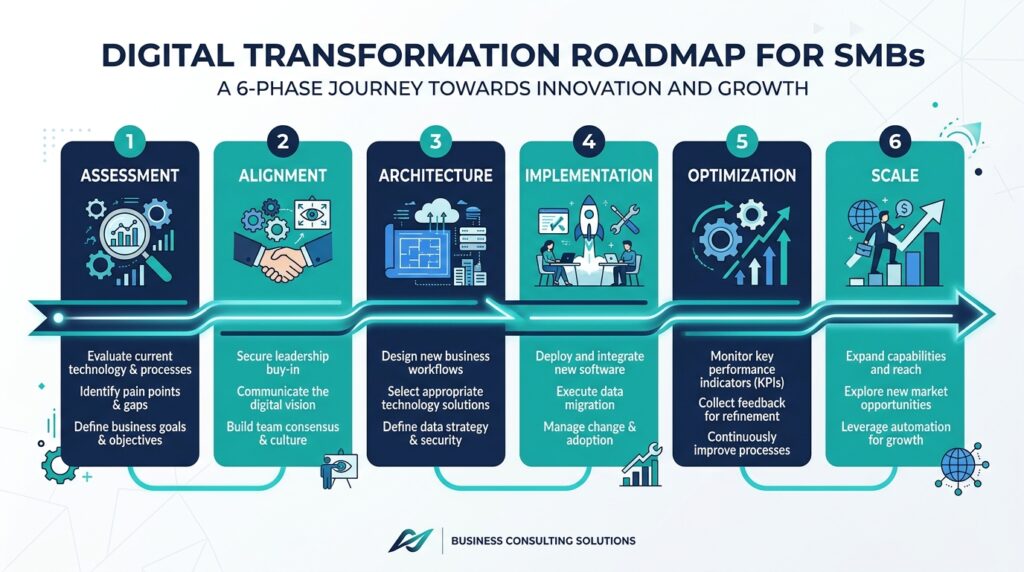
Phase 4: Implementation — Where Strategy Meets Reality (Weeks 8–20+)
This is where most of the work happens. And where most of the risk lives.
4.1 Start with Data, Not Features
Before you configure a single workflow or turn on a single automation, clean your data. We can’t overstate this.
Migrating dirty data into a new system is like moving into a new house and bringing all your garbage with you. Duplicate customer records, inconsistent naming conventions, missing fields, outdated contacts — all of it needs to be addressed before migration.
Practical steps:
- Deduplicate your customer and vendor databases. Tools like Dedupe.io or even well-structured Excel formulas can handle this for smaller datasets.
- Standardize naming conventions. Is it “IBM,” “I.B.M.,” “International Business Machines,” or “IBM Corp”? Pick one. Enforce it.
- Define required fields. What data must exist for a record to be valid? If a customer record doesn’t have an email, a primary contact, and a billing address, it’s incomplete.
- Assign data ownership. Someone — a specific person, not “the team” — needs to own data quality for each domain.
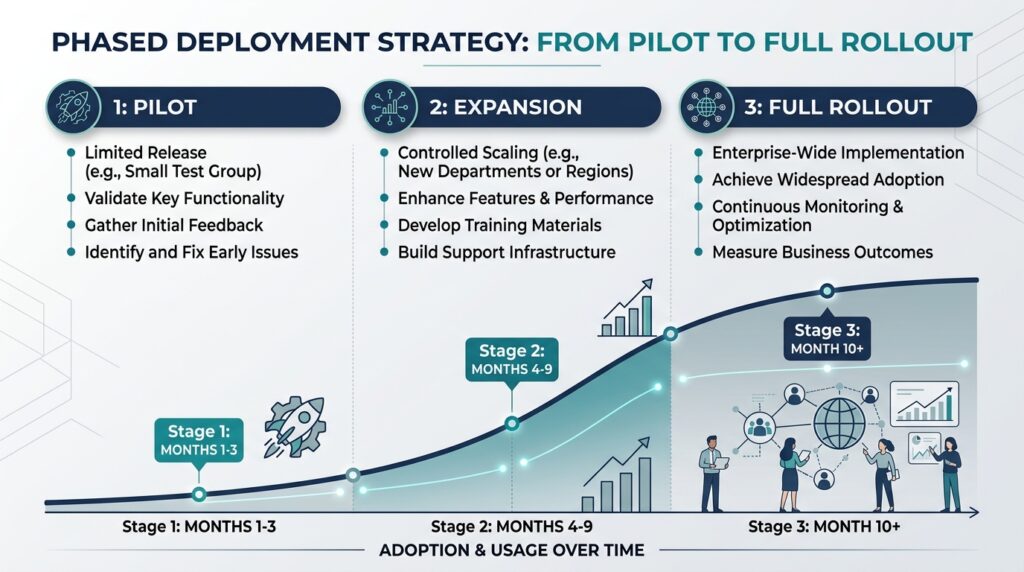
4.2 Phased Rollout, Not Big Bang
We never recommend flipping the switch on everything at once. Ever.
A phased approach looks like this:
- Pilot group (2–4 weeks): Roll out to one team or one location. Gather feedback aggressively. Fix what’s broken.
- Controlled expansion (4–6 weeks): Extend to additional departments or locations. Refine training based on pilot learnings.
- Full rollout (4–8 weeks): Company-wide deployment with established support channels and documentation.
Each phase should have clear success criteria. What does “working” look like? Define it before you start, not after.
4.3 Change Management Is Not Optional
Here’s the uncomfortable truth: your people will resist this. Not because they’re stubborn — because they’re human.
People resist change when they:
- Don’t understand why the change is happening.
- Weren’t involved in the decision.
- Fear they’ll look incompetent with new tools.
- Don’t trust that leadership will stick with it.
Address all four. Communicate the “why” relentlessly. Involve key users early — we call them transformation champions, and they’re worth their weight in gold. Provide training that meets people where they are (not everyone learns from a webinar). And follow through. Nothing kills adoption faster than leadership losing interest after launch.
Phase 5: Optimization & Measurement (Ongoing, Starting Month 4)
You’ve launched. Things are running. Now the real work begins.
5.1 Establish Your KPI Dashboard
You need to measure what matters. Not 47 metrics — five to eight that directly reflect your Phase 2 objectives.
Examples for a mid-market B2B company:
- Process efficiency: Average time from order to fulfillment. Average time to close a support ticket.
- Data quality: Percentage of complete customer records. Duplicate rate.
- Adoption: Daily active users of core systems. Feature utilization rates.
- Financial impact: Cost per transaction (before vs. after). Revenue per employee.
- Customer experience: Net Promoter Score. First-response time.
Review these monthly with your leadership team. Not in a 90-minute meeting — in a focused 30-minute review with pre-distributed dashboards. Decisions should be made in the meeting, not after it.
5.2 The 90-Day Optimization Cycle
Every 90 days, revisit your process maps. Things will have changed. New bottlenecks will have emerged. Some automations will need tuning. Some will need to be scrapped.
This is normal. Transformation is not a project with an end date — it’s an operating discipline. Companies that treat it as a one-time initiative always regress. Companies that build continuous improvement into their culture keep compounding gains.
5.3 Technical Debt Management
New technical debt starts accumulating the moment you launch. Workarounds get created. “Temporary” fixes become permanent. Integrations drift as vendors update their APIs.
Budget 15–20% of your ongoing technology spend for maintenance, updates, and debt reduction. It’s not glamorous, but it’s what separates companies that scale from companies that stall.

Phase 6: Scale & Evolve (Month 6+)
Once your foundation is solid — clean data, integrated systems, adopted processes — you can start thinking about advanced capabilities.
6.1 Automation & AI (When You’re Ready)
Notice this is Phase 6, not Phase 1. We see too many SMBs chasing AI before they have their data in order. Machine learning on dirty data gives you confident wrong answers. That’s worse than no AI at all.
When your data foundation is strong, practical AI applications for SMBs include:
- Predictive demand forecasting — reducing inventory carrying costs and stockouts.
- Intelligent document processing — automating invoice capture, PO matching, contract extraction.
- Customer behavior analytics — identifying churn risk, upsell opportunities, and support trends.
- Workflow automation with decision logic — not just “if this, then that,” but context-aware routing and exception handling.
Start with one use case. Prove ROI. Then expand. The companies that get the most value from AI are the ones that were boring and disciplined about their data first.
6.2 Building Internal Capability
Consultants like us should be working ourselves out of a job. The goal is to build internal capability so your team can drive continuous improvement without outside help.
Invest in:
- A dedicated operations or systems analyst — even part-time. Someone who owns the technology roadmap internally.
- Cross-functional process owners — people who understand both the business process and the technology supporting it.
- Ongoing training budgets — not just initial onboarding, but continuous skill development. Platforms evolve. Your team’s skills need to evolve with them.
6.3 When to Re-Platform vs. Extend
At some point — usually 3–5 years into a transformation — you’ll face a critical decision: do we extend what we have or start migrating to a new platform?
The honest answer depends on:
- Is your current platform constraining growth? If you’re hitting scalability limits, API rate caps, or user count ceilings, it might be time.
- Has your business model changed significantly? The platform you chose for a $10M company may not fit a $50M company with different operational complexity.
- What’s the migration cost vs. the opportunity cost of staying? This is a financial modeling exercise, not a gut feeling.
We generally advise extending and optimizing first. Re-platforming is expensive, disruptive, and carries real risk. But when the numbers clearly say it’s time, delaying just compounds the pain.
Common Pitfalls We See (And How to Avoid Them)
After years of doing this work, these are the patterns that consistently derail SMB transformation:
- Skipping the process map. You can’t automate what you don’t understand. Period.
- Letting the IT department own the strategy. IT should be a critical partner, not the sole driver. This is a business initiative with technology components, not the other way around.
- Underinvesting in change management. Budget for it. Staff for it. Prioritize it. The best system in the world is useless if nobody uses it.
- Chasing “best of breed” for everything. Fifteen best-of-breed tools that don’t integrate well create more problems than a single good-enough platform that’s well-connected.
- Ignoring data quality. We’ve said it multiple times in this article because it’s that important.
- No executive sponsor. If a senior leader isn’t visibly championing this effort, it won’t survive the first budget review.
Final Thought: Transformation Is a Discipline, Not a Destination
We’ve worked with companies that spent millions and got nothing. We’ve worked with companies that spent $50K and transformed how they operate. The difference was never the budget. It was always the approach.
Map your processes. Fix your data. Align your team. Choose your technology. Implement in phases. Measure relentlessly. Optimize continuously.
That’s the roadmap. It’s not flashy. It won’t make a great keynote slide. But it works — and after 12 years of doing this, we’ve learned that “it works” is the only thing that matters.
Have questions about where to start? The honest first step is always the same: map what you actually do today, without judgment. Everything else follows from there.