Table of Contents
Most organizations don’t fail at digital transformation because of bad technology. They fail because of bad strategy.
Introduction: The Gap Between Ambition and Execution
If you’ve ever sat in a boardroom where leadership announced a “bold digital transformation initiative” — and then watched it quietly dissolve eighteen months later into a graveyard of unused platforms, frustrated employees, and a budget that nobody wants to talk about — you’re not alone.
Digital transformation is one of the most discussed, most funded, and most misunderstood strategic imperatives in modern business. Executives know they need it. Consultants promise it. And yet, research consistently shows that the majority of transformation programs fall short of their original objectives.
This guide is not another surface-level overview. It’s a practitioner’s playbook built from hard-earned lessons: the kind of insights you don’t get from a whitepaper, but from being in the room when things go sideways — and when they don’t.
Whether you’re leading a transformation program, advising leadership, or architecting the technical foundation for change, this article will give you the strategic depth, the practical frameworks, and the honest perspective you need to move from initiative to impact.

What Is Digital Transformation — Really?
Before diving into strategy, let’s establish a precise definition, because imprecision here is one of the earliest failure points.
Digital transformation is not digitization. Digitization means converting analog processes into digital formats — scanning paper invoices, for example. It’s also not digitalization, which means using digital tools to improve existing processes.
True digital transformation is the fundamental rethinking of how an organization creates value — its business model, customer relationships, operational logic, and cultural norms — enabled by, but not limited to, digital technology.
McKinsey, Gartner, and MIT Sloan have each contributed frameworks that converge on a similar insight: transformation is an organizational change program that happens to use technology, not a technology program that happens to touch the organization.
That distinction matters enormously in practice.
Working in a smaller organization? The principles above apply at every scale — but the sequencing, tools, and resource constraints look very different when you’re not operating with an enterprise budget or a dedicated transformation office. If that’s your context, our Small Business Digital Transformation: Strategy, Tools & Implementation Guide breaks down exactly how to apply these concepts with the constraints and speed advantages that smaller teams actually have.
The 4 Pillars of Digital Transformation
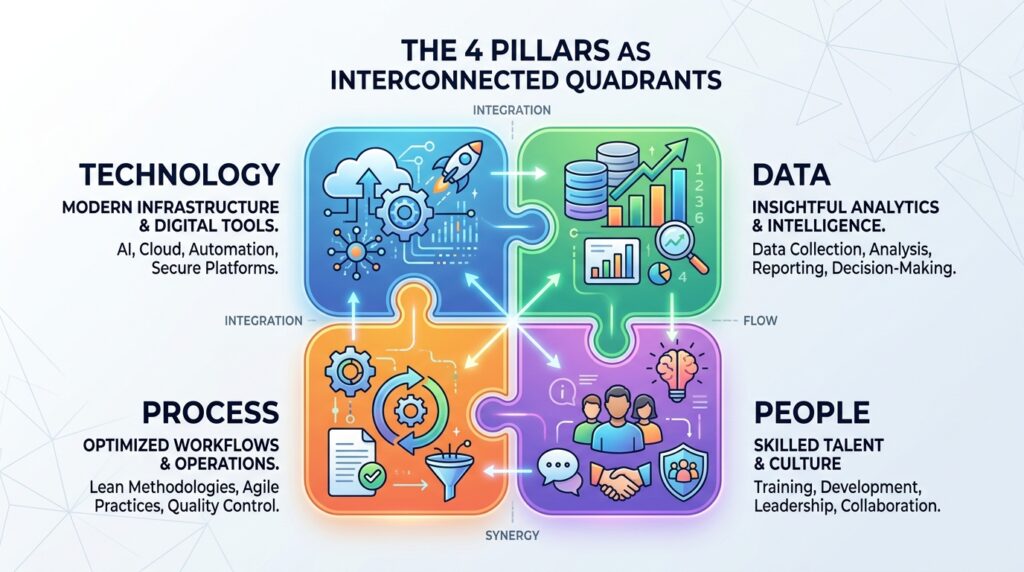
Every successful transformation program, regardless of industry or organization size, is built on four interdependent pillars. Weakness in any one of them creates systemic risk across the whole initiative.
1. Technology
This is the pillar most organizations focus on — often exclusively, which is a mistake. Technology is the enabler, not the destination.
Key components include:
- Cloud infrastructure and migration strategy (IaaS, PaaS, SaaS adoption models)
- Data architecture and integration layers (APIs, data lakes, real-time pipelines)
- Emerging technology adoption — AI/ML, IoT, automation, edge computing
- Cybersecurity posture and zero-trust architecture
- Legacy system modernization or decommissioning
The nuance most teams miss: technology decisions are strategy decisions. Choosing a cloud vendor, a data platform, or an automation stack locks in capabilities and constraints for years. These choices deserve C-suite attention, not just IT sign-off.
Cybersecurity in a transformation context isn’t just about protecting what you already have — it’s about building security into new architecture from the ground up, not bolting it on afterward. The NIST Cybersecurity Framework remains the most widely adopted reference standard for doing this systematically. If you’re establishing or auditing your security baseline as part of a transformation program, NIST Best Practices for Cybersecurity and Data Protection is a practical starting point that aligns well with both regulatory requirements and enterprise risk frameworks.
2. Data & Analytics
If technology is the engine, data is the fuel. And most organizations are running on low-grade fuel.
A mature data strategy encompasses:
- Data governance frameworks — who owns data, how it’s classified, how quality is maintained
- Data literacy programs — ensuring business users can interpret and act on insights
- Analytics maturity progression — moving from descriptive → diagnostic → predictive → prescriptive analytics
- Real-time vs. batch processing — understanding when each approach is appropriate
In practice, one of the most common failure modes is building sophisticated analytics capabilities on top of poor data foundations. Garbage in, garbage out — but at enterprise scale and enterprise cost.
3. Process & Operations
Technology doesn’t transform processes — people rethinking processes, supported by technology, do.
This pillar covers:
- Business Process Reengineering (BPR) — redesigning workflows from first principles rather than automating inefficiency
- Agile and DevOps methodologies — shifting from project-based to product-based operating models
- Intelligent automation — RPA (Robotic Process Automation) layered with AI for cognitive tasks
- Value stream mapping — identifying where digital tools create the most leverage
The experienced practitioner’s warning: if you automate a broken process, you get broken results faster. Always redesign before you automate.
4. People & Culture
This is consistently the hardest pillar — and the one that determines whether the other three deliver value.
Cultural transformation requires:
- Leadership alignment and visible sponsorship at the executive level
- Change management frameworks such as Kotter’s 8-Step Model or Prosci’s ADKAR
- Digital upskilling programs tailored to different workforce segments
- Organizational redesign — shifting toward cross-functional, product-oriented teams
- Psychological safety — creating environments where experimentation and failure are treated as learning, not liability
Here’s the uncomfortable truth from the field: you can deploy the world’s best technology and still fail completely if your middle management layer is incentivized to protect the status quo. Culture change requires intentional structural intervention, not just communication campaigns.
Why Do So Many Digital Transformations Fail?
The statistic circulating in boardrooms — that a high percentage of digital transformations fail to meet their objectives — has been debated in terms of exact figures, but the directional truth is undeniable: most transformation initiatives underperform against their original goals.
Having been involved in transformations across financial services, manufacturing, healthcare, and retail, the failure patterns are remarkably consistent.
Root Cause #1: Strategy Disconnection
The transformation program is designed as a technology initiative, not a business strategy initiative. It lives in IT. The business units feel it’s being done to them, not with them. Executive sponsors show up for the kickoff and disappear until the quarterly review.
Root Cause #2: Underestimating Change Management
Organizations budget generously for technology licenses and systems integrators, then allocate a fraction of that to organizational change management. The result: technically functional systems that nobody uses, or uses poorly.
Change management is not a communication plan. It’s a structured, sustained program of stakeholder engagement, resistance mitigation, training, and reinforcement that runs parallel to the technical workstream — from day one.
Root Cause #3: Big Bang Thinking
Large, multi-year “boil the ocean” programs are inherently fragile. Market conditions shift. Leadership changes. Technologies become obsolete. Programs that attempt to transform everything at once create massive interdependencies that slow delivery and amplify risk.
The more resilient model: iterative, outcome-driven delivery using agile principles, releasing value in smaller increments while building toward the larger vision.
Root Cause #4: Misaligned Metrics
Organizations measure transformation success by go-live dates and feature delivery — inputs, not outcomes. What you should measure: customer satisfaction improvements, process cycle time reduction, revenue impact, cost efficiency, and employee productivity.
If your transformation scorecard is full of project milestones and empty of business outcomes, you’re measuring the wrong things.
Root Cause #5: Skills and Talent Gaps
Digital transformation requires capabilities that most legacy organizations simply don’t have in sufficient depth: cloud architects, data engineers, product managers, UX designers, AI/ML specialists. Closing this gap through hiring alone is slow and expensive. A blended strategy — strategic hiring, partner ecosystems, and aggressive upskilling — is almost always the practical answer.
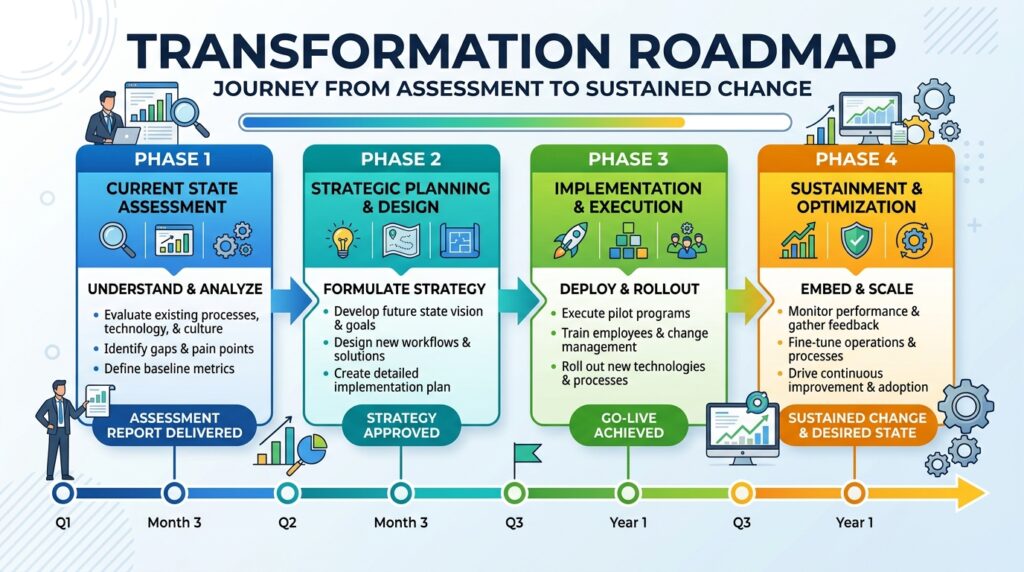
The 5 Steps of Digital Transformation: A Strategic Framework
While every organization’s journey is unique, successful programs share a common strategic progression. Here’s the framework that holds up across industries and contexts.
Step 1: Assess Current State and Define the “Why”
Before any technology decision, you need an honest, rigorous assessment of where you are and why transformation is necessary. This means:
- Business capability mapping — understanding which capabilities are competitive differentiators vs. table stakes
- Technology landscape audit — cataloging current systems, debt levels, integration complexity, and scalability limits
- Customer journey analysis — identifying friction, drop-off points, and unmet needs
- Competitive intelligence — understanding how digital leaders in your sector are creating advantage
The output of this phase is a clear transformation thesis: the specific business outcomes you’re pursuing and why the status quo is not acceptable.
Expert note: The “why” is not “because competitors are doing it” or “because the board asked for it.” A weak transformation thesis produces a weak transformation strategy. Push until you have specific, measurable business outcomes as the foundation.
Defining that “why” with the precision it deserves is harder than it sounds — and it’s where many programs quietly set themselves up to fail. We’ve written a dedicated piece on exactly this challenge: How to Define Your Digital North in Your Digital Transformation Journey walks through the strategic process of translating ambiguous organizational intent into a clear directional thesis that leadership, technology teams, and frontline employees can all align around.
Step 2: Develop a Transformation Roadmap
A transformation roadmap is not a project plan. It is a strategic sequencing document that identifies:
- Priority domains — which business areas offer the greatest value or are most at risk
- Foundational investments — infrastructure, data platforms, security capabilities that unlock future initiatives
- Quick wins — early, visible value delivery that builds organizational confidence and investment momentum
- Interdependencies — understanding which initiatives unlock or depend on others
- Governance model — who decides, who funds, who holds accountability
The roadmap should balance short-term impact with long-term capability building. This tension is real and requires active management.
Step 3: Build the Foundation
Before scaling transformation, the foundational architecture must be in place. This is typically the least visible phase but among the most consequential.
Foundational investments typically include:
- Cloud platform selection and migration strategy
- Data platform and governance framework
- API strategy and integration architecture
- Identity and access management (IAM) and cybersecurity baseline
- DevSecOps toolchain and engineering practices
- Core talent and organizational design
Rushing this phase to accelerate visible progress is one of the most expensive mistakes in transformation practice. Foundation shortcuts create technical debt that compounds across every initiative that follows.
Step 4: Execute, Iterate, and Scale
With foundations in place, transformation enters its active delivery phase. The hallmarks of high-performing execution include:
- Product-oriented teams organized around business domains, with end-to-end accountability
- Agile delivery methodologies — two-week sprints, continuous feedback loops, backlog prioritization tied to business value
- MVP (Minimum Viable Product) thinking — launching early, learning fast, iterating based on evidence
- Continuous integration and deployment (CI/CD) pipelines that enable rapid, safe releases
- Active benefits tracking — measuring outcome achievement, not just delivery progress
Scaling successful pilots is its own discipline. What works in a controlled proof-of-concept often breaks under the weight of enterprise scale, governance requirements, and organizational complexity. Build scaling plans into the initiative design from the start.
Step 5: Embed and Sustain
Transformation is not a project with an end date. The final — and perpetual — phase is about embedding new ways of working into the organizational DNA.
This includes:
- Transitioning from a transformation program to a continuous improvement operating model
- Building internal digital capability that reduces dependency on external partners over time
- Establishing governance mechanisms that continue to prioritize investment in digital capabilities
- Creating feedback loops between technology teams and business units
- Cultivating a learning culture where experimentation, adaptation, and data-driven decision-making are the norm
Organizations that reach this phase have fundamentally different competitive dynamics than those still running legacy operations. The gap widens every year.
Expert Insights: What 15 Years in the Field Actually Teaches You
These are the observations that don’t appear in methodology guides but consistently determine outcomes in practice.
The First 90 Days Are Disproportionately Important
The cultural tone for a transformation is set in the first ninety days. If the program is perceived as an IT project, or if early interactions feel like things are being done to the business rather than with it, you will spend the rest of the program fighting resistance that could have been avoided. Invest heavily in co-design, stakeholder engagement, and visible quick wins early.
Your Biggest Risk Is Not Technology — It’s the Middle Layer
Senior leadership typically sponsors transformation with genuine conviction. Frontline employees often adapt more readily than expected when change is managed well. The most persistent resistance lives in middle management: the layer that has the most to lose from new operating models, increased transparency, and performance accountability. Identify these stakeholders early, understand their concerns, and design the program to address them directly.
Beware of “Pilot Theater”
Many organizations excel at running impressive pilots — tightly scoped, generously resourced, carefully managed proofs of concept that demonstrate what’s possible. What they struggle with is scaling. If your transformation portfolio is full of successful pilots and empty of scaled outcomes, you have a scaling problem, not a technology problem.
Data Gravity Is a Real Constraint
As data accumulates in legacy systems, the cost and complexity of moving or integrating it increases. Organizations often discover mid-transformation that their most valuable data is trapped in systems they can’t easily migrate or decommission. Data strategy must precede application strategy, not follow it.
The Best Transformation Leaders Are Bilingual
The most effective digital transformation executives are those who can operate fluently in both business strategy and technology architecture. They understand P&L dynamics and cloud economics. They can speak to a CFO about ROI and to a platform engineer about API design. If your transformation leader can only do one of these, you have a gap.
Choosing the Right Digital Transformation Framework
Several established frameworks can guide your approach, depending on organizational context:
| Framework | Developed By | Best For |
|---|---|---|
| TOGAF (The Open Group Architecture Framework) | The Open Group | Enterprise architecture governance |
| SAFe (Scaled Agile Framework) | Scaled Agile, Inc. | Large-scale agile delivery |
| Kotter’s 8-Step Change Model | John Kotter | Organizational change management |
| ITIL 4 | AXELOS | IT service management transformation |
| MIT CISR Digital Transformation Framework | MIT Sloan | Strategic transformation design |
| McKinsey 3 Horizons Model | McKinsey & Company | Portfolio and innovation strategy |
No single framework is universally sufficient. Practitioners typically compose a bespoke approach by drawing on multiple frameworks, selecting the elements most relevant to their specific context. The ability to navigate and integrate frameworks — rather than dogmatically follow one — is a mark of experienced practitioners.
Measuring Transformation: Metrics That Actually Matter
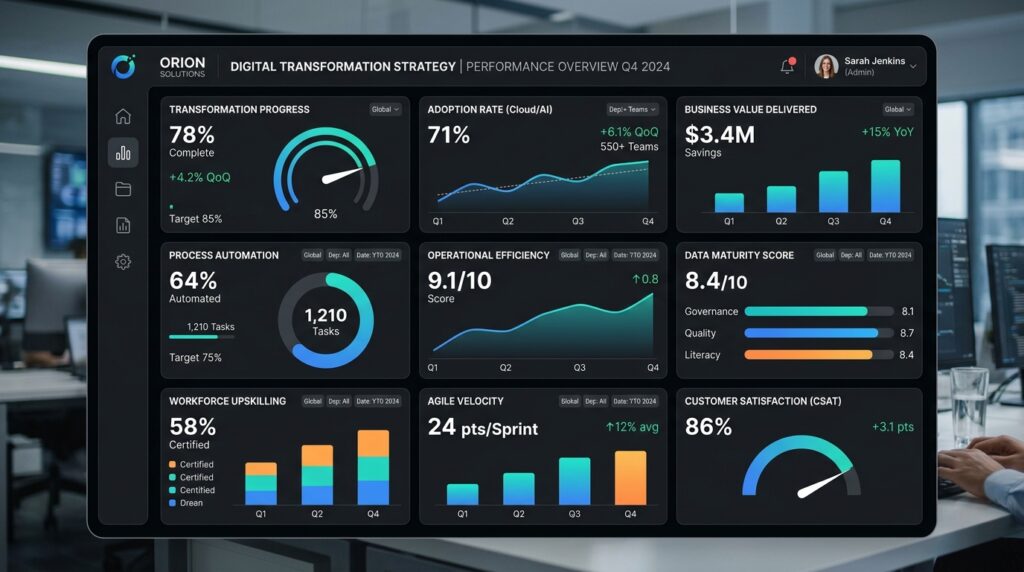
Digital transformation creates value across multiple dimensions. Your measurement framework should reflect this complexity.
Customer Impact Metrics
- Net Promoter Score (NPS) and Customer Satisfaction (CSAT) trends
- Digital channel adoption rates
- Customer journey completion rates
- Time-to-resolution for customer issues
Operational Metrics
- Process cycle time reduction
- Straight-through processing rates
- Automation coverage of repetitive tasks
- System availability and performance SLAs
Financial Metrics
- Revenue attributable to digital channels
- Cost reduction from process automation
- Technology cost per unit of output
- Return on transformation investment (RoTI)
Organizational Metrics
- Digital skills assessment scores
- Employee engagement with new tools and processes
- Time-to-market for new digital products
- Incident and defect reduction rates
Frequently Asked Questions
What are the 4 pillars of digital transformation?
The four pillars of digital transformation are Technology, Data & Analytics, Process & Operations, and People & Culture. While technology tends to receive the most attention and budget, research and practice consistently show that People & Culture is the most critical determinant of transformation success. Organizations that treat digital transformation as a technology program — rather than an organizational change program enabled by technology — are significantly more likely to underperform against their objectives. All four pillars must be developed in concert; gaps in any one of them create systemic risk across the entire initiative.
Why do so many digital transformations fail to meet their objectives?
Transformations most commonly fall short due to a combination of five root causes: strategic disconnection (the program lives in IT rather than being owned as a business strategy), underinvestment in change management, big bang thinking (attempting to transform everything at once rather than delivering iterative value), misaligned success metrics (measuring project milestones rather than business outcomes), and skills and talent gaps. The pattern that experienced practitioners see most consistently is organizations that fund technology generously and change management inadequately — creating technically functional systems that the organization lacks the will or capability to adopt at scale.
What are the 5 steps of digital transformation?
A proven strategic framework for digital transformation follows five progressive steps: (1) Assess Current State and Define the “Why” — establishing a clear transformation thesis grounded in specific business outcomes; (2) Develop a Transformation Roadmap — strategically sequencing initiatives to balance quick wins with foundational investment; (3) Build the Foundation — establishing the cloud, data, security, and talent infrastructure that enables everything that follows; (4) Execute, Iterate, and Scale — delivering value through agile, product-oriented teams using MVP thinking and continuous feedback; and (5) Embed and Sustain — transitioning from a transformation program to a continuous improvement operating model embedded in organizational culture. Steps 3 and 5 are consistently underestimated in both time and resource requirements.
Conclusion: Transformation Is a Decision, Not a Destination
Digital transformation is not something that happens to organizations. It is something that organizations choose — with clarity of purpose, strategic discipline, and the organizational courage to change not just their technology, but how they think, work, and compete.
The organizations that get this right share common characteristics: they treat technology as a means, not an end; they invest as heavily in people and culture as in platforms; they measure outcomes rather than outputs; and they build the internal capability to sustain change long after the transformation program closes.
The organizations that struggle treat transformation as a project — with a start date, an end date, and a budget that gets reallocated when the quarterly numbers get tough.
The most important thing you can do right now: go back to your transformation strategy and ask honestly — is this a technology program or a business change program? Is success defined in business outcomes or project deliverables? Is change management funded and staffed at the level the complexity demands?
If the answers give you pause, that pause is the most valuable thing this article can offer you.
The gap between a digital transformation that changes everything and one that changes nothing is not technology. It is strategy, leadership, and will.
Further Reading & Reference Frameworks
- MIT Sloan Center for Information Systems Research (CISR) — digital transformation research and measurement frameworks
- Gartner Digital Transformation Research — industry benchmarks and technology adoption curves
- McKinsey Digital — practitioner case studies and transformation performance research
- The Open Group (TOGAF) — enterprise architecture standards and certification
- Scaled Agile, Inc. (SAFe) — scaled agile framework documentation and community
- Prosci ADKAR Model — change management methodology and practitioner tools
- Harvard Business Review Digital Transformation Collection — leadership and strategy perspectives